

Hezbollah-Israel: An Endless War in Whose Interests? (13)
The Cedar Revolution and the Lahoud mandate

This series of articles aims to provide a clearer understanding of the current situation on the Lebanese political scene in light of the past, free from passionate, ideological, or romanticized narratives that miss the underlying realities, leaving readers to draw their own conclusions.
The previous twelve installments offered a reexamination of the events surrounding Hezbollah's rise to power, from the Taif Agreement through the deeply flawed implementation of UN Security Council Resolution 1701 in 2006.
Two years before the 33-day war of 2006, and more specifically on September 3, 2004, under direct pressure from Bashar al-Assad's Syria, the Lebanese Parliament extended President Émile Lahoud's term by three years.
This constitutional amendment was pushed through in blatant disregard of UN Security Council Resolution 1559, adopted the day before at the initiative of France and the United States.
That resolution had explicitly called for strict adherence to Lebanon's constitutional rules and for a free, fair presidential election free from foreign interference.
Furthermore, the same resolution demanded the disbanding of illegal militias—including Hezbollah—and the withdrawal of Syrian forces from Lebanon.
In an attempt to project a semblance of popular legitimacy in the face of international condemnation, Émile Lahoud turned the Baabda Palace into a stage for displays of allegiance.
Pro-Syrian delegations, government officials, military personnel, officers of all ranks, civilian supporters, and Hezbollah partisans paraded through to orchestrate effusive congratulations, manufacturing the appearance of broad national consensus around his forced extension—while in reality he was internationally, regionally, and domestically isolated, save for pro-Syrian factions, Hezbollah, and the Amal movement.
Having opposed the presidential term extension under direct threats from Bashar al-Assad, Prime Minister Rafic Hariri resigned in October 2004 and subsequently aligned himself with the anti-Syrian opposition.
The Assassination of Rafic Hariri and the Cedar Revolution
This political shift was identified by the UN—and later by the Special Tribunal for Lebanon—as the primary motive behind his assassination, along with his companions and security escort, on February 14, 2005.
This crime directly triggered the Cedar Revolution and ultimately forced the withdrawal of Syrian troops from Lebanon.
The February 14, 2005 assassination was followed by three weeks of massive mobilization on the streets of Beirut, with crowds loudly demanding an end to Syria's occupation of Lebanon and holding up photographs of senior officers who ran Lebanon's security apparatus—including Generals Jamil Sayed, Raymond Azar, and Ali Hajj—accusing them of complicity in Hariri's murder and denouncing them as symbols of the Lebanese-Syrian security apparatus.
Deepening Ties Between Lahoud and Nasrallah
To prop up and shield an increasingly isolated Lahoud—who served as a critical legal cover for Hezbollah—Hassan Nasrallah responded by mobilizing his supporters on March 8, 2005, effectively sealing a pact of mutual survival: protecting the president was declared a red line, and any attempt to remove him was met with explicit warnings of retaliation.
Lahoud's political survival was ultimately secured when Maronite Patriarch Nasrallah Sfeir refused to countenance his removal through street pressure, unwilling to set such a precedent in Lebanon's contemporary history.
His position was accepted, albeit reluctantly, by the sovereigntist coalition of the time, which was mindful of maintaining the country's sectarian balance.
The sovereigntists mobilized their own supporters a week later in direct response to the March 8 demonstration.
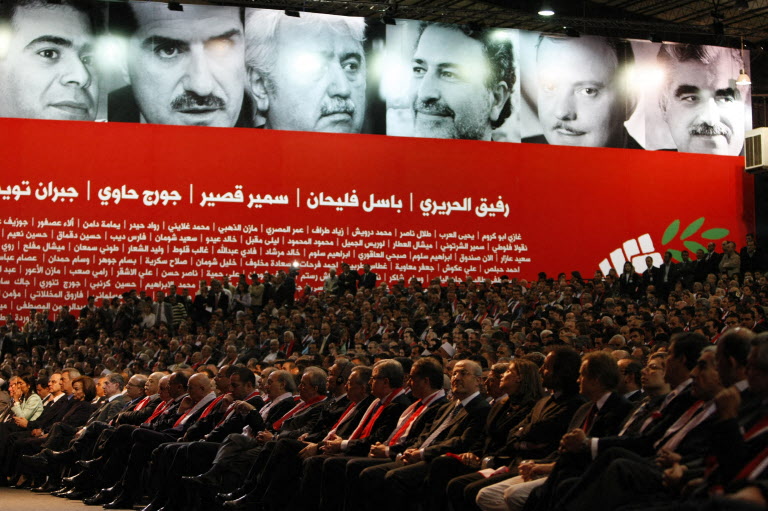
Thus, on March 14, 2005, Beirut witnessed a historic rally of hundreds of thousands of supporters from the late Rafic Hariri's Future Movement (FM), the Lebanese Forces (LF), the Kataeb, the National Liberal Party (NLP), the Free Patriotic Movement's Aounists (FPM, still anti-Syrian at the time), the Progressive Socialist Party (PSP), Shia liberals, leftists… all demanding the withdrawal of Syrian troops, the dismantling of the Lebanese-Syrian security apparatus, and the implementation of UN Security Council Resolution 1559.
Following this rally, the 'March 14, 2005 Forces' coalition was formed, with prominent figures including Samir Frangié, Gebrane Tueni, Samir Kassir, Nayla Moawad, former President Amine Gemayel, and others.
This further strengthened the ties between Lahoud, who was running out of options, and Nasrallah.
A pro-militia culture at odds with the rule of law
From the time he served as commander-in-chief of the Lebanese Army, Emile Lahoud gradually fostered—through his attitudes and directives—a 'culture' of acceptance toward the Syrian occupation, and a 'culture' of sympathy toward Hezbollah, which he portrayed as a national liberation movement against Israel.
This approach was reflected in Lahoud's speeches and memoranda, which deliberately overlooked the fundamentalist ideology of the pro-Iranian party—an ideology at odds with the very foundations of the Lebanon established in 1920.
Later, as President of the Republic, Lahoud continued to promote this image of Hezbollah at the national level, not only within the Shia communities that supported him, but also among Christian, Druze, and Sunni circles.
This propaganda was facilitated and amplified by leaders with outsized ambitions, such as Free Patriotic Movement leader Michel Aoun, ten months after his return from exile in France, as well as a host of politicians from various Lebanese communities—including Democratic Party leader Talal Arslan and certain dissidents from sovereigntist parties who had been approached by the security services of the time.
Pro-militia sympathies also made inroads within state institutions. Officials began endorsing the logic of 'resistance,' justifying illegal practices, and a gradual erosion of the rule of law took hold.
This replacement of the sovereigntist culture—the cornerstone of a strong state—with one of submission to a militia driven by a sectarian religious ideology seeped, under the banner of 'resistance,' into Lebanon's military, security, administrative, and judicial institutions.
Lebanon continues to suffer from this to this day, so deep-rooted is this cultural erosion.
Throughout all these years, a large number of Lebanese politicians were comfortable submitting to the Syrian occupation, and remain equally comfortable under Hezbollah's hegemony.
These politicians made no effort to uphold national dignity, and for decades preferred to focus on their narrow day-to-day interests, blending business, public affairs, and populism.
Army deployment in the South, incidents with Hezbollah
Despite the compromise between legality and Hezbollah's arsenal, incidents were reported as early as September 2006 during the Lebanese Army's deployment in the South, following the Israeli withdrawal that began on August 17.
These incidents were notably illustrated, for example, by the army's interception of ammunition trucks traveling from Syria to the Bekaa, and from the Bekaa toward the South.
The Lebanese soldiers behind these interceptions, proud of their role and driven by a sense of duty, found themselves frustrated by political decisions that forced them either to return the confiscated ammunition or to immediately release the stopped vehicles and the militiamen accompanying them.
Another example hampering the restoration of state sovereignty: the demarcation of zones — often wooded and fortified — that were off-limits to Lebanese legal forces (the army and the ISF) on the orders of President Emile Lahoud.
These zones were held exclusively by Hezbollah fighters. Citizens who tried to approach them were turned away by the militiamen, either on the pretext that they were 'nature reserves,' or explicitly because they were militia-controlled areas that had become de facto exclusion zones within the army's deployment area in the South.
Read more on the same topic:
Hezbollah-Israel, an endless war in whose interest? (12)
Hezbollah-Israel, an endless war in whose interest? (11)
Hezbollah-Israel, an endless war in whose interest? (10)
Hezbollah-Israel, an endless war in whose interest? (9)
Hezbollah-Israel, an endless war in whose interest? (8)
Hezbollah-Israel, an endless war in whose interest? (7)
Hezbollah-Israel, an endless war in whose interest? (6)
Hezbollah-Israel, an endless war in whose interest? (5)
Hezbollah-Israel, an endless war in whose interest? (4)
Hezbollah-Israel, an endless war in whose interest? (3)
Hezbollah-Israel, an endless war in whose interest? (2)
Hezbollah-Israel, an endless war in whose interest? (1)
Hezbollah-Israel: An Endless War in Whose Interests? (20)
The Trump-Xi Summit: Between Pragmatism and Necessity
The Conflict in Yemen: Geopolitical and Strategic Considerations
Yemen: The Mecca Pact Moves from Theory to Military Action
Hezbollah-Israel: An Endless War in Whose Interests? (19)
More from Khalil Helou
View All


More in Strategia
View All


Latest from Levant Time
View All


