

Hezbollah-Israel: An Endless War in Whose Interests? (19)
The episode of the “Baabda Declaration”
This series of articles offers a clearer understanding of the current situation on the Lebanese scene in light of the recent past, steering clear of the impassioned, ideological, or romantic narratives that overlook realities and leaving readers to draw the necessary conclusions. The previous eighteen installments revisited the events surrounding Hezbollah’s rise to power, from the Taif Agreement to the beginning of its military intervention in Syria alongside Bashar al-Assad’s regime.
Adopted unanimously on June 11, 2012, at a meeting of political leaders held at the Presidential Palace, the Baabda Declaration was intended to preserve Lebanon’s stability and shield it from the spillover of the Syrian civil war onto its territory.
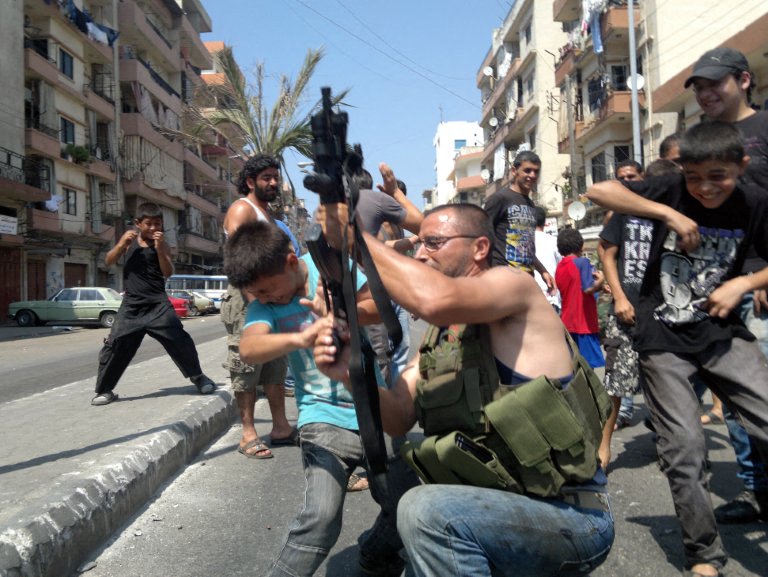
Sectarian armed clashes had already broken out in Tripoli between supporters and opponents of Bashar al-Assad’s regime, while the infiltration of weapons and anti-Assad fighters from Lebanon into Syria raised fears that the country could once again descend into civil conflict.
In the face of this threat, the president at the time, General Michel Sleiman, played a decisive role as initiator, mediator, and guarantor: he urgently convened the National Dialogue Committee in order to defuse the crisis and establish the principle of keeping Lebanon at a distance from regional conflicts.
Through sustained personal efforts, he also drafted the Baabda Declaration, an official document that would be recognized by the Arab League and the United Nations.
Having become the symbol of his presidency, the Declaration, which he defended vigorously, brought him into a sharp confrontation with Hezbollah, which was already militarily engaged in Syria.
The text was unanimously approved by the National Dialogue Committee, which brought together the March 8 camp—particularly Hezbollah, represented by Mohammad Raad; Nabih Berri’s Amal Movement; Michel Aoun’s Free Patriotic Movement; and Emir Talal Arslan—the March 14 camp, including former Prime Minister Fouad Siniora, Walid Joumblatt, and former President Amine Gemayel, as well as the then-prime minister, Najib Mikati, as a non-aligned participant.
The June 11, 2012 session was nevertheless marked by several notable absences, particularly that of Saad Hariri, leader of the Future Movement, who was then in exile for security reasons, and that of Samir Geagea, leader of the Lebanese Forces, who boycotted the meeting to express his skepticism about Hezbollah’s genuine willingness to honor its commitments.
The main provisions of the Baabda Declaration
The Baabda Declaration makes the principle of Lebanon’s disengagement and neutrality from regional and international conflicts a cornerstone, keeping it out of bloc politics in order to preserve its national unity and stability.
However, the Arabic phrase used, تحييد لبنان عن صراعات المنطقة, is more nuanced than the concept of neutrality in the strict sense: it refers to a policy of neutrality, rather than absolute constitutional neutrality.
The text formally commits all Lebanese political forces to strengthening the national coexistence pact and rejecting both violence and the use of weapons, while affirming the imperative of supporting state institutions, foremost among them the Lebanese army and the judiciary.
Lastly, the Declaration calls for strict control of the Lebanese-Syrian border to prohibit the transit of weapons and fighters in both directions, and reiterates Lebanon’s unwavering commitment to international resolutions, notably UN Security Council Resolution 1701.
From the end of 2012 onward, however, the March 8 camp began informally distancing itself from it: Hezbollah's increasingly open military involvement alongside Bashar al-Assad's regime effectively violated the text's central pillar—Lebanon's policy of distancing itself from and remaining neutral in the Syrian crisis.
The turning point: the Battle of Qusayr
The major turning point in Hezbollah's intervention in Syria was the Battle of Qusayr, fought between April and June 2013.
Located fifteen kilometers northeast of the Lebanese border, near the towns of Qaa and Hermel, and thirty-five kilometers south of Homs, the city was of paramount strategic importance: whichever force was established there could control the Damascus–Homs and Homs–Tartus routes, thereby threatening to cut off the road linking the Syrian capital to the Mediterranean coast.
Some 2,000 rebel fighters were entrenched there, mainly the Al-Farouq Brigades, affiliated with the “Free Syrian Army,” made up of regular army personnel who had defected in opposition to Bashar al-Assad, and supported by the al-Nusra Front.
Qusayr was also one of the main entry points into Syria for Lebanese volunteers seeking to join the rebellion.
From April 2013 onward, the city was encircled by the Syrian army and Hezbollah, which seized the surrounding villages that had previously been under rebel control.
The aim was to completely isolate it from both the Syrian interior and Lebanese territory. The offensive itself began with a swift air and ground assault, before turning into street fighting in which the rebels put up fierce resistance, inflicting heavy losses on Hezbollah, which held the front line.
The city ultimately fell to the Shiite party and the regular Syrian army on June 5, 2013.
The toll was heavy: 450 rebels killed and 114 Hezbollah fighters—losses acknowledged by the party itself. To justify them, Hassan Nasrallah publicly took responsibility for the involvement, stating that it was part of the fight against fundamentalist groups and the defense of Lebanon.
From consensus to repudiation by the March 8 camp
The March 8 camp's official political break with the Baabda Declaration came in the wake of the Battle of Qusayr: exactly one year after the text was adopted and one week after the city's fall, on June 12, 2013, Mohammad Raad, an MP and head of Hezbollah's parliamentary bloc, publicly declared that “the Baabda Declaration was stillborn; all that remains is ink on paper.” The statement enshrined the document's rejection by the main component of the March 8 alliance.
Hezbollah justified this reversal by asserting that the Declaration had never been intended to hinder the actions of the “Resistance” or call its arsenal into question in the face of external threats, foremost among them the growing strength of jihadist groups in Syria.
Michel Aoun followed suit by stripping the text of its substance without ever formally denouncing it: replacing the principle of distancing with that of national security, he argued that the threat posed by jihadist groups infiltrating from Syria had rendered neutrality obsolete. Portraying Hezbollah's involvement as an act of self-defense, he relegated the Declaration to the status of a theoretical, impracticable text.
(to be continued)