

Hezbollah-Israel: An Endless War in Whose Interests? (20)
Hezbollah's rejection of a national defense policy and the warning of May 26, 2013

This series of articles offers a better understanding of the current situation in light of the past, steering clear of impassioned, ideological or romantic narratives that overlook realities and leaving readers to draw their own conclusions. The nineteen previous installments revisited the events surrounding Hezbollah’s rise to power, from the Taif Agreement to the Baabda Declaration and its massive military intervention in Syria in support of Bashar al-Assad’s regime.
President Michel Sleiman, setting aside the March 8 camp’s repudiation of the Baabda Declaration, asked members of the National Dialogue Committee to prepare a draft text for a national defense policy, with the long-term aim of establishing a state monopoly on the use of arms.
During a private visit, Hezbollah informed him that it opposed a defense policy for Lebanon, arguing that such a policy would endanger state institutions, which could become targets for Israel, including the presidential palace.
President Sleiman replied that he was prepared to take that risk and had already done so as an army officer. The day after this visit, specifically on the evening of May 26, 2013, amid escalating tensions caused by Hezbollah’s involvement alongside the Syrian regime and a few days before its capture of the Syrian town of Qusayr on June 5, two rockets struck near the Baabda presidential palace: one landed near the army’s staff college in Rihaniyeh, a few hundred meters from the palace, and the other right at its eastern entrance.
A statement from the Free Syrian Army claimed responsibility for the attack, but the message was clear: the rockets came from Hezbollah and were intended to signal its firm rejection of a defense policy that would have forced it to hand over its weapons to the state.
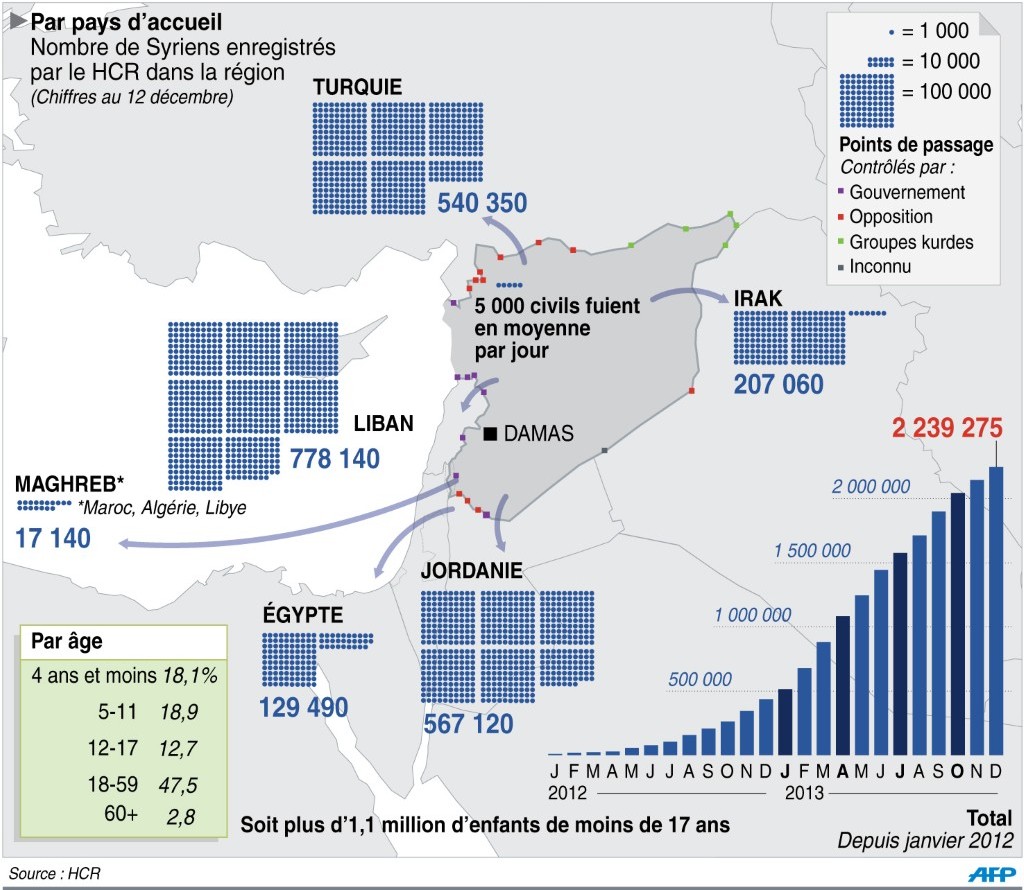
Distribution of Syrian refugees in 2013.
Rejection of the Baabda Declaration
This crudely disguised rocket attack, along with the repudiation of the Baabda Declaration by leading March 8 figures, brought the dialogue bodies to a standstill for several months.
In August 2013, faced with scathing criticism from the March 14 camp over Hezbollah’s intervention in Syria, the March 8 bloc refused to attend follow-up sessions of the national dialogue.
Then, on March 31, 2014, during President Michel Sleiman’s final attempt to revive the dialogue before his term expired, Hezbollah and its allies, notably Michel Aoun and Talal Arslan, formally boycotted the session, sealing the Declaration’s political demise.
At a deeper level, this rejection stemmed from the March 8 camp’s view that the Baabda Declaration had quickly become a political weapon, wielded by the March 14 camp and President Michel Sleiman to delegitimize Hezbollah’s arsenal and regional role.
Syria’s isolation: Lebanon becomes a supply base for the warring parties.
Residents who fled Qusayr in June 2013 headed to Lebanon with their weapons and belongings, particularly to the town of Arsal, which alone took in 30,000 refugees, and to the Bekaa Valley, where, paradoxically, Hezbollah’s strongholds are located.
The shortsightedness of Hezbollah and the Iranian Revolutionary Guard Corps, of which it is a part, in seeking to save Assad’s regime at any cost resulted in the movement of thousands of rebels and their families, along with hundreds of extremist fighters (1), from Syria into Lebanon.
Meanwhile, thousands of Qusayr residents who chose to remain in Syria headed for towns and villages along the Lebanese border, particularly in the Qalamoun Mountains, including Assal al-Ward (opposite Arsal), Flita, Yabroud, Qara and Nabk.
This region, covering roughly 1,000 square kilometers, thus became a rebel stronghold through which supply lines ran from Lebanon to insurgents around Damascus, and from which Syrian rebels dispatched car bombs that exploded in Beirut’s southern suburbs, a Hezbollah stronghold.
In total, seven car bombs planted by Syrian rebels exploded in Beirut’s southern suburbs between July 2013 and February 2014, killing more than 80 people and injuring 450.
Lebanon thus became a rear base for supplies and recruitment not only for the Baathist regime through Hezbollah, but also for the rebels, turning into a theater of operations that extended the Syrian battlefield.
After Qusayr, the Ghouta gas attack
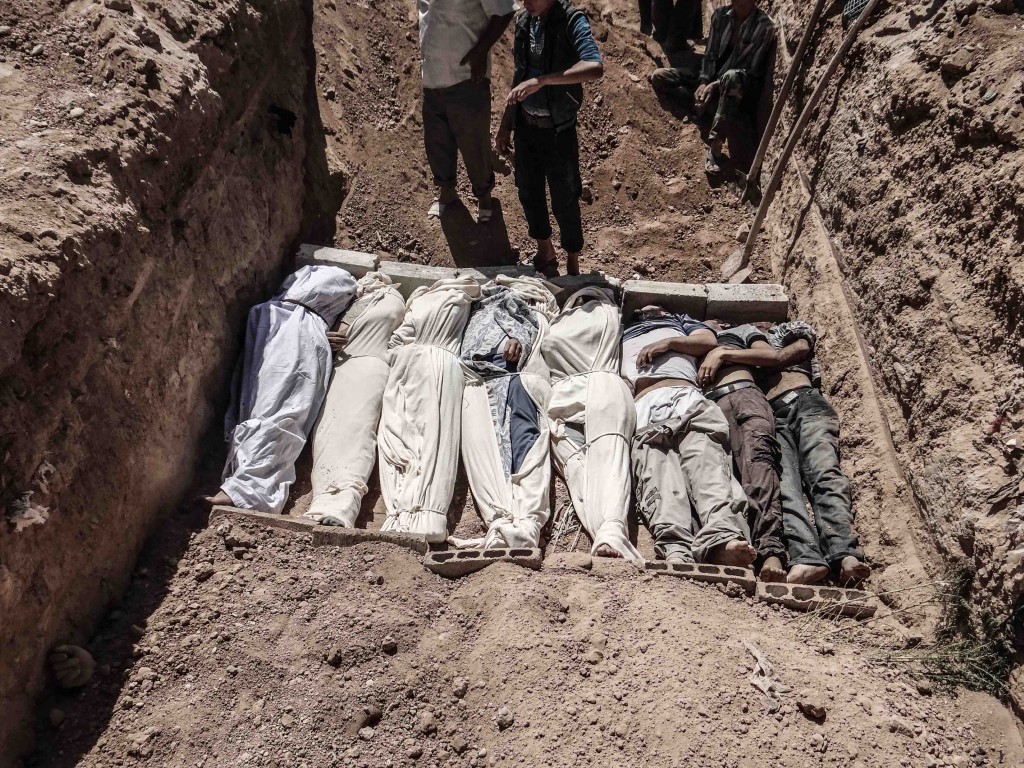
Bodies are buried in mass graves following a nerve gas attack that killed 1,300 people in Ghouta, on the outskirts of Damascus, on August 21, 2013. This massacre once again confirms the criminal nature of Bashar al-Assad’s regime, an ally of Hezbollah. (AFP)
On August 21, 2013, Syria’s Ghouta region—a fertile agricultural plain near Damascus whose population opposed Assad—suffered the deadliest chemical attack of the civil war.
In the middle of the night, Syrian regime forces fired surface-to-surface rockets loaded with sarin, a powerful military-grade nerve agent.
This coordinated bombardment caught residents asleep, causing severe asphyxiation. The death toll was heavy: between 1,100 and 1,400 people, mostly civilians, including hundreds of children.
Described as a crime against humanity, this tragedy prompted Syria to undertake what was, in theory, the dismantling of its chemical arsenal under international supervision.
The Battle of Qalamoun
Following the Syrian rebels’ withdrawal from Qusayr to Qalamoun, the battle for this hilly region (2013–2015) marked a decisive turning point in Hezbollah’s direct military involvement in Syria, transforming this border mountain range from an opposition logistics base into a defensive buffer for the Syrian regime.
Situated along the highway linking Damascus to Homs and the coast, the region controlled a route vital to the survival of Assad’s military apparatus, while giving Hezbollah a means of sealing Lebanon’s eastern border against infiltration, car bomb attacks, and the spread of the conflict into the Bekaa Valley.
Launched after the fall of Qusayr, specifically in late 2013 with the capture of Qara, Nabak, and Yabroud by Hezbollah and the Syrian army, the campaign continued until the large-scale offensive of May–June 2015, announced by Hassan Nasrallah, which resulted in almost complete control of the high ground held by rebel factions and Jabhat al-Nusra.
This victory established Hezbollah as a maneuver force capable of conducting combined operations in mountainous terrain, albeit at the cost of considerable casualties, while depriving the rebels of bases near Damascus and their supply lines from Lebanon.
The security benefits for the pro-Iranian party were tangible: it secured its strongholds in the northern Bekaa Valley and spared Beirut’s southern suburbs further attacks. This military victory deepened divisions in Lebanon over the legitimacy of the war and dealt the final blow to the principle of dissociation enshrined in the Baabda Declaration.
By late 2014, Hezbollah had already deployed between 5,000 and 7,000 Lebanese fighters in Syria on continuous rotation, while the rebels used the numerous routes connecting the Qalamoun mountains and the northern Bekaa Valley for supplies, logistics, and recruitment.
Meanwhile, the Syrian regime, accused of terrorism and war crimes, found itself isolated by international sanctions, bringing its airports and ports to a standstill.
Lebanon thus became not only a haven and a base for recruitment and operational logistics for the warring parties in Syria, but also the lifeline through which Damascus secured its major imports via the ports of Beirut and Tripoli.
(to be continued)
(1) Not all the rebels fighting Assad were Islamist extremists. Initially, most were secularists and mutineers from the regular Syrian army. These were the people Assad wanted to eliminate at all costs, forcing the countries of the region and the international community to face a difficult choice: either him or the extremists.
The Trump-Xi Summit: Between Pragmatism and Necessity
The Conflict in Yemen: Geopolitical and Strategic Considerations
Yemen: The Mecca Pact Moves from Theory to Military Action
Hezbollah-Israel: An Endless War in Whose Interests? (19)
Mecca Pact: Anatomy of the Islamabad–Riyadh–Ankara Axis (4/4)
More from Khalil Helou
View All


More in Strategia
View All


Latest from Levant Time
View All


