

Hezbollah-Israel: An Endless War in Whose Interests? (18)
In Syria, in the shadow of the Ba'athist regime: logistics and strategic coordination
This series of articles provides a better understanding of the current situation in light of the past, steering clear of impassioned, ideological, or romantic narratives that overlook the facts and leave readers to draw the necessary conclusions. The previous 17 installments revisited the events surrounding Hezbollah’s rise to power from the Taif Agreement through the first half of President Michel Sleiman’s term.
Between 2008 and 2011, before the Syrian war, Hezbollah still had no military training base or combat deployment in Syria. Bashar al-Assad’s regime, then backed by its police institutions and army, tolerated no foreign armed presence on its territory.
However, Hezbollah was ubiquitous in Syria as a strategic and logistical partner, where it was extensively rearmed from Iran. As it had been since 1992, Damascus was the indispensable hub for this supply and armament operation of the pro-Iranian party.
Discreet Hezbollah logistical cells, operating in coordination with Syrian intelligence services, received military equipment arriving from Iran at Damascus or Aleppo airport, the port of Latakia, or by land convoys through Iraq. These weapons were temporarily stored in Syrian military warehouses around Damascus and Homs.
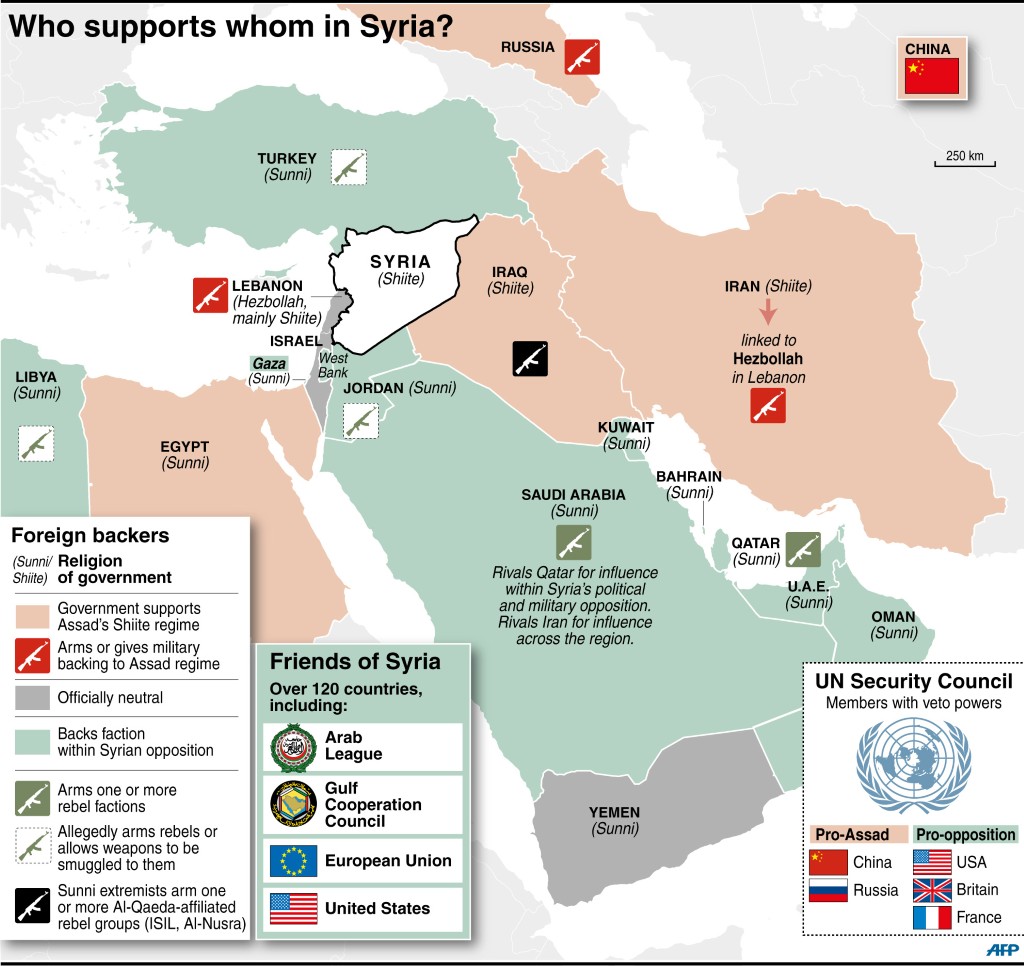
The forces present in Syria in 2014. (AFP)
Hezbollah’s Unit 108, an ultra-secret and highly specialized branch, oversaw the covert transfer of these weapons to the Bekaa Valley. This Hezbollah component bore sole responsibility for securing, loading, and transporting these sensitive shipments to Lebanon.
This unit managed safe-conduct passes, fleets of unmarked civilian-looking trucks, and cross-border smuggling networks.
Moreover, during this period, and for the first time in the history of Syrian-Iranian relations, the Assad regime no longer merely served as a transit corridor for Iranian weapons, but directly transferred surface-to-surface missiles and heavy rockets from its own state-run factories to Hezbollah. These transfers were supervised on Syrian soil by Unit 108.
Damascus: the hub of Hezbollah’s regional command
Damascus also served as a sanctuary for Hezbollah’s senior leadership.
The assassination in Syria of Imad Mughniyeh, head of Hezbollah’s military wing, brought the extent of the collaboration between the Syrian regime and the pro-Iranian party into the open.
Mughniyeh lived and operated partly from the Syrian capital under the protection of local security services. He was assassinated in Damascus on February 12, 2008, when a device placed in his car’s headrest exploded in the Kfar Soussa district.
The operation was attributed to Israel’s Mossad, working with the CIA, according to later reports in the American press. After his death, his successor, Mustafa Badreddine, continued his mission, setting up secret coordination offices to align regional strategies among senior Hezbollah security officials, their Syrian mukhabarat counterparts, and the command of the Quds Force, itself the foreign operations branch of Iran’s Islamic Revolutionary Guard Corps.
It was therefore a genuine command-and-control center (C3) where the future of the “Axis of Resistance” and its doctrine of strategic coordination linking its various Iranian-backed factions was decided—namely, the “Unity of the Arenas,” known in Arabic as (وحدة الساحات).
This doctrine holds that any aggression against one component of the alliance triggers a synchronized response across several regional fronts (Gaza, the West Bank, Lebanon, Syria, Iraq, and Yemen).
Later theorized by Hezbollah leader Hassan Nasrallah, this slogan of The Operations Theater Unit became the central pillar of the Axis's military strategy, as was systematically illustrated in the regional conflicts that followed.
Syria: Hezbollah's logistical and training rear base
Although Hezbollah had its own training facilities in the Bekaa Valley and southern Lebanon, access to Syrian territory gave it the essential strategic depth needed to further refine the training and operational preparations of its elite troops.
Although it did not have its own camps in Syria, it periodically sent its elite personnel there, including members of the Al-Radwan special force, to Syrian army training bases or those run by Iran's Islamic Revolutionary Guard Corps.
These secret stays on Syrian soil enabled Hezbollah fighters to train in the use of heavy or highly advanced equipment that they could not easily handle in Lebanon because of Israeli satellite surveillance or the presence of UNIFIL in the south.
This included mobile air-defense systems, advanced electronic warfare techniques, and the operation of reconnaissance drones.
Moreover, another Hezbollah unit, Unit 1800, responsible for supporting operations involving pro-Iranian Palestinian groups such as Hamas, maintained reception infrastructure in Syria, including logistical facilities and “safe houses” for extracting or accommodating militants in transit, thereby confirming Damascus's role as a strategic rear base for Hezbollah's power projection.
This symbiosis with the Syrian regime explains the speed and scale of Hezbollah's intervention in the Syrian civil war from late 2011 onward. When Bashar al-Assad's regime began to falter under the blows of the uprising, Hezbollah did not have to improvise an intervention: it simply activated the networks, supply routes, and coordination channels it had patiently established over the previous three years.
In summary, between 2008 and 2011, a period of relative calm at the regional level was a phase of intensive preparation for Hezbollah. The party evolved from a regional militia into an organization capable of managing logistical flows on the scale of a real state and asserting itself in alliance dynamics among major powers, thereby laying the groundwork for its entry into open warfare in the Syrian theater. This shift would redefine the balance of power in the Middle East for the following decade.
Hezbollah's involvement in the war in Syria
From the beginning of the Syrian uprising in 2011, Hezbollah firmly supported Bashar al-Assad's regime in order to preserve their strategic alliance forged over three decades, consolidate the essential link that Damascus represented for the “axis of resistance,” and safeguard the strategic bridge connecting Tehran to Beirut that Syria constituted.
Hezbollah's initial involvement alongside Assad was discreet at first, becoming more visible later.
From 2012 onward, it played a central role in training and structuring pro-regime militias. It acted both as an operational adviser and as a coordinator of local Syrian and foreign militias.
Through its Unit 3800, which specializes in training allied groups, it helped shape the al-Ridha Forces, composed of Syrian Shiites from the Homs region and often described as the Syrian Hezbollah, as well as the Imam al-Baqir Brigade, recruited in the Aleppo region.
Unit 3800 also provided urban guerrilla warfare training to the Popular Committees, the forerunners of the National Defense Forces, and Jaysh al-Sha'bi, a mixed structure jointly created with Tehran.
Finally, this Unit 3800 acted as a command relay for foreign units brought in by Iran, notably the Liwa Abu al-Fadl al-Abbas militia, originally formed to protect the Shiite mausoleum of Sayyida Zeinab in Damascus; the Afghan Fatemiyoun, drawn from the Shiite Hazara population; and Al-Nujaba and Kataeb Hezbollah, two Iraqi militias.
These militias were trained in Iran, after which Lebanese Hezbollah managed their operational deployment and coordinated their assaults during major urban battles.
(to be continued)