

Lebanon, the Iranian Project, and the Unfinished Self-Critique
A reading of Mohammad Ali Mokalled’s latest book

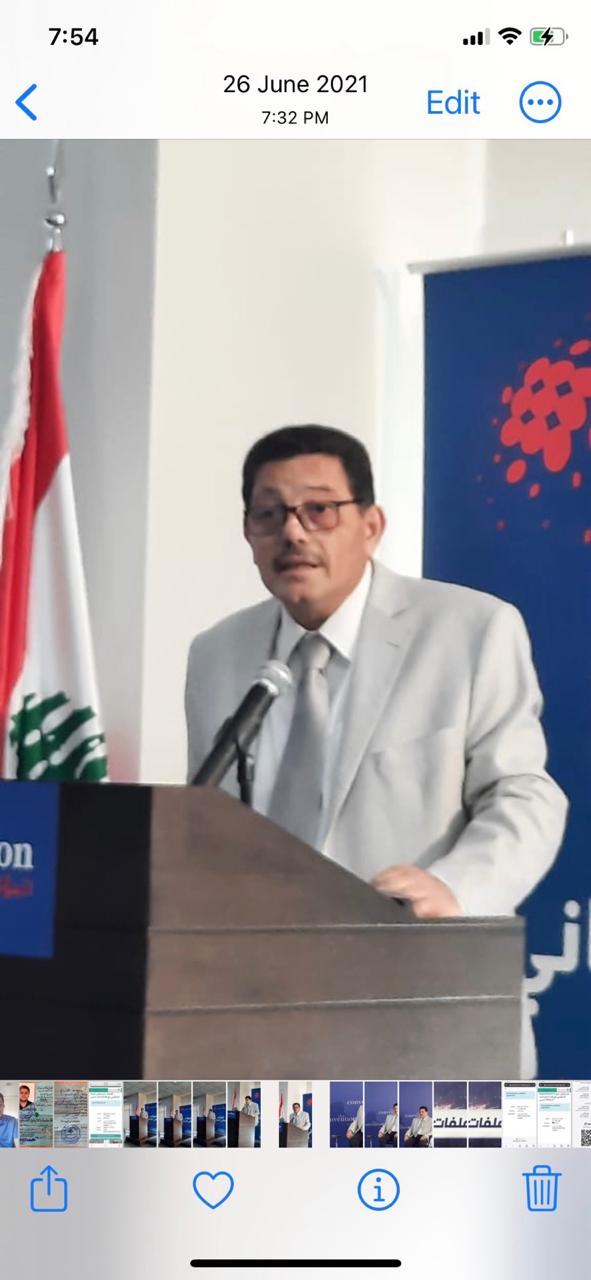
The following text is a translation of a panel discussion on Dr. Mohammad Ali Mokalled’s book, “The End of Hezbollah and All Forms of Fundamentalism”, held as part of the Beirut Book Fair. The author of this text, our contributor Hisham Dibsi, endorses and values the practice of questioning accepted ideas in order to correct our understanding of history. He therefore appreciates Mohammad Ali Mokalled’s approach to historical and political research.
In Lebanon, critical reassessment of relations with the state, society, and violence should not begin by examining the experience of others, but rather one’s own role, then that of one’s party, while also scrutinizing the social milieu that provided its setting and support.
I consider this approach the most appropriate for Lebanon, given its distinctive political characteristics and the particular nature of its national identity.
This conviction is reinforced by the fact that Lebanon was classified as a supporting state in the Arab-Israeli conflict, rather than a confrontation state, even though it belonged to the so-called “frontline states” (دول الطوق), in the Nasserist terminology once used in the Arab world.
In this context, Lebanon escaped the occupation of any part of its territory following the June 1967 war and was not covered by United Nations Resolution 242, which remains the basis for Arab-Israeli settlements to this day.
Yet this country suffered the catastrophic consequences of the June 1967 defeat more severely than the states directly involved in the confrontation, and it continues to pay the price for policies that are not its own.
In 1969, it was compelled to sign the Cairo Agreement with the Palestine Liberation Organization (PLO).
It then endured a civil war that spared none of its participants, adversaries and allies alike. The Syrian dictator Hafez al-Assad, followed by his son, imposed a violent and criminal tutelage, with the acquiescence of the US administration and Israel, for a period equivalent to nearly half of Lebanon’s history as an independent country.
Then the first contingents of Iran’s Revolutionary Guards arrived in Baalbek, eventually evolving into a party that fills every available vacuum—and, when circumstances in Lebanon call for it, creates a vacuum itself.
Its influence eventually spread beyond the borders of Greater Lebanon to the far reaches of the Middle East, as well as among the Lebanese diaspora worldwide.
I also believe that any genuinely useful reassessment of history requires evidence drawn from the archives. The truth brought to light will provide the basis for a new historical approach.
Yet in Lebanon, political figures, researchers, and journalists have been systematically assassinated simply because they had some connection, however tenuous, to the truth. Even ordinary laborers and workers have not been spared, for fear that they might one day testify to what they knew when a major conflict broke out.
The scale of the problem of violence and its relationship with the state and Lebanon’s very existence as a nation goes far beyond what is usually said about it, and has no equivalent elsewhere in the region. This is why I believe that the parties of the Lebanese National Movement and their elites have never produced a critique commensurate with this distinctly Lebanese problem.
Any criticism shaped by immediate political needs and interests is not genuine criticism. Rather, it amounts to using selective criticism to serve specific goals. It resembles perfunctory apologies intended to keep dialogue going, or marriages of convenience based on immediate, limited benefits, with a few exceptions that only prove the rule.
Most published critical analyses contain so many gaps and justifications that they end up partly or entirely stripping self-examination of its meaning and purpose. Unless it rests on a sincere and profound acknowledgment of responsibility, an act of contrition serves no purpose and cannot pave the way for fresh, innovative solutions to a complex reality, as Lebanon continues to endure dark times to this day.
Reading Dr Mohammad Ali Mokalled’s book, I noted several points of convergence, to varying degrees, with these introductory reflections. Although I am convinced of the sincerity of his approach and positions, the issue here concerns his method, not the author himself, for whom I have affection and respect.
He is indeed among the rare few who have had the courage to engage in criticism and rigorous personal and collective self-examination, unlike those who remain trapped in their certainties and unshakable in their convictions, whether on the right or among my friends on the left.
The Project’s Objectives and the Logic of Iranian Interests
An examination of these critical analyses and positions reveals that they have focused more on the mistakes and problems that have accumulated throughout Hezbollah’s development in Lebanon than on a fundamental critique and questioning of Iran’s regional project, particularly its profound conflict with Arab interests in general and the national interests of individual countries, above all Lebanon, followed by Palestine.
Indeed, the revolution against the shah’s regime became the main benchmark for political judgment. Similarly, slogans hostile to the United States and Israel provided common ground with liberation movements, revolutionary forces, and the left in both Lebanon and Palestine.
This convergence was accompanied by a sweeping populist wave that left no room for reservations or any lack of enthusiasm toward the victory that had toppled the shah’s regime, which was widely hated in our countries.
In the Palestinian case, the honeymoon was not yet over when differences between Supreme Leader Khomeini and Palestinian leader Yasser Arafat were already apparent. They stemmed from a fundamental divide between the Islamic revolution and the national revolution.
In other words, they arose from Yasser Arafat’s rejection of any form of subordination or outside control over independent Palestinian decision-making—a principle that encapsulates and clearly expresses the logic of the Palestinian national interest.
This model did not take hold in Lebanon, either among forces on the left or among those on the right that openly and explicitly fly the flag of Lebanese independence, including some leaders of the March 14 Revolution.
Yet we have examples, positions, and policies that demonstrate this inability to uphold a coherent conception of Lebanon’s national interest. Several major actors bear responsibility for this. Key examples include:
First, Hezbollah’s long-standing policy of eliminating other forces, liquidating party figures and secular Shiite personalities, and attempting to sideline the Amal Movement.
Second, the deep divide between the March 14 and March 8 forces, which ultimately gave way to a marriage of narrow interests, embodied in the Quadripartite Alliance. There is no need to spell out the consequences of this process for the Lebanese state, which became unable to fulfill its role in shaping and implementing policies based on the national interest, a situation that persisted through the presidency of General Michel Aoun.
Thus, when the forces that are supposed to define Lebanon’s national interest fall short, criticism loses any foundation from which it might produce tangible results.
It is reduced to mere media sparring between supporters and opponents, as we see every day on television channels, digital platforms and social media.
The Problem of the State and Violence
From “Hezbollah—those who are victorious” (the Quranic phrase) to the “Islamic Resistance,” and then simply the “Resistance,” these changes in name carry considerable significance.
They mark the transition from a founding phase, in which a distinct identity was asserted, to the formation of an “Islamic resistance front” alongside forces sharing the same ideology, before reaching a phase of dominance, control and expanded alliances with secular and left-wing forces.
The term “resistance” has thus become a watchword, a concept that some can no longer challenge even at the level of terminology.
In this context, I see little point in Dr. Mokalled’s assertion: “I agree with the principle of resistance, but I disagree with the methods.”
Nor do I believe that criticism focused on a particular aspect, whether valid or mistaken, can affect or weaken Hezbollah as long as it is conducted on Hezbollah’s own terms.
This is not a mistake on Dr. Mokalled’s part, but rather a major failing of the leading political parties in the March 14 coalition and their leaders during its early years.
Indeed, their criticism of Hezbollah’s project never went so far as to question its ties to Iran’s regional project or the role it plays within it.
On the contrary, they entered into the “Quadripartite Alliance” with Hezbollah during the elections following the Syrian withdrawal in 2005, and adopted its favored formula: “The army, the people and the resistance.”
From that point on, Hezbollah set the pace of political life and the workings of the Lebanese state, while the other actors proved unable to chart an independent course for their party policies or their policies in government.
Despite their considerable popular support and their Arab and international connections, they were content to dance to Hezbollah’s tune. They paid the price for these policies in exchange for remaining in power and maintaining their public presence.
The foregoing can be summed up as the inability of Lebanon’s pro-sovereignty forces to criticize the use of violence outside state institutions.
This inability is not merely a recent development. Its roots lie in the events that followed the June 1967 war, the Cairo Agreement and the May 17 Agreement—all decisive turning points.
A “Province” of a Particular Kind
The Persian word “ostan” means “province.” From the outset, the Iranian project made clear its ambition to export the revolution to the Islamic world, and especially to the Shiite community.
It was also clear that the Revolutionary Guards’ activities in Lebanon were linked to the political conflict between Tehran and Washington.
Establishing a strong military foothold in Lebanon under the banner of fighting Israel therefore offered Tehran an exceptional advantage: proximity to both Israel’s borders and the Mediterranean Sea.
Since the makeup of Lebanese society did not allow for the establishment of an Islamic regime in Lebanon, contrary to what advocates of wilayat al-faqih (rule of the Islamic jurist) proclaimed, building an Iranian “province” based on the Shia community’s demographic and geographic presence was the feasible option, and also the one best suited to Tehran’s uncompromising pragmatism.
This is what the Iranian project began to put into practice in Baalbek and Beirut’s southern suburbs, before expanding to encompass the entire area south of the Awali River—not the Litani.
Anyone who follows this development, understands its mechanisms, and observes the scale of the structure built across the political, economic, military, and security spheres will understand that this is no longer simply a party participating in a state, but rather a party dominating a state.
It is easy to say this today. But those who voiced such views in the 1980s were considered traitors or defeatists at the time.
Here, it is essential to revisit the nature of Hezbollah’s military activities and security operations.
In its early days, these included hostage-taking, operations against American and French facilities, and actions to eliminate rivals and seize control on the domestic front.
Subsequently, clashes with the South Lebanon Army continued until Israel’s withdrawal in May 2000.
We then entered a six-year period dominated by the issue of the “Shebaa Farms,” culminating in the abduction of Israeli soldiers in July 2006—an operation intended, according to this interpretation, to strengthen Iran’s negotiating position with Washington over its nuclear program.
That operation triggered a catastrophic war, described as a “divine victory,” which led to the adoption of Resolution 1701.
Finally, the rules of engagement held until the launch of limited support operations, followed by operations carried out to avenge the Supreme Leader. The consequences of these events are now known.
All of this confirms that the bulk of the military power Hezbollah built has been used in the Lebanese domestic, Syrian, and regional arenas.
This demonstrates that this military buildup fundamentally served Iranian interests, not those of Lebanon as a homeland. Those involved openly boast of it.
I was therefore not exaggerating when I said that an Iranian province had been built in Lebanon.
Conclusion
1. It can be said that Iran defeated the Arabs in the battle to win over part of the Shia community and detach it from its loyalty to its respective homelands, within the framework of the doctrine of wilayat al-faqih.
2. Iran also succeeded in cultivating Sunni political Islam, in its various forms, and using it to serve its overarching interests.
3. Iran managed to infiltrate nationalist and left-wing movements and forge alliances with them that served its interests, drawing on broad slogans hostile to Israel and the United States.
4. Through undeclared alliances with Washington and with other international and Arab capitals, Iran succeeded in taking its imperial project to its furthest extent, even boasting that it controlled four Arab capitals.
5. The rupture in Iranian-American relations, in its new form during Donald Trump’s current term, triggered a strategic shock that forced Iran’s regional project to shift from an offensive phase of strategic expansion to a posture of strategic defense, accompanied by a forced withdrawal from certain positions, notably in Syria.
6. However, we cannot say that the Iranian regime in Tehran has reached the point of capitulation. It is still trying to buy time as long as U.S. policy remains undecided between a strategy of containment and a policy of regime change.
7. It is still too early to speak of the end of this project in Iraq, Yemen, and Lebanon as long as the Revolutionary Guards continue to hold the reins of power in Tehran.
8. The claim that fundamentalisms are coming to an end in a historical sense is open to debate. By contrast, speaking of their disappearance on the ground makes little sense in the short term.
9. The transitional periods preceding the emergence of a new order should not be assumed to be brief. On the contrary, they can last for years, far longer than theoretical predictions suggest.
Finally, objective laws, independent of human will, sometimes seem to toy with us, forcing us to pay a price that people cannot bear, as is happening today in Palestine, Yemen, Iraq, and Lebanon.
That is why we must study our situation and deepen our analysis of our problems, time and again, however bitter they may be, in order to develop a meaningful vision for the future.
A vision that can help put an end to uncontrolled violence in our countries and rebuild a society and a state worthy of future generations.
"Yemen Dawn": A Turning Point with Lasting Consequences (2)
"Yemen Dawn": A Turning Point with Lasting Consequences (1)
The Twin Towers - Manhattan Today
More from Hisham Dibsi
View All


More in An Eye on the Event
View All


Latest from Levant Time
View All


