

France Avoids a State of Emergency but Prepares for the Worst


The French government announced its first measures on Monday in response to the weekend riots in several cities across the country, starting with “partial” and “localized” curfews, even as the possibility of declaring a state of emergency was raised.
President Emmanuel Macron, who is touring the Gulf states, reportedly preferred not to declare a state of emergency to avoid spooking the markets, especially since Paris had very recently announced an increase in its debt and public deficit. Political or security instability would certainly affect interest rates.
The “chaos” is “confined to very specific urban areas,” Prime Minister Sébastien Lecornu said. He said he had “asked prefects to impose a number of curfews tonight,” Monday, specifying that they would be “localized” and “partial.”
Although Sébastien Lecornu ruled out declaring a state of emergency for now, he said he was prepared to do so “if necessary.” More demonstrations are planned: the Yellow Vest movement has announced an “Act II” for next Saturday, ahead of further protests on October 31 and November 5…
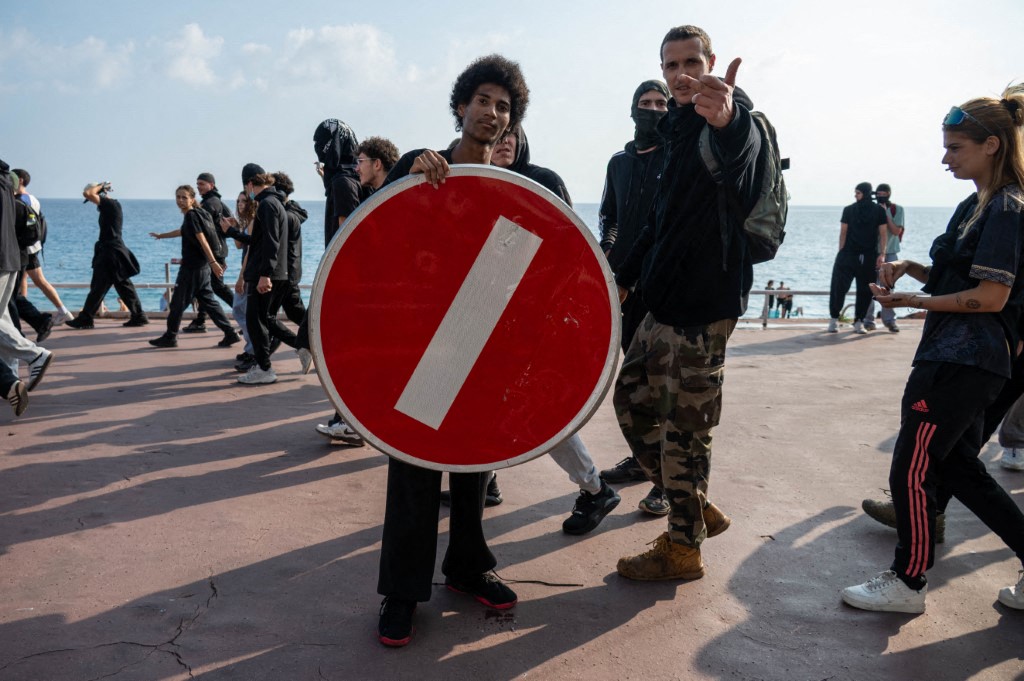
Yellow Vest protesters in Nice. (AFP)
Over the weekend, “at least 3,000 businesses” were damaged or looted, said Serge Papin, the minister responsible for the sector. He announced a “dedicated support fund” to help business owners.
Justice Minister Gérald Darmanin announced that 2,513 people had been taken into police custody, many of whom were still being held, and that 67 people had been jailed since the weekend's violence.
In an interview with TF1, the justice minister also said he had sent “instructions to all public prosecutors in France asking them to treat these offenses as organized crime.” This would allow police custody to be extended from 48 to 72 hours and enable “the use of geolocation and phone tapping, which will allow us to find out (...) where they were when shops were looted and town halls attacked.”
Paris police chief Patrice Faure issued several orders banning demonstrations in certain parts of the capital from 8 p.m. on Monday until 6 a.m. on Tuesday and imposing an 11 p.m. curfew in more limited areas, including Place de la République, according to the Paris prefecture.
Curfews will also be imposed in other major cities, including Lyon, Lille and Nice.
Politicians look for an opening
With six months to go before the presidential election, the crisis has taken a political turn: the opposition says the government and law enforcement were poorly prepared for the demonstrations and mishandled the unrest.
Interior Minister Laurent Nuñez admitted fault on Monday, acknowledging a “loss of control” in some cities. But President Emmanuel Macron refused to accept his resignation.
While the government acknowledges shortcomings, it is pointing the finger at France Unbowed, which it says bears “moral and political responsibility for the violence.” Sébastien Lecornu also accused the “ultra-left movement” and its candidate Jean-Luc Mélenchon of seeking to sow “profound disorder” and “even call the presidential election timetable into question.”
Against this tense backdrop, Emmanuel Macron has tasked the prime minister with bringing together political parties, trade unions, local authorities and members of parliament.
A Nobel Peace Prize to Save International Law in Peril
A Lebanese-Iranian Meeting in New York, but Several Political Messages
“No State Can Have Two Armies and Two Decision-Making Authorities,” Salam Says in New York
Trump Pulls Back at the Last Minute From Strikes on the Houthis
Trump Leaves Riyadh Alone to Face the Houthis
More from LevantTime .
View All


More in Today's Essential
View All


Latest from Levant Time
View All


