

Hezbollah-Israel: An Endless War in Whose Interests? (15)
May 2008: after Beirut, the Mountains

This series of articles offers a deeper understanding of the current situation in light of the past, steering clear of impassioned, ideological or romanticized narratives that miss the mark on reality. Our approach aims to leave it to the reader to draw the appropriate conclusions. The previous fourteen installments retraced the events surrounding Hezbollah's rise to power, its armed conflicts with Israel and its dominance over Lebanon, from the Taif Agreement to the Doha Agreement.
May 2008, the mountain after Beirut. On May 7, 2008, Hezbollah and its allies (the Amal Movement and the Syrian Social Nationalist Party, SSNP) forcibly took over the offices of Saad Hariri's Future Movement in Beirut, along with much of the capital's Sunni neighborhoods, which formed the popular base of the March 14 coalition.
The Future Movement's positions quickly fell into the hands of the attackers, as the army had largely stayed out of the clashes, and political mediation efforts didn't have time to halt the operation. The army's commander-in-chief faced a dilemma: on one hand, he knew that a forceful intervention by troops in an urban setting would come at a heavy cost in both civilian and military lives, not to mention the material damage; on the other, he had to contend with the frustration of officers, especially Sunni ones, who watched as the neighborhoods of their loved ones were left without the army's protection.
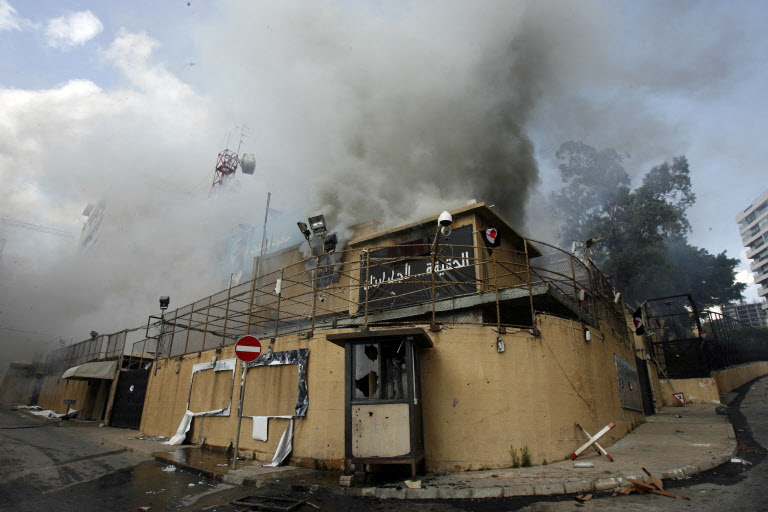
The headquarters of Future TV ransacked in Beirut. (AFP)
The military's top brass still had fresh memories of the Battle of Nahr al-Bared, which had pitted the army against the terrorist group Fatah al-Islam a year earlier, claiming the lives of 170 soldiers over 105 days of fighting in a far less urban and evacuated combat zone spanning barely one square kilometer. A battle in densely populated Beirut would have come at an unbearable human cost, would have spread across the entire Lebanese territory, and would have dragged on endlessly, with Hezbollah enjoying wide-open logistical supply lines from Syria.
However, the army did get the chance to deploy in force between Hezbollah and Future Movement supporters on Mazraa Street, forcibly blocking any militia movement from crossing the street in either direction and preventing an attack on Tariq al-Jdideh, a Future Movement stronghold. Troops also set up security perimeters around the government palace, where Prime Minister Fouad Siniora was staying, and around the residence of Walid Jumblatt, a leading figure in the March 14 coalition.
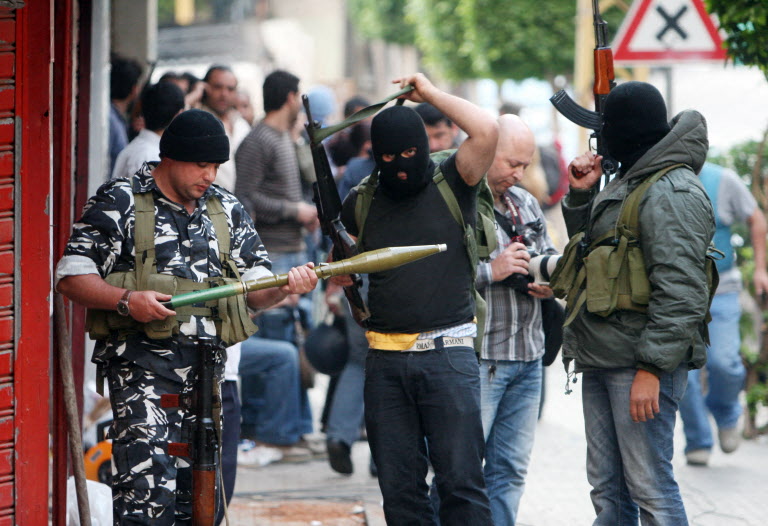
Shiite militiamen near Hamra Street: the one handling an RPG-7 anti-tank rocket launcher is wearing an Internal Security Forces uniform… (AFP)
These measures, combined with behind-the-scenes contacts from Gulf capitals, helped dissuade Hezbollah from attacking the government palace. Still, the Shiite party set its sights on controlling the Druze stronghold of Mount Lebanon. Tensions boiled over on May 9 when Hezbollah militants kidnapped municipal police officers in Aley, triggering a counterattack from the Druze Progressive Socialist Party's (PSP) militia.
Fighting quickly spread to Choueifat, Aley, Souk el-Gharb and Baissour. Both sides brought heavy weapons into play, and PSP fighters dug into the old fortifications and trenches left over from the civil war, managing to halt Hezbollah's advance. Hezbollah tried but failed to seize Hill 888, overlooking Beirut airport and situated between Aley and Souk el-Gharb. It did, however, manage to take the old fortress of Niha, in the Chouf, in order to secure a direct logistical route linking the Bekaa to South Lebanon without having to go through the coastal road.
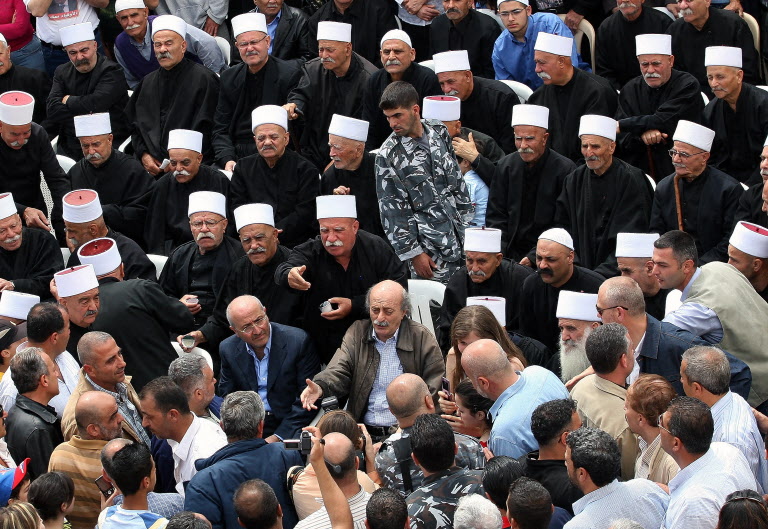
Lebanese Druze leader Walid Jumblatt (foreground, center) and Information Minister Ghazi al-Aridi (center left) take part in a rally in the Druze village of Baysour, in Mount Lebanon, the day after roadblocks were lifted in the capital, bringing an end to a week of deadly violence. (AFP)
On Sunday, May 11, Hezbollah tried unsuccessfully to attack Barouk and Choueifat, a failed assault that cost the lives of 36 of its fighters, including the commander of the attacking force in Choueifat. That same day, the army deployed in the town and ordered both sides to withdraw. The PSP then handed over its positions to the troops, and Hezbollah pulled out along with its dead and wounded.
Politicians allied with Hezbollah tried, through both indirect and direct means, to delay the army's deployment in Choueifat, but to no avail. Their goal was to buy Hezbollah time to regroup, relaunch its offensive, and secure a victory in the town. However, the officer in charge of the mission flatly refused, sparing the town further destruction and easing pressure on the surrounding villages of Kfarchima, Wadi Chahrour, and Bsaba.
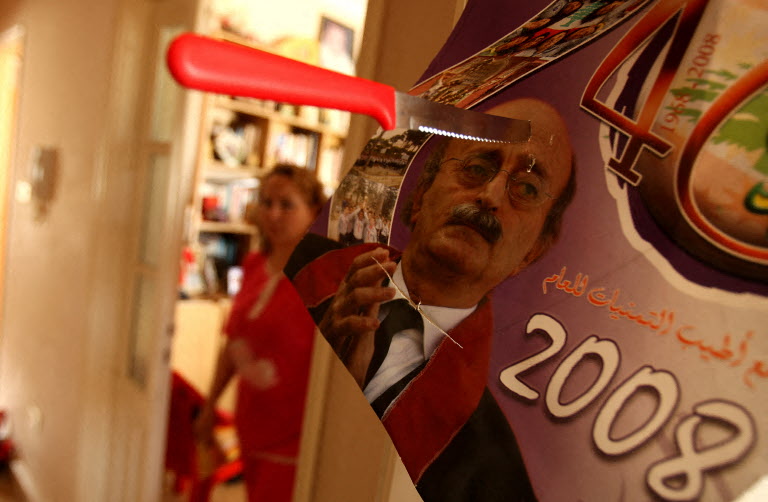
On the door of this apartment in Choueifat, militiamen left a message that couldn't have been clearer... (AFP)
That same day, Hezbollah spread completely baseless rumors claiming that Samir Geagea's Lebanese Forces (LF) were preparing to attack the Rabieh residence of Free Patriotic Movement (FPM) leader Michel Aoun, as well as Shiite villages in the Jbeil district. These rumors were meant to spread the armed conflict into Christian areas by dragging the FPM and the LF into it. Military intelligence services stepped in, however, and put an end to the rumors.
The army-people-resistance triad
The Future Movement and its allies in the March 14 coalition were forced to the negotiating table after their defeat on May 7, 2008. Qatar stepped in as mediator and sponsored the Doha Agreement (May 2008), a compromise that largely favored Hezbollah and its allies. The agreement led to the election of army commander-in-chief General Michel Sleiman as President of the Republic, ending a six-month presidential vacuum, since neither of the two candidates from the March 8 and March 14 alliances could secure a sufficient majority in Parliament.
Fouad Siniora was reappointed prime minister, and with Qatar's direct involvement, he formed a national unity government. Yet this government was doomed from the outset to gridlock on major decisions, since it included 16 ministers from the March 14 parliamentary majority and 11 from the March 8 opposition—among them Hezbollah, the Amal Movement, and the FPM—giving the latter a “blocking third.”
This government's ministerial statement enshrined the formula of the “army, people, resistance” triad. This formula had first taken shape under Emile Lahoud and Hassan Nasrallah. In a speech before the UN General Assembly on September 21, 2006, just after the July war between Hezbollah and Israel, Lahoud stated verbatim: “… this (Israeli) barbarity has not weakened my people, nor shaken their determination to resist, nor affected their attachment to the state, the army, and the national resistance …”
Back in the 1990s, as army commander-in-chief, he already stressed in his speeches the unbreakable bond between regular soldiers, ordinary citizens, and the resistance against Israel. Hassan Nasrallah, for his part, argued in numerous speeches after the 33-day war that Lebanon had only been able to withstand Israel thanks to the spontaneous coordination between the army and fighters, backed by popular support.
The Red Sea and the Horn of Africa: The Shifting Balance of Power in the Middle East (1/6)
Hezbollah-Israel: An Endless War in Whose Interests? (20)
The Trump-Xi Summit: Between Pragmatism and Necessity
The Conflict in Yemen: Geopolitical and Strategic Considerations
Yemen: The Mecca Pact Moves from Theory to Military Action
More from Khalil Helou
View All


More in Strategia
View All


Latest from Levant Time
View All


