

Mecca Pact: Anatomy of the Islamabad–Riyadh–Ankara Alliance

This second installment in a four-part series examines the formation and early implications of the Mecca Pact, a trilateral alliance between Saudi Arabia, Turkey, and Pakistan. From the Saudi-Pakistani “Strategic Mutual Defense Agreement” (SMDA) to the Istanbul summit, the analysis traces the gradual development of a collective security framework in the face of Iranian ambitions, regional realignments, and the limits of U.S. leadership. The article also explores how Saudi financial, technological, and military resources complement those of the other two members, as well as the challenges of institutionalizing the alliance.
With the meeting in Istanbul of the defense ministers of the three countries that signed the Mecca Pact(1), on August 31, and the prospect of a reshaping of the balance of power in the Middle East, it is becoming increasingly clear that the security and defense responsibilities of the Pact’s member states are beginning to be allocated and take shape. However, there is still a long way to go before it can be compared with NATO or other military alliances, or with earlier alliances among Arab League countries, notably the “Arab Common Defense” (الدفاع العربي المشترك), which did not survive beyond 1973.
If the three countries’ military alliance results in even a minimal unification of their military capabilities, it will certainly force Iran to reassess its asymmetric strategies, Israel to rethink its regional military hegemony, and global actors such as India and Russia to adjust their multipolar alliances. However, it remains unclear how this unprecedented trilateral axis could overcome the structural limitations of U.S. leadership in the region, or how it could do without it.
First milestone: Saudi-Pakistani bilateral cooperation
Questions about U.S. leadership and guarantees emerged a year and a half ago, when Middle Eastern countries signaled that they wanted to rely increasingly on themselves and on multipolar alliances, rather than on an exclusive alliance with the Americans, while still maintaining their close ties with Washington. This realignment began with the Saudi-Pakistani Strategic Mutual Defense Agreement (SMDA), signed on September 17, 2025, at Al-Yamamah Palace in Riyadh. This agreement forms the direct bilateral foundation upon which the Mecca Pact, signed on August 7, 2026, was based.
Initialed by Saudi Crown Prince Mohammed bin Salman and Pakistani Prime Minister Shehbaz Sharif, the SMDA transformed the relationship between the two countries from a transactional arrangement into a binding security alliance. The two states committed themselves “de jure” to the principle that any armed aggression against one of them would be treated as direct aggression against both. The SMDA was signed only days after Israel’s September 9, 2025 attack on Hamas targets in Qatar, an event that triggered a security earthquake in the Gulf.
For Riyadh, this bilateral pact represented a strong diplomatic signal to the United States. Faced with growing skepticism about the absolute reliability of the U.S. shield against regional threats, Saudi Arabia sought immediate strategic alternatives. The agreement caused immense international perplexity because of Pakistan’s military status as the Islamic world’s only nuclear power.
Statements by Pakistani Defense Minister Khawaja Mohammad Asif initially suggested that Saudi Arabia would now fall under Islamabad’s nuclear umbrella, but Riyadh simultaneously played down those claims to avoid a non-proliferation crisis with Western powers. Moreover, the treaty formally provided for the operational deployment of Pakistani armed forces, fighter jets, and defense systems on Saudi soil, a measure already being implemented. By making Saudi Arabia’s security a priority for Islamabad, the agreement laid the first stone of a much broader structure: an alliance capable of offering an alternative to the Sunni world.
After the ASDM: the Regional Four, or R4 Group
During the first half of 2026, Riyadh and Islamabad held intensive consultations with Ankara and Cairo to shape what observers call “Sunni security.” Later, following the outbreak of hostilities between the United States and Israel on one side and Iran on the other, the four-country group came to be known as the R4 Group, or Regional Four. One of its first concrete actions was neutral mediation between the United States and Iran. Building on Islamabad’s initial diplomatic success in this regard, the R4 Group sought to turn its own quadrilateral ties into a collective security treaty. Egypt subsequently declined to join the military component, preferring to maintain a strictly diplomatic stance toward Iran and Israel.
The Birth of the Mecca Pact
The path toward the Mecca Pact accelerated rapidly in the summer of 2026 following repeated Iranian missile and drone attacks on oil-export infrastructure in the Gulf, which starkly demonstrated the inadequacy of traditional missile-defense systems against Tehran’s sophisticated asymmetric threats. These strikes, which threatened the economies of the Gulf states and the global economy, made it imperative to finalize the agreement’s military provisions. The issue was no longer debating the theoretical outlines of an alliance, but pooling defense, information, and intelligence capabilities capable of saturating the skies over the Gulf against hostile incursions. Thus, an operational military alliance began to take shape. This momentum gave rise to the Mecca Pact on August 7, 2026.
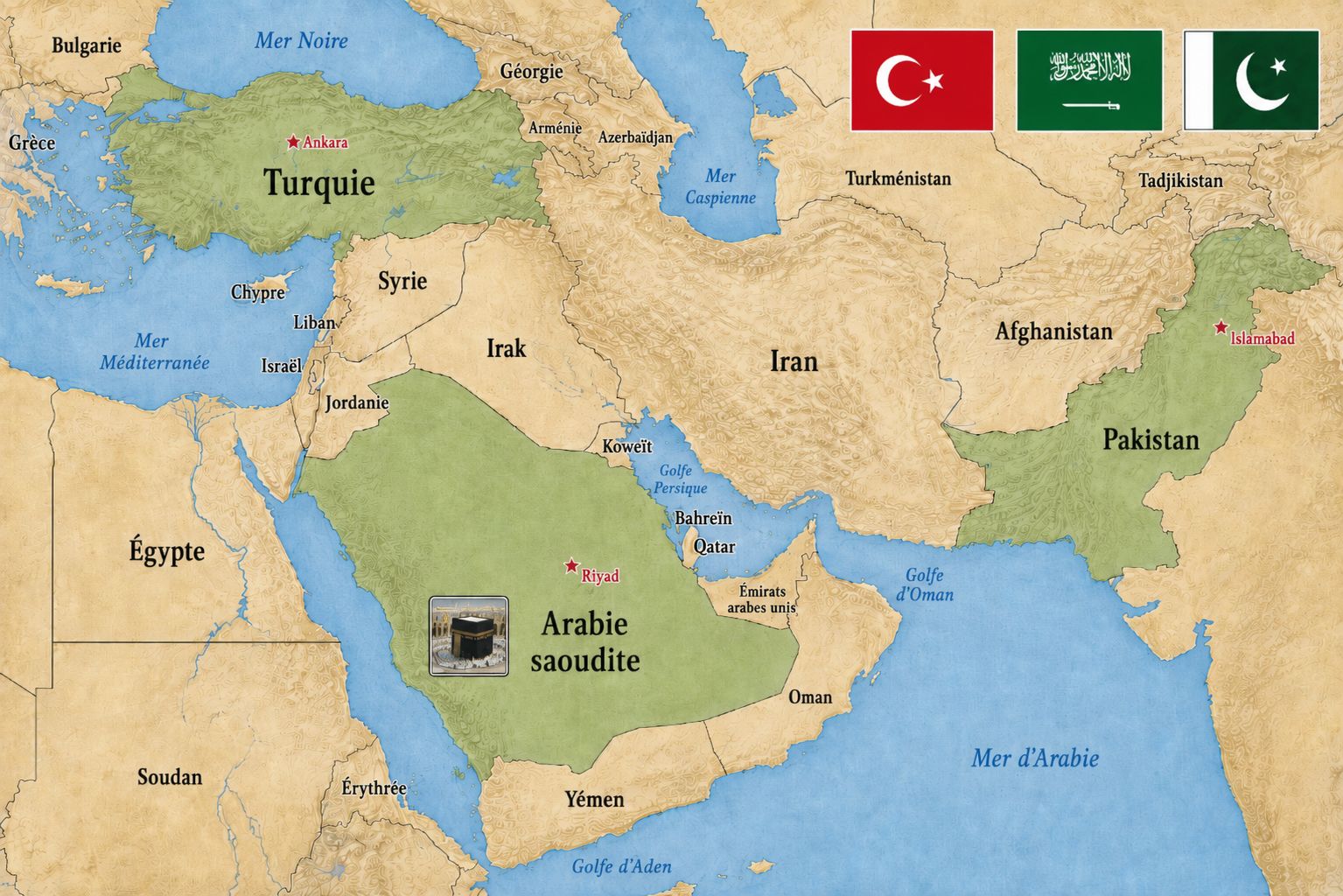
The convergence of complementary strengths within this bloc could prove exceptionally effective if each member’s resources are used efficiently, as each brings distinct and indispensable added value to the overall balance. Moreover, at the signing ceremony, senior officials from the three countries formally stated that the agreement was not connected to any nuclear ambitions, technology transfers, or deployment of an atomic umbrella. Saudi Deputy Minister Rayed Krimly specified in particular that the pact was aimed solely at developing sustainable conventional capabilities.
Saudi Arabia’s role
Riyadh provides the alliance’s financial depth and diplomatic centrality. The Kingdom seeks to be not only its financier, but also the Pact’s political linchpin and logistics hub. To that end, the Saudis are investing heavily in domestic defense infrastructure. This is based on the Saudi Kingdom’s military sovereignty strategy under Vision 2030. Riyadh is gradually localizing its defense sector in order to become less and less dependent on imported weapons and military equipment.
Saudi Arabia’s 2025–2026 defense budget amounts to $72.5 billion, or around 21.2% of the total state budget. This is the foundation that will fund interoperability within the Pact. Outside the Pact, half of military spending is expected to fund local defense industries by 2030, compared with just 2% in 2016 and nearly 19.35% in 2026. In this context, and in partnership with Turkish and Western arms companies, the Saudi General Authority for Military Industries (GAMI)(2) and the state-owned defense company (SAMI)(3)now produce locally designed drone systems. Finally, the Kingdom has signed defense contracts with Western and Russian firms that require technology transfers and the establishment of Maintenance, Repair, and Operations (MRO) centers on Saudi soil.
This enables the country to independently reconfigure and repair the air, naval, and land fleets used by its own forces and those of its allies in the event of conflict. Saudi Arabia is thus using the Pact to establish itself as a partial supplier of military materiel and equipment, in addition to its pivotal role in regional security. It does not intend merely to buy protection from its Pact allies; it aims to become a co-organizer and the central player steering an asymmetric complementarity by combining its brand-new logistics hubs with Turkish military technology and Pakistan’s force-projection capability. If Riyadh succeeds in this endeavor, it will effectively assume the political leadership of this pact.
(to be continued)
(1) Mutual Defense Pact signed by the Kingdom of Saudi Arabia, Pakistan, and Turkey on August 7, 2026.
(2) GAMI (General Authority for Military Industries) was established by the Saudi government in August 2017. It is the state body responsible for regulating, structuring, and developing the defense sector in Saudi Arabia and allocating its budgets. It is chaired by Crown Prince Mohammed bin Salman.
(3) SAMI (Saudi Arabian Military Industries) is Saudi Arabia’s national defense company. Established in May 2017, it is wholly owned by the Saudi Public Investment Fund (PIF). It owns the factories, hires the engineers, manufactures military equipment, and could become a key pillar of logistical and industrial support for the Mecca Pact.
The Red Sea and the Horn of Africa: the cases of Sudan and Ethiopia (2/6)
The Red Sea and the Horn of Africa: The Shifting Balance of Power in the Middle East (1/6)
Hezbollah-Israel: An Endless War in Whose Interests? (20)
The Trump-Xi Summit: Between Pragmatism and Necessity
The Conflict in Yemen: Geopolitical and Strategic Considerations
More from Khalil Helou
View All


More in Strategia
View All


Latest from Levant Time
View All


