

Hezbollah-Israel: An Endless War in Whose Interests? (21)
Zabadani: the rebel stronghold that threatened the Beirut-Damascus highway


This series of articles offers a clearer understanding of the present situation in light of the past, steering clear of impassioned, ideological or romantic narratives that overlook realities, and leaving readers to draw their own conclusions. The previous twenty installments revisited the events surrounding Hezbollah’s rise to power, from the Taif Agreement to its large-scale military involvement in Syria in support of Bashar al-Assad’s regime, and the fall of the Syrian city of Qusayr and the Qalamoun hills near Damascus.
After the battle of Qalamoun (May–June 2015), Hezbollah intensified its intervention in the Syrian civil war. It evolved from a force tasked with securing the Lebanese-Syrian border into a major offensive actor operating across Syria.
Zabadani: The Rebel Stronghold That Threatened the Beirut–Damascus Highway
In July 2015, Syrian rebels still held a major stronghold: the city of Zabadani. Located in the governorate of Rif Dimashq (the Damascus “countryside,” or province), just 10 kilometers from the Lebanese border and close to the Beirut–Damascus highway, it was controlled primarily by the group Ahrar al-Sham. At the time, it was one of the most powerful, best-organized and most influential factions in the Syrian rebellion, having established itself as a disciplined army in its own right. Ahrar al-Sham and local factions held Zabadani and maintained supply lines from the Bekaa Valley, where displaced Syrians and refugees—rebels and their families—had settled after fleeing the fighting.
Understanding the Syrian Refugee Population in Lebanon During the Syrian Civil War
Syrian refugees came to Lebanon mainly from areas close to the border that had been heavily affected by the fighting, particularly the cities of Homs and Qusayr and the regions of Ghouta and Qalamoun. Four main factors explain this influx.
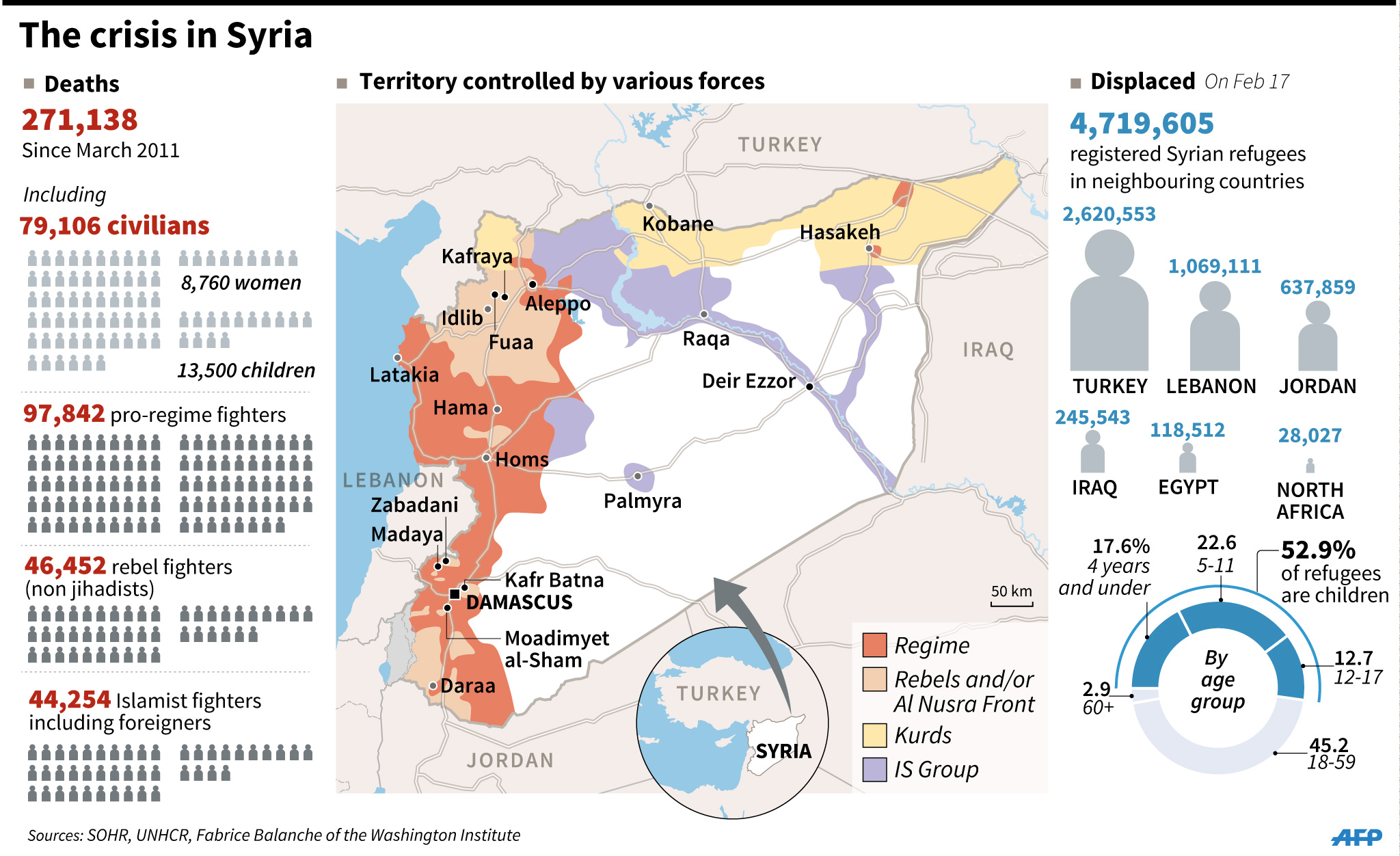
Map showing the areas controlled by the various forces on the ground, the human toll of the crisis and the number of refugees in neighboring countries from the start of the conflict through February 2016.
The first was geographical proximity: the Bekaa shares a long border with western Syria, and numerous uncontrolled crossings, particularly around the Lebanese town of Arsal, directly linked the rural areas surrounding Damascus and Homs to Lebanon. This was the quickest and least expensive route for families urgently fleeing bombardment.
The second factor was the intensity of the fighting and the scorched-earth strategy. Homs endured sieges and massive bombardments in 2012–2013 that destroyed entire neighborhoods. The fall of Qusayr to Hezbollah in 2013, followed by its joint offensives with the regular Syrian army in Qalamoun and Ghouta between 2013 and 2015 to secure the Lebanese border, triggered an immediate exodus of Sunni populations into the neighboring Bekaa Valley.
The third factor was a history of migration: since the early twentieth century, the Bekaa had welcomed seasonal Syrian agricultural workers from rural areas of their country. When war broke out in 2011, refugees therefore naturally headed for places where they already had contacts, employers and relatives, and knew the area well.
Finally, religious and local ties shaped their choice of destinations: the vast majority of refugees preferred to settle in predominantly Sunni towns and villages in the central and western Bekaa, such as Bar Elias, Saadnayel and Arsal, where local residents initially showed strong solidarity with them.
Faced with this mass exodus, the March 8 and March 14 parties refused to establish permanent official camps to accommodate the refugees, but for different reasons. The March 8 parties, and Hezbollah in particular, feared that the refugees would organize and arm themselves in these camps, as had happened in the Palestinian camps after 1948, turning them into bases from which to project force into Syria and potentially threaten Assad’s regime. The March 14 forces, meanwhile, did not want to be accused of chauvinism or xenophobia. These shortsighted policies resulted in large numbers of refugees crowding into thousands of tent settlements on agricultural land.
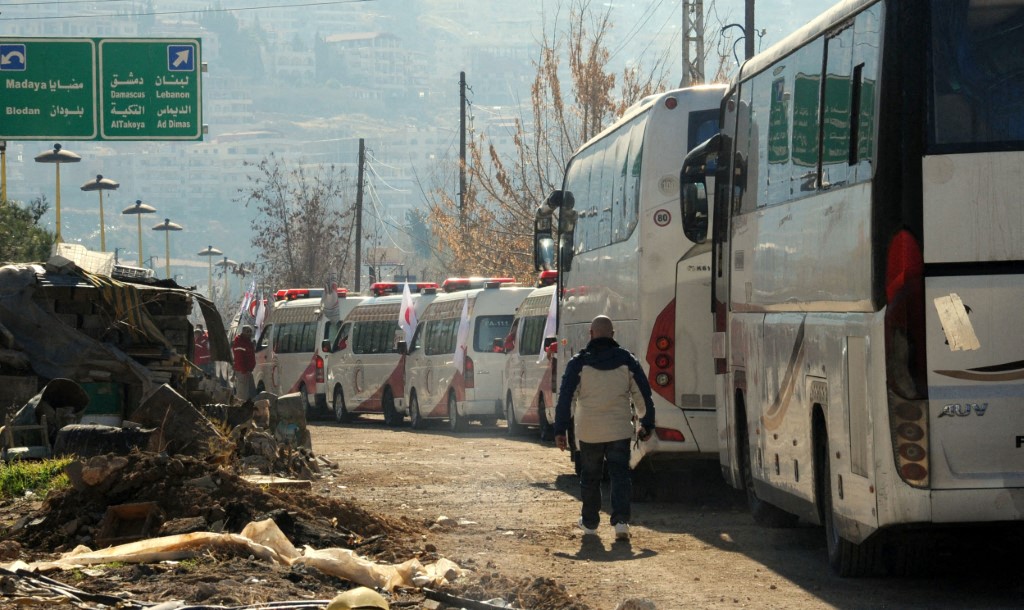
Syrian Red Crescent ambulances and buses waiting in the Syrian town of Zabadani, on the Lebanese border, for the departure of a convoy due to enter Lebanon under a UN-brokered truce, December 28, 2015. The convoy, carrying more than 120 rebels and wounded people from Zabadani, consisted of seven buses and 22 ambulances. Lebanese security forces escorted it from the Masnaa border crossing. (AFP)
Lebanon thus became a lifeline not only for the Syrian regime, through the port of Beirut, but also for the rebels in Syria, through their communities driven from their land by Hezbollah and Assad’s army.
For Hezbollah and the regime, Zabadani was a barrier that had to be broken
In June 2015, Hezbollah and the Syrian regime decided to capture Zabadani for strategic, security and political reasons. Zabadani was part of the rebel belt surrounding Damascus: its fall would ease pressure on the capital and free up forces for other fronts. The town threatened the vital Damascus–Masnaa corridor linking Syria to the port of Beirut. It also served as a base for Ahrar al-Sham and local factions, which received fighters, weapons and food there through supply routes from the Bekaa Valley. Retaking it therefore meant eliminating this rebel operational and logistical base, closing the Bekaa–Rif Dimashq corridor used by the rebels, and isolating the few remaining insurgent pockets in Qalamoun.
For Hezbollah, the stakes also included protecting the areas it controlled in the Bekaa Valley and its own routes into Syria, while curbing infiltrations and car bomb attacks against Beirut’s southern suburbs, with the vehicles being packed with explosives in Zabadani.
Prestige and deterrence were also factors. After the battle of Qalamoun, Hezbollah wanted to consolidate its gains and demonstrate its offensive capabilities, while the Syrian regime, facing setbacks in the north (Idlib) and the south, sought a symbolic victory. Finally, the siege of Zabadani became linked to that of the pro-regime Shiite towns of Foua and Kafraya in Idlib province, which were surrounded by Syrian rebels, turning Zabadani into a powerful bargaining chip.
As a geographic chokepoint, a logistical link for the rebellion and a political symbol, Zabadani brought together a range of strategic interests. Its fall would bolster the security of both the regime and Hezbollah while dealing a lasting blow to the rebel presence near the Lebanese border.
The Siege and Assault on Zabadani (July–September 2015)
On July 4, 2015, Hezbollah and the 4thAn armored division of the Syrian army, commanded by Maher al-Assad, the Syrian president's brother, launched a major offensive against Zabadani. The city was first completely encircled. Hezbollah deployed massive firepower there (artillery and guided missiles), alongside barrel bombs dropped by the Syrian air force. Despite being outnumbered, the rebels entrenched in the city center put up fierce resistance. With the ground fighting at a stalemate, Hezbollah changed strategy and turned to negotiations through its Iranian patron.
The pressure mechanism: the Foua–Kefraya equation
To force the rebels in Zabadani to surrender, Hezbollah and the Syrian regime used the geographical counterweight mentioned above: Foua and Kefraya. These two Shiite villages in Idlib province, in northwestern Syria, were then completely surrounded and under heavy bombardment by the Jaish al-Fatah rebel coalition, dominated by the al-Nusra Front and Ahrar al-Sham. Every Hezbollah assault on Zabadani triggered retaliatory rebel bombardments of the two villages. Negotiations therefore began directly between Iran, representing Hezbollah and the regime, and Qatar and Turkey, representing the rebel factions.
(to be continued)
United States vs. Iran: An Assessment and Outlook
Energy Geopolitics 2026: Oil and Gas
Red Sea and Horn of Africa: Four Possible Scenarios (6/6)
The Red Sea and the Horn of Africa: Converging Interests and Regional Rivalries (5/6)
Red Sea and the Horn of Africa: Türkiye’s Role (4/6)
المزيد من Khalil Helou
عرض الكل


المزيد في Strategia
عرض الكل


الأحدث من Levant Time
عرض الكل


