

The Red Sea and the Horn of Africa: The Shifting Balance of Power in the Middle East (1/6)
Gulf rivalries, African vulnerabilities, and prospects for regional security


The Red Sea, the Bab el-Mandeb Strait, the Gulf of Aden and the Horn of Africa form a strategic space contiguous with the rest of the Middle East. Treating them as separate theaters obscures the mechanisms through which a local war, rivalry over ports or a maritime attack simultaneously affects the Arabian Peninsula, East Africa and international trade. Stretching between the Indian Ocean and the Mediterranean, this corridor links, through the Suez Canal, economies whose interests are interdependent but whose means of protection and political priorities remain profoundly different.
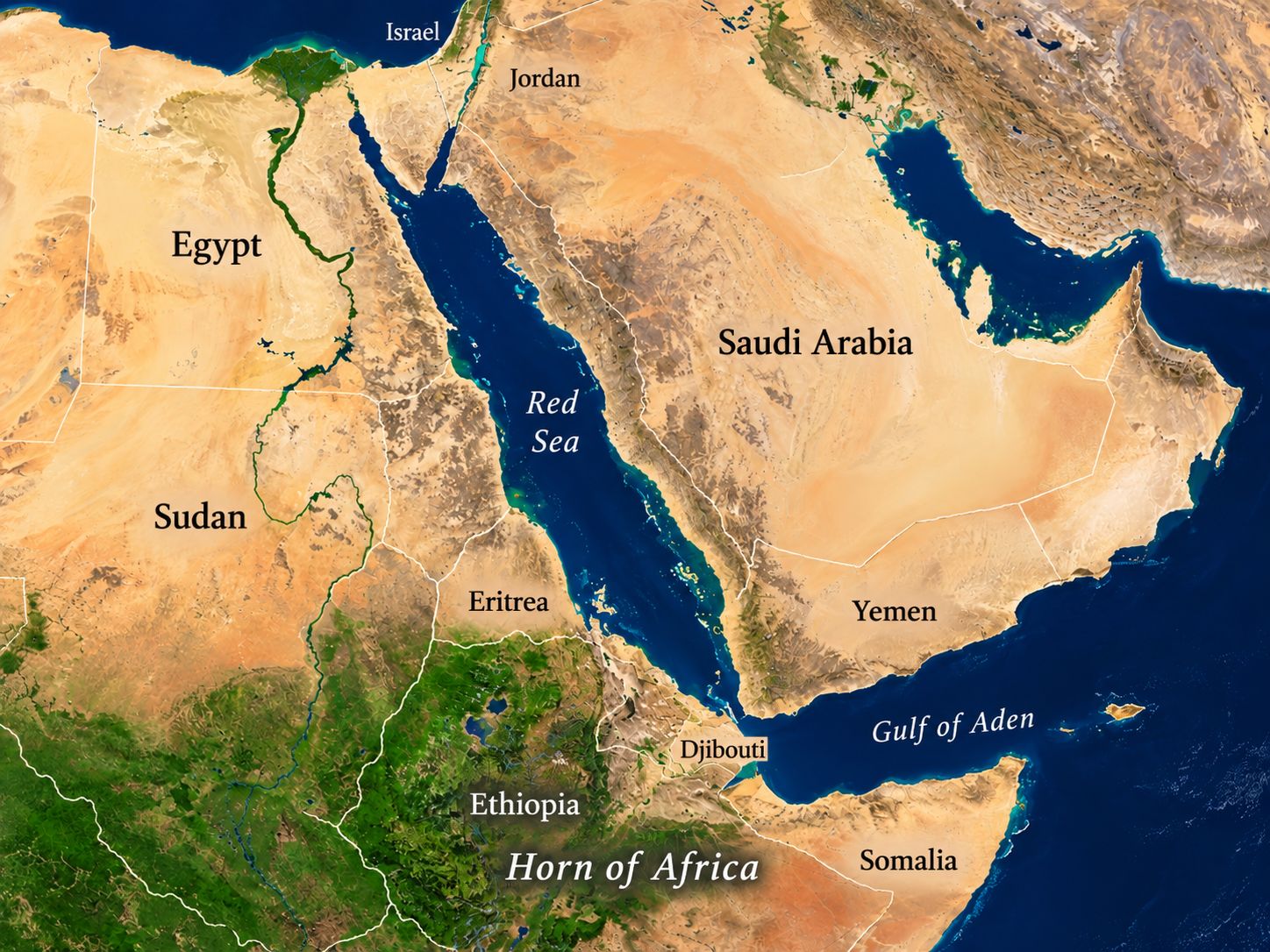
Local actors in this space include the states of the Horn of Africa and its surrounding areas—Somalia, Ethiopia, Eritrea, Djibouti and Sudan—as well as Yemen on the Arabian shore. They also include authorities and forces without state status, notably the breakaway territory of Somaliland, which claims independence from Somalia; the Houthis in Yemen, who see themselves as the state; the Rapid Support Forces (RSF) in Sudan; and the armed group Al-Shabaab in Somalia. Regional powers—Saudi Arabia, the United Arab Emirates, Egypt, Turkey, Israel and Iran—intervene through investment, diplomatic partnerships, and military and security support. Moreover, as coastal states, Saudi Arabia and Egypt are both directly affected and capable of projecting influence beyond their borders.
The importance of this strategic space extends beyond the movement of goods and hydrocarbons. For Saudi Arabia, it provides a coastal development zone and an essential supply route. For Egypt, it is crucial to the operation of the Suez Canal. For landlocked Ethiopia, it offers the prospect of overcoming its economic isolation. For the United Arab Emirates, it is part of a logistics network linking ports, markets and investments. Maritime security thus becomes the meeting point for national ambitions that only partially align.
This geographical continuity contrasts with the wave of crises sweeping the region. Yemen, Sudan and Ethiopia are ravaged by internal conflicts. The conflict that has emerged between Ethiopia and Eritrea, along with persistent insecurity in Somalia, is weakening the state institutions responsible for controlling territory and coastlines. These factors prompt outside powers to intervene in this space to protect their interests, but their competing engagements can deepen the divisions they claim to be containing.
Food and logistics drive Gulf states’ engagement
Relations between the Gulf states and the Horn of Africa are not based solely on military considerations. They are rooted in long-standing trade in livestock, meat and agricultural products. For states on the Arabian Peninsula facing severe constraints on water resources and agriculture, diversifying food supplies remains a lasting priority. For their part, the African economies involved find commercial outlets, capital and development opportunities in Gulf markets.
Investment strategies have, however, evolved. The acquisition or cultivation of land by Gulf states on the African shore of the Red Sea and in the Horn of Africa is no longer enough to guarantee food security: safe, navigable shipping routes, storage capacity, cold chains (1) and accessible ports are also needed. Agricultural projects are therefore increasingly being integrated into much broader logistics systems. Control over the infrastructure linking production areas to markets is thus becoming as important as production itself.
This transformation explains the growing convergence between economic investment and security commitments. A war can disrupt a harvest, destroy infrastructure, or render a trade corridor unusable. Investors therefore seek political guarantees, local partners, and security and military capabilities to protect their interests. Yet this carries risks: by supporting certain local actors to safeguard their investments, Gulf powers can become embroiled in their partner countries’ internal conflicts.
Yemen: A Strategic Pivot and the Epicenter of Persistent Maritime Insecurity
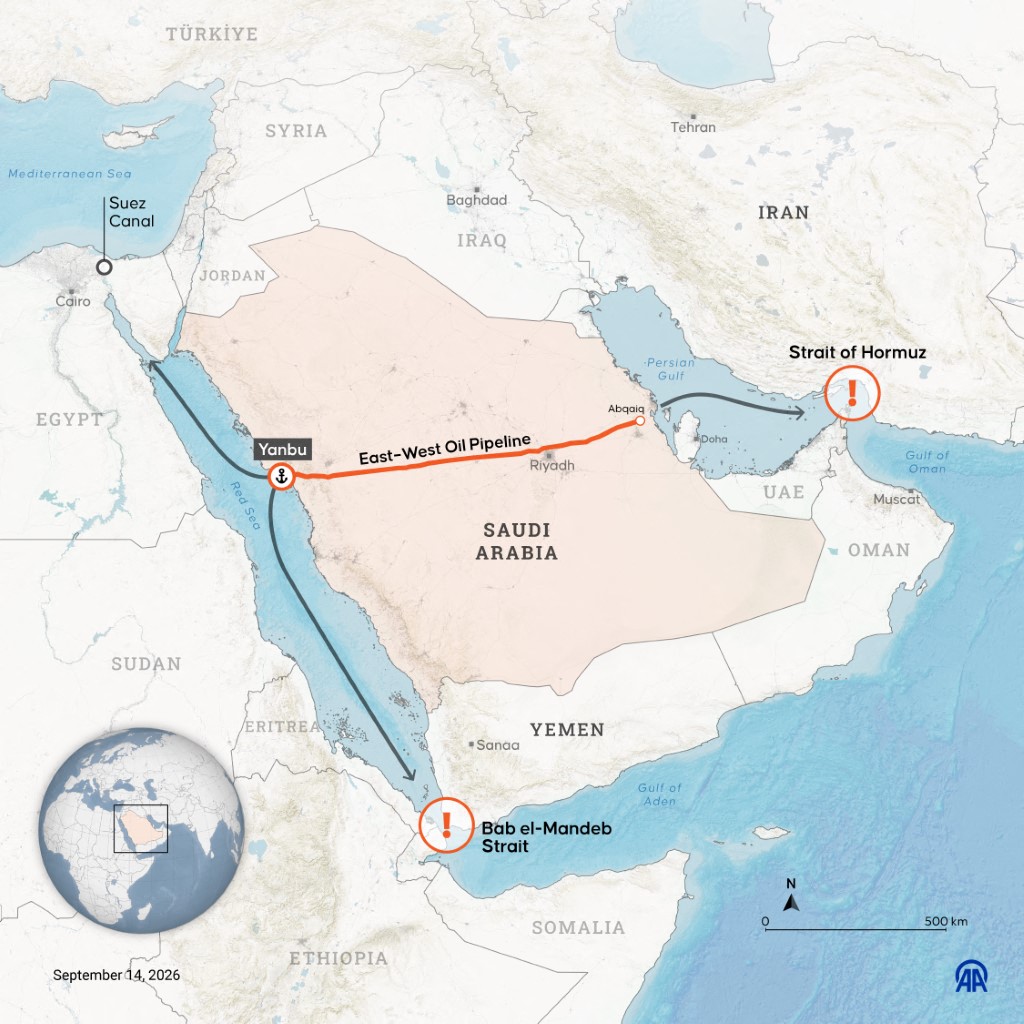
Yemen’s geographical position makes it a pivotal link between the Red Sea, Saudi Arabia, the Middle East, and international shipping, placing it at the center of a complex interplay between territorial conflict and international security. The current war illustrates this reality perfectly: the strike capabilities of the Iranian-backed Houthis allow them to threaten international shipping and impose substantial economic costs on global actors without requiring full territorial control of the Bab el-Mandeb Strait. The distinction here is crucial: the ability to disrupt a maritime passage is not the same as exercising sovereignty over it or being able to keep it closed for an extended period. The Strait of Hormuz offers another example.
The Houthis’ seizure in September 2026 of Yemen’s Red Sea coast and strategic islands in the heart of the Bab el-Mandeb Strait, followed by their recapture in a counteroffensive by Yemeni government troops and their allies, has placed this vital corridor at the center of instability that looks set to persist. Repeated attacks on Saudi oil facilities and airports, as well as military camps and airports in southern Yemen, could at any moment expand to target international shipping at Iran’s urging, forcing changes to trade routes, sharply increasing insurance premiums, and complicating global supply chains. Such actions would undoubtedly affect the Suez Canal and ports in the eastern Mediterranean, including Beirut and Haifa.
For Riyadh, the challenge is immense: protecting its borders and maritime interests while avoiding an open-ended military quagmire. For example, the deadly Houthi ballistic missile strikes on the Shabwa camp on October 20, which killed more than 50 young Yemeni army recruits and wounded 200, prompted an immediate aerial response from the Saudi-led coalition. Without these repeated airstrikes, the Houthis would undoubtedly have gained broader control over the eastern coast of the Red Sea, adding another dimension to Iranian influence. Moreover, Saudi campaigns confined to naval and air operations may reduce some immediate threats to the kingdom’s security, but they do nothing to address the deep-rooted political causes of a conflict that is spreading across the region.
The current instability, described by the United Nations as a return to “all-out war,” now extends beyond Yemen and forms part of a broader regional security crisis affecting freedom of navigation and economic activity in the Gulf. Restoring stability to Red Sea shipping therefore remains closely tied to the prospects for a political settlement in Yemen. As of October 2026, those prospects seem more remote than ever, fostering defensive solidarity among several regional and international powers without erasing their fundamental differences over the conduct of the war.
(to be continued)
1. Cold chains, which are designed to preserve meat and perishable foods, require cold storage facilities throughout the supply chain, particularly on farms, in slaughterhouses, at export ports, aboard cargo ships, and at import ports.
Hezbollah-Israel: An Endless War in Whose Interests? (20)
The Trump-Xi Summit: Between Pragmatism and Necessity
The Conflict in Yemen: Geopolitical and Strategic Considerations
Yemen: The Mecca Pact Moves from Theory to Military Action
Hezbollah-Israel: An Endless War in Whose Interests? (19)
More from Khalil Helou
View All


More in Strategia
View All


Latest from Levant Time
View All


