

In Beirut as in Baghdad, Iran’s Proxies Continue Their Obstruction
“Hezbollah’s weapons serve regional agendas and are not intended to defend Lebanon,” Joseph Aoun stresses.

Are we witnessing what English speakers call a buildup intended to pave the way for a “major strike”—a large-scale operation, military or otherwise—whose ultimate aim would be to eradicate, or at least decisively cripple, the Iranian mullahs’ regime, rightly described by President Donald Trump as the orchestrator of terrorism worldwide?
It would be presumptuous at this stage to make any firm assertions on the matter or offer a definitive answer to such a question. Yet serious questions inevitably arise in light of the rapidly unfolding developments, concrete events, media revelations, increasingly forceful statements and decisive initiatives taken at the highest levels of government in several countries around the world.
In the wake of this striking buildup, President Joseph Aoun minced no words in an interview with an Iraqi television channel, openly condemning the course Hezbollah has pursued for years, particularly since it took it upon itself to launch two successive wars against Israel to “support” Iran’s strategic objectives in the region.
“Hezbollah’s weapons serve regional agendas, not the defense of Lebanon,” the head of state declared bluntly, even going so far as to say that “the Shiite community can no longer tolerate Hezbollah’s behavior.” Putting his cards on the table, he added: “We have decided that the state must have a monopoly on weapons. Any arms shipment belonging to Hezbollah or any other organization will be seized by the security services. The wars fought in support of Gaza and Iran failed to achieve their objectives and became a burden on Lebanon, while also leading to the occupation of our territory (…). A monopoly on weapons is essential to building the state. A country can no longer move forward with two armies and two competing centers of authority over state decisions.”
Washington hardens its tone toward Hezbollah
The US ambassador to the United Nations, Mike Waltz, was equally firm following his meeting on Tuesday with Parliament Speaker Nabih Berri. “Bringing all weapons under state control is not an option; it is the only way forward,” the US ambassador said, adding bluntly: “The cancer that is Hezbollah has infected the great nation of Lebanon. This cannot continue”…
The severity of this “cancer” was highlighted on Tuesday by revelations from the Saudi-aligned Arabic-language channel Al-Hadath, which reported that the five Hezbollah operatives detained a few days earlier in the mountainous hinterland of Batroun had been conducting reconnaissance to plan security incidents targeting villages in Bsharri whose residents are sympathetic to the Lebanese Forces.
The channel said the five Hezbollah suspects were carrying documents indicating that Hezbollah was preparing provocations targeting Lebanese Forces supporters in the mountainous area in question.
In Iraq, too…
The problem posed by the expansionist strategy of destabilization developed over the years by the Iranian mullahs’ regime is, of course, not confined to Lebanon. For several days now, Iraq has been the scene of a dangerous standoff between the government led by Ali al-Zaidi and Kataib Hezbollah, a militia beholden to the Islamic Republic of Iran that, as its name suggests, is the Iraqi counterpart of Lebanon’s Hezbollah.
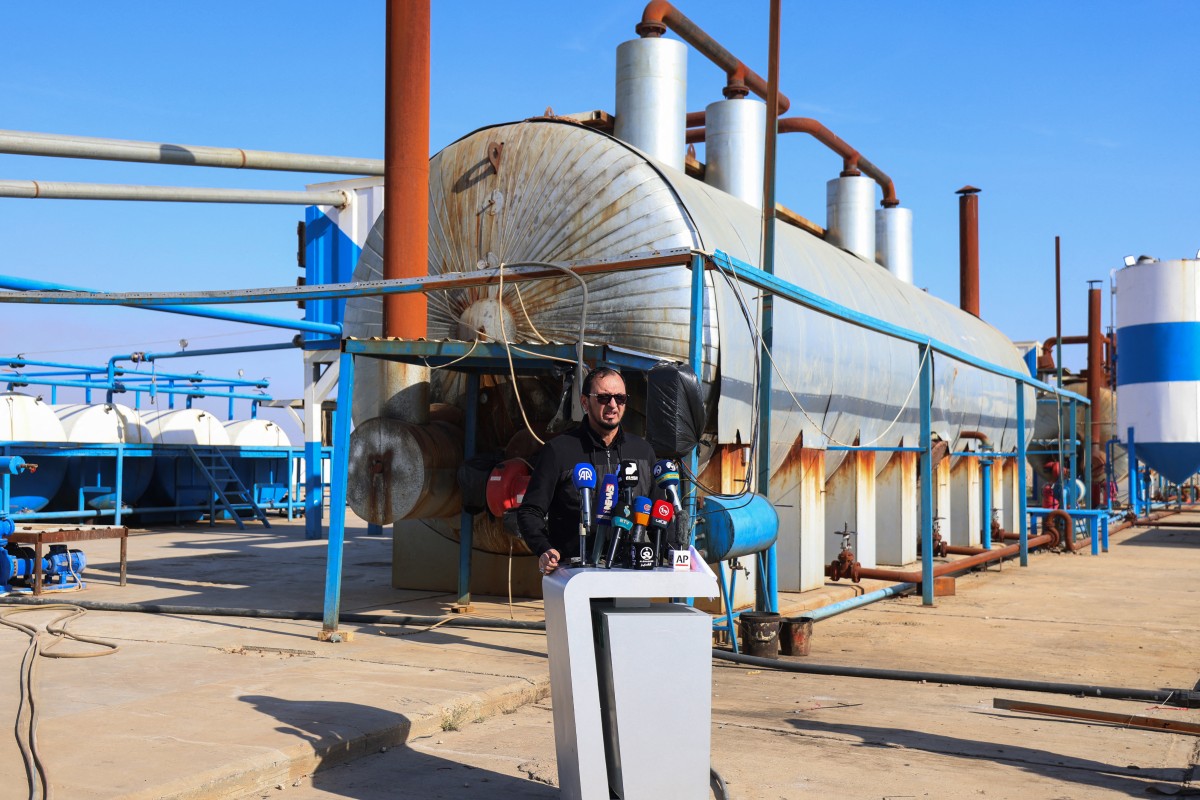
Abu Taleb al-Saidi, a commander of Iraq’s Kataib Hezbollah, speaks at a press conference at an oil facility in the group’s stronghold of Jurf al-Sakhar. The Iraqi government announced that an investigative commission had confirmed oil smuggling in the area, an allegation denied by the pro-Iranian armed group. (AFP)
Tensions between the two sides recently came to a head when the central government discovered that Iraqi Hezbollah was illegally extracting oil in its stronghold of Jurf al-Sakhar, where it has exercised absolute control for several years, beyond any state oversight. The pro-Iranian group is smuggling the diverted oil out of Iraq on a large scale, presumably to Iran.
In response to these extensive smuggling operations, Ali al-Zaidi’s government issued an ultimatum to Kataib Hezbollah, giving the pro-Iranian party until Friday evening to withdraw from Jurf al-Sakhar. State security forces are to deploy there, bringing Iranian influence in the area to an end.
But the Shiite group, which answers to Tehran, refuses to leave the area. It has also reiterated its refusal to surrender its weapons to the state, as required under the government’s plan for the comprehensive disarmament of all Iraqi militias, most of which are close to the Islamic Republic.
Kataib Hezbollah’s obstructionist stance, which unsurprisingly mirrors that of Lebanon’s Hezbollah—as their shared theocratic Khomeinist ideology would suggest—was sharply condemned on Tuesday by the Iraqi president. His forceful remarks were essentially in line with statements by President Joseph Aoun. “We will not accept a state within a state,” the speaker of the Iraqi parliament declared in response to Kataib Hezbollah. “No armed force can stand above the law, and no one may act in violation of the law and the Constitution.”
The immediate catalyst for this showdown between the government and the pro-Iranian party is undoubtedly the oil smuggling carried out by allies of the mullahs’ regime.
The issue is critical for the central government, which derives nearly 80 percent of its revenue from oil exports. But the real stakes extend beyond economics and are fundamentally strategic: ultimately, this is about the Islamic Republic’s influence in Iraq and, by extension, across the region.
Shenzhen Summit: Three Giants, Four Platitudes And A Photo
Multinational Pushback Against Tehran’s Tentacles
The Saudi-Yemeni Front May Soon Reach Its Breaking Point
Washington and Tehran: Neither War Nor Peace, For How Long?
From Tehran to Beirut, the Iranian Axis Seeks to Legitimize its Grip on Lebanon
المزيد من Michel Touma
عرض الكل


المزيد في Decryption
عرض الكل


الأحدث من Levant Time
عرض الكل


