

The Abolition of the Death Penalty: Ibrahim Najjar and Élie Keyrouz’s Long Fight
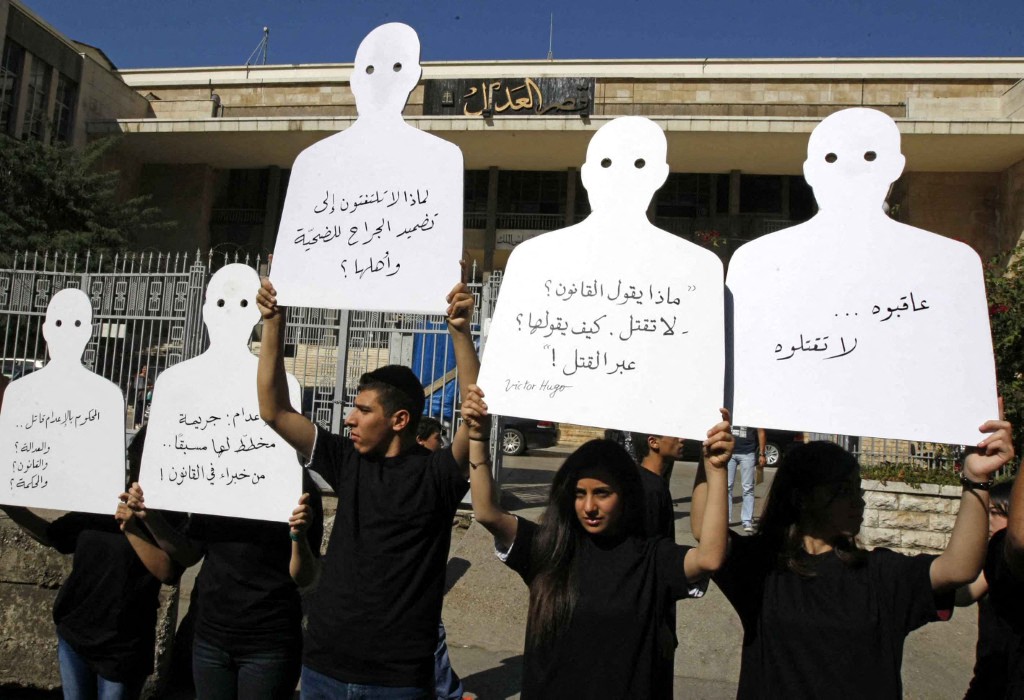

The abolition of the death penalty in Lebanon is not the result of steps taken in 2026. It is the culmination of a long political and legal process, marked by successive initiatives, deadlocks and years of debate. Two figures in particular led this fight: former Justice Minister Ibrahim Najjar and former MP and Lebanese Forces executive council member Élie Keyrouz.
For Najjar, it all began in 2008, when he was appointed justice minister. As for Keyrouz, his campaign notably took shape through a bill he submitted in 2012. It would be 14 years before Lebanon finally abolished capital punishment. Much would change between these two milestones, in 2008 and 2012, but their convictions would remain unchanged.
When Najjar was being considered for a government post in 2008, he asked for the Justice Ministry, in keeping with his legal background. Upon taking office, the chief clerk handed him a file bearing the signatures of former officials and asked him to sign off on the execution of 17 people sentenced to death.
“My reaction was immediate: ‘Thou shalt not kill.’ I told him, ‘No, I’m not signing.’” Najjar stresses that he was unequivocal.
He then called Judge Chucri Sader, who was then head of the Legislation and Consultation Department at the ministry – and had previously been his student – and asked him to draft a bill abolishing the death penalty. “The next day, I had it in my hands.”
Yet this decision did not come from a longtime activist committed to the “abolitionist” cause. Najjar says he had never been a human rights activist. Until then, the issue of capital punishment had seemed relatively abstract to him. His philosophical, literary and legal education had nevertheless made him receptive to Emmanuel Mounier’s ideas on personalism and the supreme dignity of the human person.
“I had never imagined that I would be confronted with such a decision as soon as I took office,” he says.
His bill called for the death penalty to be commuted to life imprisonment with hard labor. At the time, he did not even know how many people sentenced to death were being held in Lebanese prisons. He only knew that 17 executions were being considered.
A Philosophical and Personal Conviction
His position soon went beyond the legal question. “It was a philosophical and personal conviction, quite apart from religion,” Najjar says. “I don’t think I could ever have made the decision to execute someone. I could not imagine one person sentencing another to death, in Lebanon or anywhere else. For me, it was an absolute conviction.”
That conviction also brought him face to face with the most difficult question: what should be done when the person sentenced to death has committed a particularly serious crime?
Najjar says he reflected on the horror of executing a person. “I could not imagine putting someone to death, whatever the reason,” he says.
He did not yet know that this decision would lead him to join the international abolitionist movement. He gradually discovered the breadth of the debate in Europe and elsewhere in the world, as well as the role played by states and international organizations in advancing the abolition of the death penalty.
In Lebanon, however, winning support was far from a given.
Najjar presented his position to his political allies, including the Lebanese Forces, and secured the backing of the party’s leader, Samir Geagea. With that support, he convened representatives of the various parliamentary blocs and held three meetings in an effort to rally MPs behind his bill.
He soon discovered that views were far from uniform. His predecessor as justice minister, Bahige Tabbara, supported the death penalty, as did former Prime Minister Salim Hoss, although Hoss had refused to personally sign an execution order, leaving it to his deputy prime minister, Michel Murr, to do so instead. “For me, if you oppose an execution, you have to stand by that opposition to the end,” Najjar says.
He knew, however, that Druze leader Kamal Joumblatt supported abolishing the death penalty. He later discovered that other prominent figures had already championed the cause. The debate also had deeper and more painful roots: in 2004, under President Émile Lahoud, two men sentenced to death were publicly executed in Baabda.
The Lack of Support
Najjar therefore presented his bill to the various parliamentary blocs and asked them to support it. But, he says, what characterized the debate was not open opposition so much as a lack of support. “Most of the Muslim blocs told me they would study the issue and seek the views of the mufti or other religious authorities,” he adds. “So I did not secure broad support. Most of the Christian blocs backed the initiative, as did the Druze.”
The debate then moved into the public arena. On October 10, International Day Against the Death Penalty, the French Embassy, under the late Ambassador Denis Pietton at the time, invited him to speak. Najjar declared that he would never sign a death sentence or carry out the execution of anyone sentenced to death.
That was when he realized that his position would bring him into contact with abolitionist movements, international organizations and several states.
A few days later, a high-level Spanish delegation asked to meet with him. Najjar initially assumed it wanted to discuss the Special Tribunal for Lebanon (STL), which was then dominating the news. Instead, the delegation asked him about his position on abolishing the death penalty. It had previously met with President Michel Sleiman, Parliament Speaker Nabih Berri and Prime Minister Fouad Siniora on the same issue.
Najjar later learned that President Sleiman had refused to support the abolition of capital punishment, citing, among other reasons, crimes committed by terrorists against Lebanese soldiers in Tripoli’s main square. Fouad Siniora, for his part, reportedly invoked Islam’s position on the death penalty. Berri, meanwhile, reportedly said that if Parliament passed a law abolishing capital punishment, he would accept it, without expressing his own personal position. “That was when I realized just how difficult it would be to get my bill passed,” Najjar recalls.
The International Experience
The context surrounding the Special Tribunal for Lebanon also contributed to shaping his thinking. Najjar says he learned that, when the STL was being established, France and the United Nations had insisted that the tribunal not apply the death penalty provided for under Lebanese law.
“That gave me a great deal to think about,” the former minister recalls. “In the case of Rafic Hariri’s assassination, Lebanon had agreed that the tribunal would not be able to impose the death penalty provided for under its laws.”
At the same time, the issue was raised with him directly in the Council of Ministers. Hezbollah’s representative in the government, Mohammad Fneich, challenged him over his refusal to sign an execution order. “Mr. Minister, how can you allow yourself not to sign an execution when the law provides for it? You are obliged to enforce the law,” Mohammad Fneich told him. Najjar’s response was unequivocal: “I will not sign, whatever the consequences.”
The bill was ultimately not adopted. Najjar describes the response in terms of “a lack of support” and criticism rather than any real confrontation. “The bill was, in a sense, dead, but it had existed and it had raised the question,” he notes. But that first battle did not end with his departure from the ministry. A few days after the Spanish delegation’s visit, Spanish Prime Minister José Luis Rodríguez Zapatero invited him, at the request of Federico Mayor and Robert Badinter, to join the International Commission Against the Death Penalty.
He accepted and joined the commission alongside, among others, Badinter, Mayor and Mohammad Bedjaoui. He gradually became one of its senior officers and is now its vice president.
The international experience also changed the way he viewed the issue. “Over time, I came to understand that the death penalty was at once a political, legal, humanist and humanitarian issue.”
In this regard, he notes that capital punishment can be used by some nondemocratic regimes as a means of governing through fear, targeting opponents or other groups. He studied the practices of several countries, including Syria, Iran, Egypt, Japan, China and the United States. He also observed that some Muslim countries may want to abolish the death penalty but fear that such a decision would be seen as a repudiation of their traditions.
Even so, he considers the international shift irreversible. More than 145 countries have now abolished the death penalty in law or in practice. “In my view,” he says, “abolition should meet the same fate as slavery did in the 19th century: it must be abolished everywhere.” In this regard, he recounts trying to travel to Iran to argue for this position. “They always refused to receive me. They did so politely, certainly, but they refused.”
Élie Keyrouz’s Initiative
In Lebanon, meanwhile, other figures continued the fight. Among them was Élie Keyrouz, a former MP and member of the Lebanese Forces’ executive council, who introduced a bill to abolish the death penalty in his own name and on behalf of the Lebanese Forces parliamentary bloc. He had also sent the media a written statement on March 4, 2009, explaining why the penalty should be abolished, before submitting another bill on March 6, 2012.
For Keyrouz, the initiative was not prompted by any particular political, social or legal circumstances. It was rooted in a fundamental principle: the death penalty violates the right to life, which he considers “an absolute and immutable right.”
He also invoked the Lebanese Constitution, the Universal Declaration of Human Rights, developments in international law and the philosophy of punishment. Another argument was, in his view, essential: once a condemned person has been executed, a miscarriage of justice can never be corrected.
“Abolishing the death penalty remains fundamental to justice, because we do not believe in a justice that tortures and kills,” he stresses.
His thinking was also shaped by his Christian conception of the human person. “I started from the Church’s understanding of the death penalty, which stems from its view of the human being,” he explains, arguing that a person retains a dignity that cannot be reduced to the crime they have committed.
For Keyrouz, abolition was also intended to help modernize Lebanese law and bring it into line with international developments.
But another 14 years would pass before the initiative finally came to fruition. “We were 14 years behind, and we are behind in everything we do,” Élie Keyrouz says. He recalls that the bill remained for years before Parliament’s Administration and Justice Committee, awaiting placement on the agenda of a plenary session.
Keyrouz cites the example of France, where the death penalty remained in place for two centuries before being abolished in 1981 under François Mitterrand, on the initiative of then-Justice Minister Robert Badinter. “Why this delay?” Badinter had asked French MP’s.
For Keyrouz, the question resonates today with Lebanon’s own experience. In 2026, the process finally reaches its conclusion.
A Combination of Influences
Najjar describes the abolition of the death penalty as “almost a miracle.” In this context, he stresses that the amnesty adopted in Lebanon was not sufficient on its own. “It had to be accompanied by the abolition of the death penalty, because once a death sentence has been handed down, it cannot simply be covered by a general amnesty.”
He sees the reform’s eventual success as the result of “a combination of influences”: the government, the justice minister, associations and the various actors who had worked on the issue over the years.
For him, the role played by Parliament’s Administration and Justice Committee was one of the most significant moments in this final stage. The president of the Beirut Bar Association had asked him to represent the bar in Parliament. Najjar attended the committee meeting and, he says, was surprised to discover a level of unanimity that had seemed almost unimaginable to him.
“I was surprised to see that the miracle was happening: the roughly 40 MPs and other figures present were unanimously in favor of abolition,” Najjar recalls. “I cannot tell you how happy and delighted I was…”
On June 1, while in Madrid for a meeting of the International Commission Against the Death Penalty, he announced to his colleagues that the abolition of capital punishment in Lebanon was imminent. It was eventually enacted and published in the Official Gazette.
Najjar also points with satisfaction to the fact that he had asked for Article 1 of the law to use the wording chosen by Robert Badinter in France in 1981: “The death penalty is abolished.” For him, one further step remains: enshrining the abolition in the Constitution.
Meeting Pope Francis
The legislative victory did not, however, bring his fight entirely to a close. Najjar also reflects on the sentence that comes in place of capital punishment and criticizes the introduction of life imprisonment without parole.
This issue brings him back to another important moment in his international career: his meeting with Pope Francis at the Vatican in December 2019, in the presence of a delegation that included heads of government, presidents and former justice ministers.
Najjar recalls two things in particular from the 50-minute meeting. The first was the Catholic Church’s support for abolishing capital punishment and the pope’s decision to instruct that the abolition of the death penalty be incorporated into the Catechism. The second was a discussion about life imprisonment without parole. For Pope Francis, Ibrahim Najjar recalls, when a person is sentenced to a life term from which they can never be released, the possibility of redemption disappears. The sentence can then become, in a sense, a form of civil death.
It is on this basis that Najjar is now calling for life imprisonment without parole to be removed from Lebanese law. In his view, abolishing the death penalty does not mean doing away with punishment. It reflects a different conception of justice: punishing crime without permanently taking a person’s life and without closing off any possibility of rehabilitation.
Keyrouz shares this view of abolition as a step forward for civilization. He now believes that Lebanon should show other Arab countries that a state can abolish capital punishment without giving up on justice.
Najjar, for his part, believes that the fight he began in 2008 has finally reached its culmination, without erasing the years of criticism and resistance along the way.
“I never backed down or hesitated,” Najjar says. “For me, abolishing capital punishment is a civilizational achievement, and Arab countries must now follow our example.” He refers to a recent invitation to travel to Malaysia and meet with the prime minister to present the Lebanese experience.
But former minister Najjar also wants to emphasize that those who championed the cause over the years are not limited to those now standing at the finish line. “The good has been done, and I am very proud and happy about it,” he says. He adds: “One day, history will know whom to remember.”
His thoughts finally turn to the criticism he faced over the years. He says, in particular, that he was criticized by people close to Raymond Eddé, whose position on the death penalty was different.
But, he notes, attitudes have changed profoundly. “A lot has changed over the past 75 years,” he says. “We have come to understand that the death penalty can be used as a means of governing and concealing the shortcomings of those in power.” He sums up, in a few words, what has remained at the heart of his commitment since that day in 2008, when he refused to sign off on the 17 executions: “We must not confuse governing with killing. We must have the courage to govern well, and the courage not to kill.”