

In Search of Lebanon, from Beirut to the Vatican
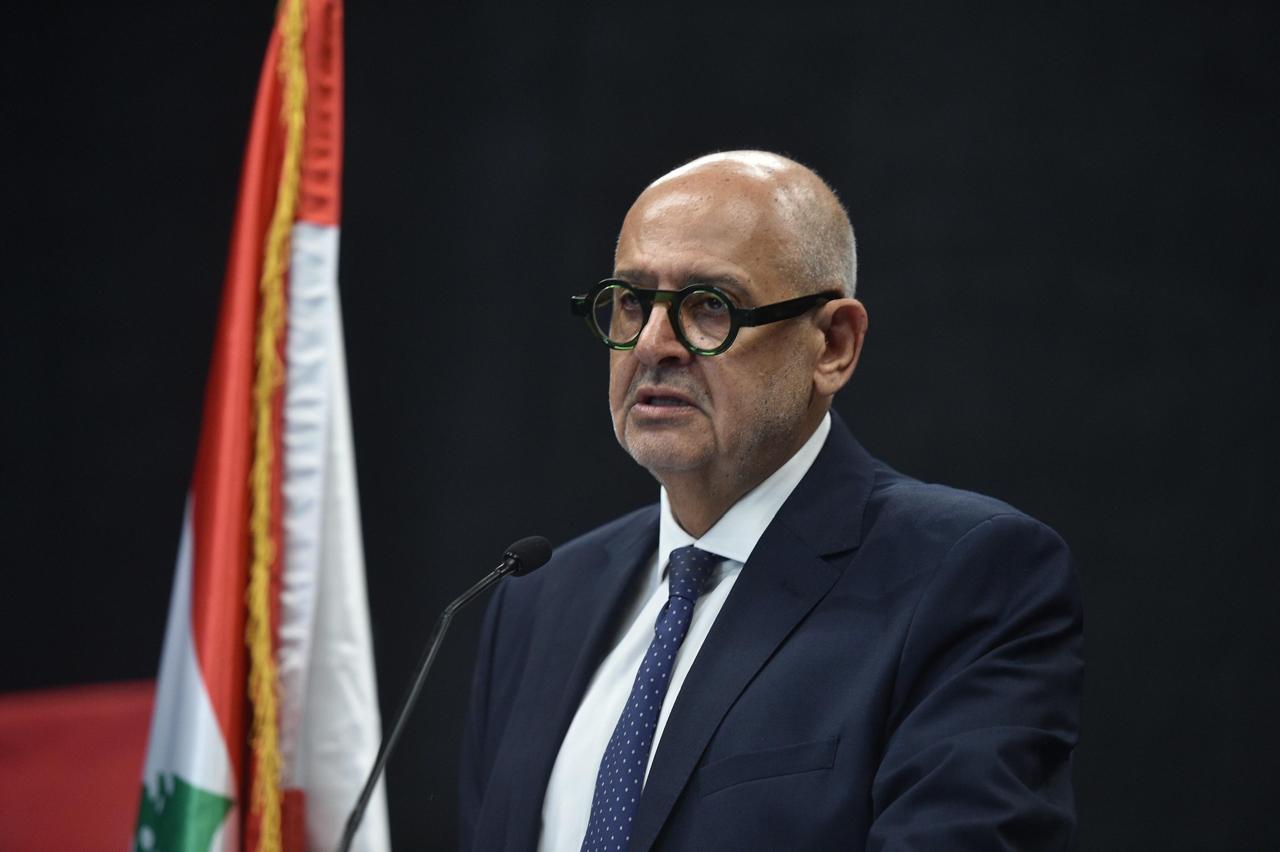
Some journeys end when you return to the airport. Others truly begin only after you come back.
Weeks have passed since our visit to Rome, yet many details have stayed with me.
It was a short visit, but it made me look at Lebanon from a different distance.
Who Opened Rome’s Doors to Us?
Behind this visit was an effort that deserves to be acknowledged.
Bernard Selwan Khoury and Jessie Karam played a central role in organizing the meetings and opening doors for us in Rome, through a program that was not merely a series of protocol appointments, but an attempt to bring a different Lebanese voice into academic, political and Vatican circles.
Through COSMO Monitor, the main stop began on September 8 at LUISS University, with a seminar titled “Lebanon in Transition: Perspectives on the Country’s Future,” under the patronage of the Med-Or Italian Foundation. Political meetings then followed in Rome and at the Italian Chamber of Deputies, culminating at the Vatican.
The importance of what Bernard and Jessie did lay not only in arranging the meetings, but in giving us the opportunity to say directly, and without intermediaries, what we believe the outside world needs to hear about Lebanon.
We went carrying a great deal of Lebanon in our bags.
We carried the South and its wars, the state we dream of but have so far failed to complete, the weapons that have become present in every discussion about the country’s future, and the fear that Lebanese Shiites might be reduced, in the eyes of the outside world, to a single image, as though millions of people shared one opinion and one political choice.
Above all, we carried the desire to say that there is another Lebanon, one that does not always appear on the news.
At LUISS: How Do Others See Us?
At the seminar, I watched the audience as much as I listened to the speakers.
What do these people know about Lebanon? What do they see when they hear its name?
War? Hezbollah? Israel? Iran? Collapse? Or do they still see a country that can be saved?
There, I rediscovered something we forget while immersed in Beirut’s daily disputes: the world does not live the details we live.
From the outside, the picture is more condensed and harsher.
There is a state that is supposed to decide, an army that is supposed to protect, and institutions that are supposed to govern. And opposite them, there are weapons and military decision-making outside those institutions.
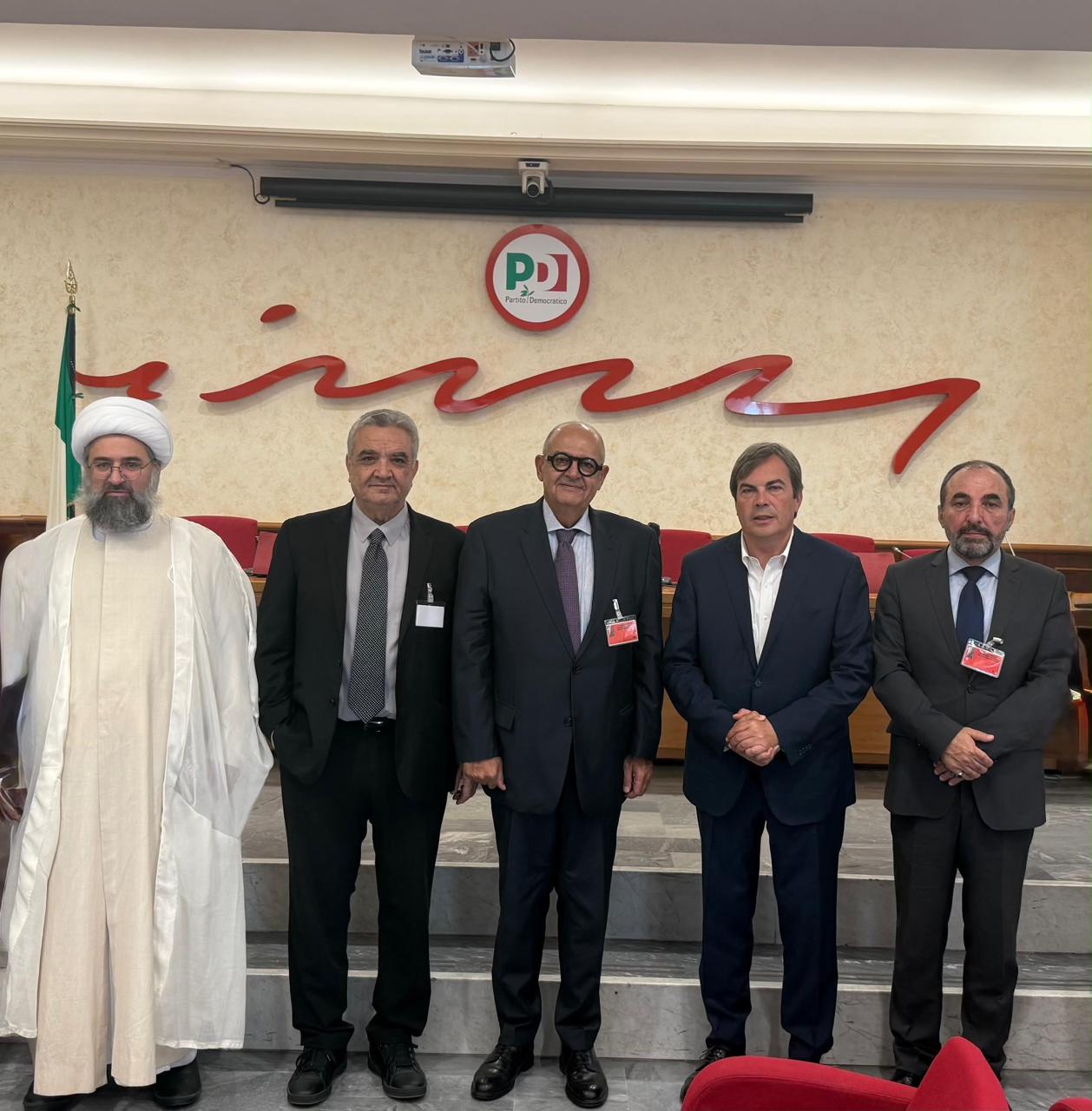
Hence the simple question:
Who decides in Lebanon?
We did not go to Rome to say that Shiites are against Hezbollah. That would not be true.
Nor did we go to claim that we represent the Shiite community. No one has the right to monopolize an entire community, neither us nor anyone else.
We went to say that Lebanese Shiites are not a single bloc, that among them are people who want a full state rather than half a state, and who believe that protecting Shiites does not mean isolating them from their country, but bringing them back to the heart of the national project.
Hence the phrase that accompanied us:
“We are Lebanese before we are Shiite.”
At the Italian Chamber of Deputies
During our political meetings, especially at the Italian Chamber of Deputies, it was clear that Lebanon continues to attract attention despite all the crises and wars occupying the world.
What was striking was the convergence between supporters of Prime Minister Giorgia Meloni and her opponents whenever Lebanon was mentioned, despite their deep and substantial disagreements.
But this interest was not sentimental.
No one told us that the world would come and save Lebanon.
And that is a good thing.
It is time we stopped waiting for others to build the state we have failed to build ourselves.
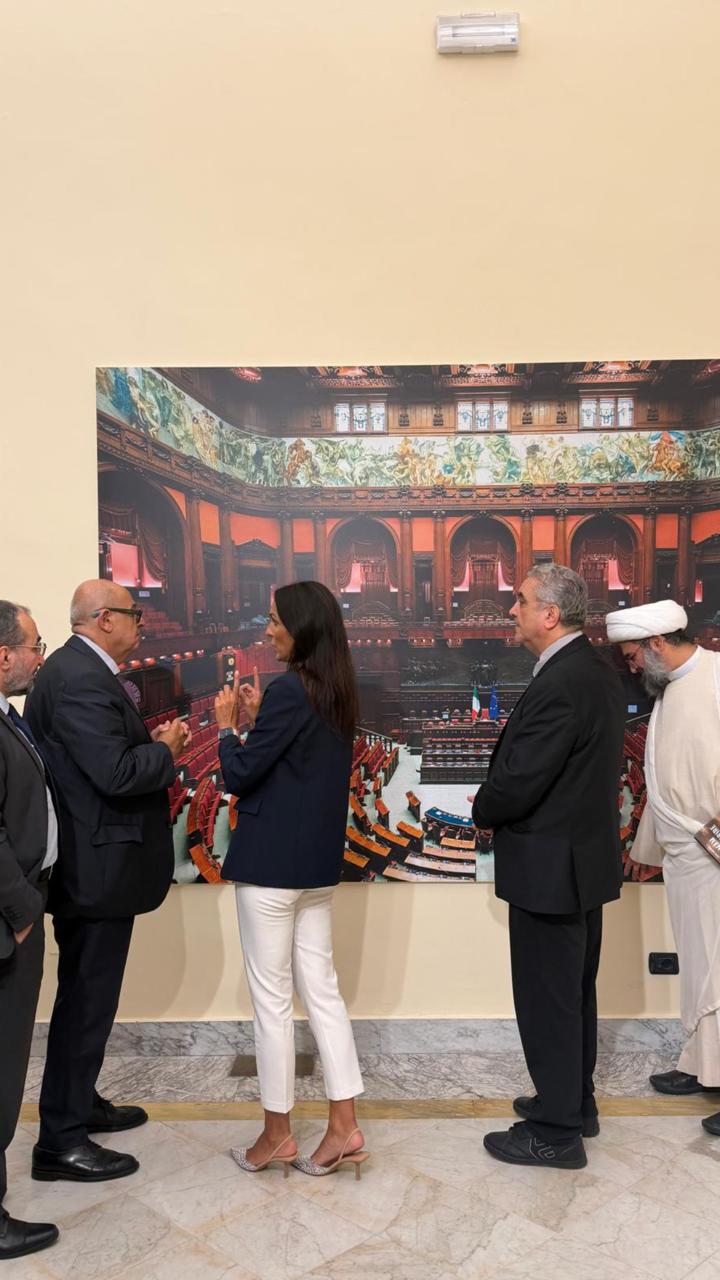
What became clear from the discussions was that Lebanon is now viewed within a broader regional and international picture: Iran, Israel, the Mediterranean, Europe, security, migration, peace, and the transformations reshaping the Middle East.
And therein lies the danger.
The world is moving quickly. If Lebanon does not find its place in these transformations, others will not stop and wait for us to settle our differences.
“Blessed Are the Peacemakers”
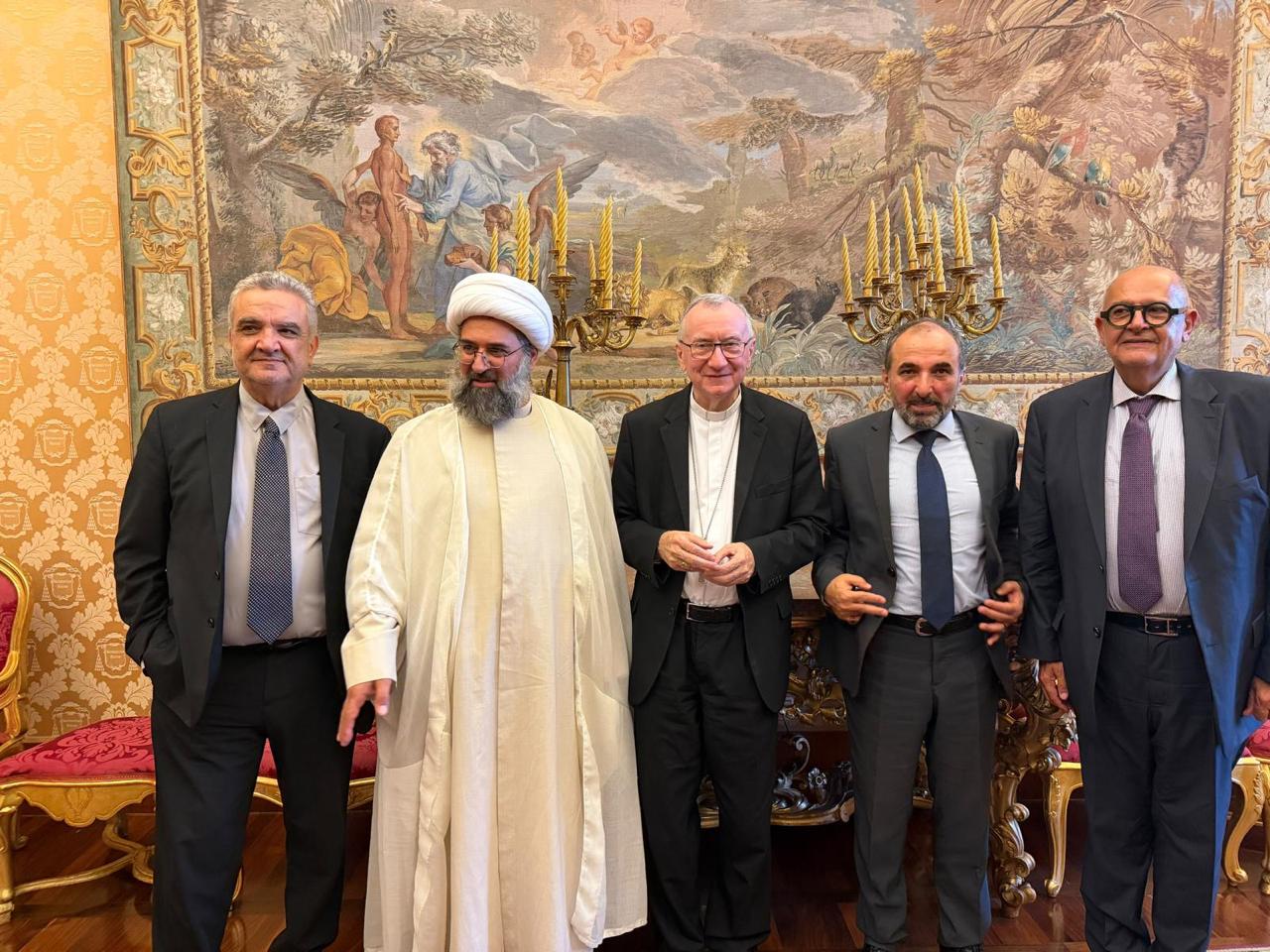
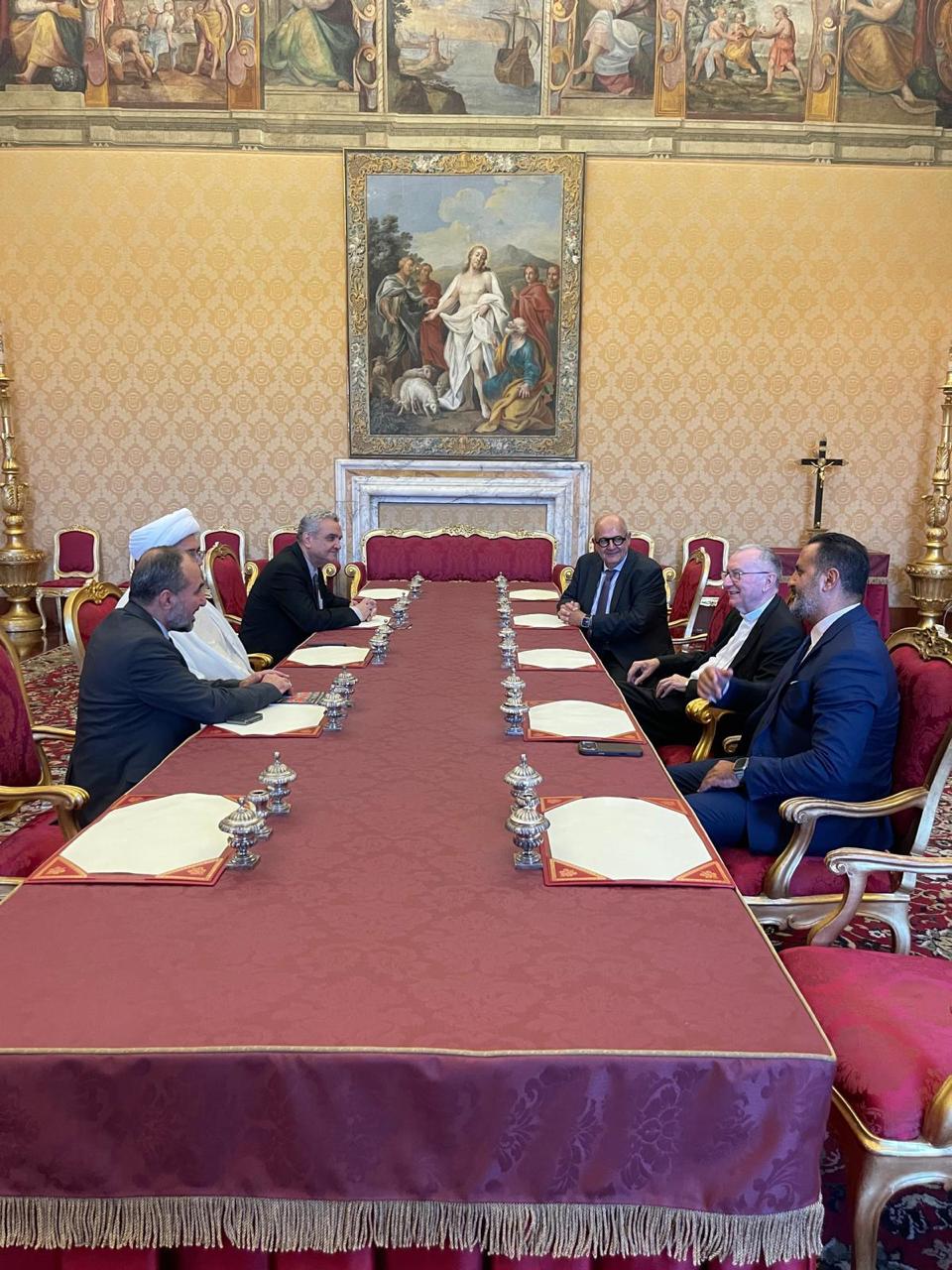
From the right: Jad Akhawi, Sayyed Ali al-Amine, Cardinal Pietro Parolin, Sheikh Mohammad Ali al-Hajj al-Amili, & Dr. Wajih Kanso.
Then came the Vatican.
There, the feeling was different.
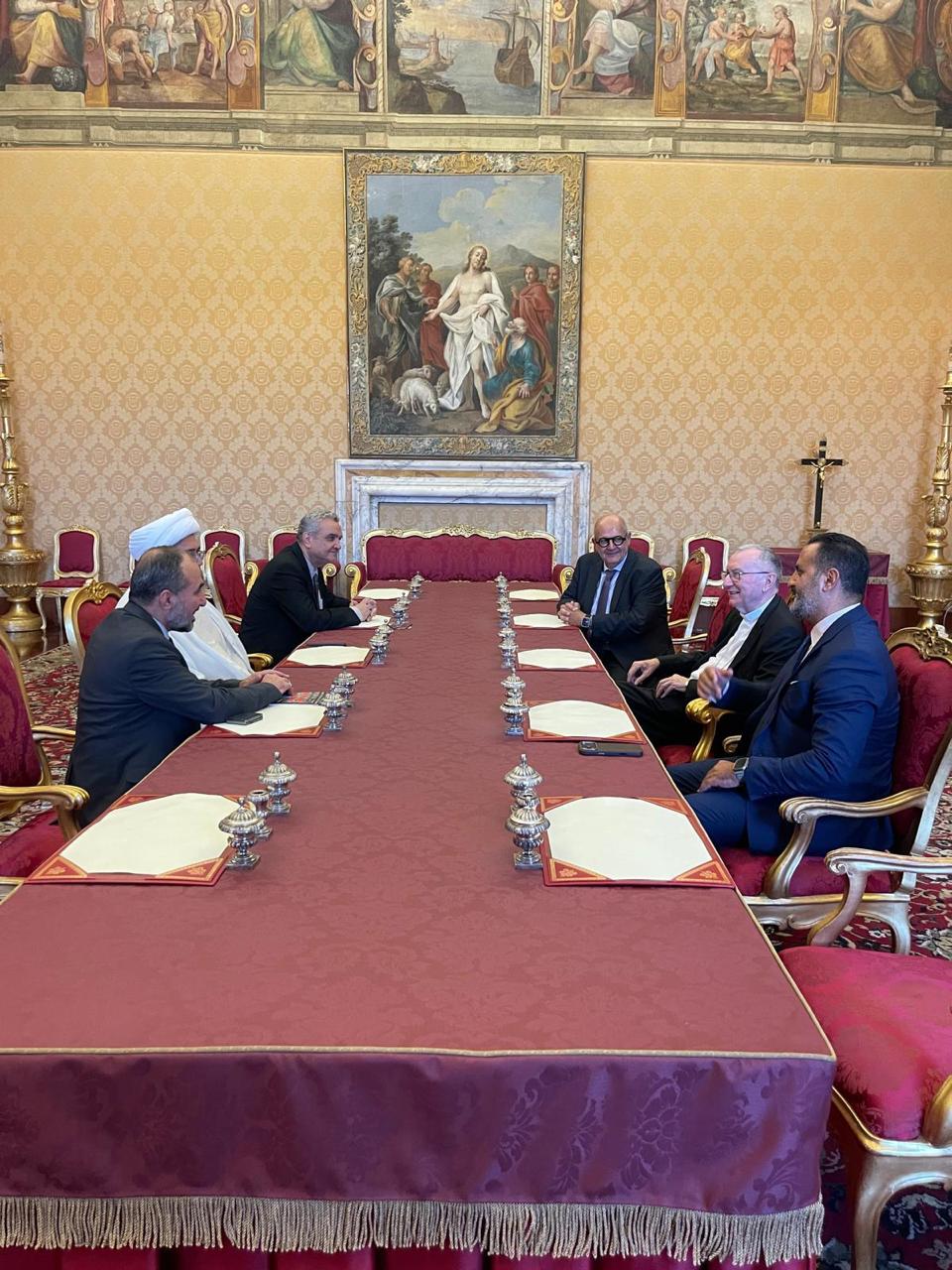
We entered to meet Cardinal Pietro Parolin as part of a delegation that included Sheikh Mohammad Ali al-Hajj al-Amili, Dr. Wajih Kanso, Sayyed Ali al-Amine, and myself.
A delegation of Lebanese Shiite figures entering the heart of the Vatican to speak not about Shiite rights, but about Lebanon.
As we entered, I told Cardinal Parolin that we were there to try to put into practice the message the Pope had brought to Lebanon and the Lebanese:
“Blessed are the peacemakers.”
I then added that we also wanted to thank the Vatican for the beatification of Patriarch Elias Hoyek.
I told him that, for us, Hoyek is not merely a Maronite patriarch or a figure in Church history. He is one of the founding fathers of the idea of Greater Lebanon, the man who carried Lebanon’s cause to the Paris Peace Conference and defended its establishment.
At that point, the cardinal’s reaction caught my attention.
He paused over the remark and showed clear interest in it.
It seemed that the connection between a Lebanese Shiite delegation, Patriarch Hoyek, Greater Lebanon, and the Pope’s message to the peacemakers carried a particular meaning for him.
From that moment on, the meeting moved beyond protocol and became a warmer, deeper discussion, to the point that the cardinal asked us to sit down and stay longer than the time originally allotted.
For me, perhaps this was the most beautiful image of the entire trip.
Four Lebanese Shiites sitting in the Vatican and speaking of a Maronite patriarch as one of the fathers of their country.
Is this not, in the end, the very idea of Lebanon?
Hoyek Does Not Belong to Christians Alone
The conversation about Hoyek stayed with me after we left the Vatican.
More than a century ago, the question was: how could Greater Lebanon be born?
Today, the question has become:
How do we preserve it?
The borders were drawn, the state was proclaimed, the Constitution was established, yet the very idea of Lebanon still needs, in every generation, people willing to defend it.
For me, as a Lebanese Shiite, there is no contradiction whatsoever in regarding Patriarch Hoyek as part of my own history.
If he is one of Lebanon’s founding fathers, then he does not belong to one community.
He is part of the national history of every Lebanese.
This is precisely where our phrase, “We are Lebanese before we are Shiite,” becomes more than a political slogan.
It also becomes a way of reading our history.
What Did I See at the Vatican?
I felt that the Vatican looks at Lebanon from a different distance than the one from which we look at ourselves.
We see the government, the weapons, the borders, electricity, the economy, the next war and the next settlement.
There, however, there is also another idea of Lebanon.
A small and extraordinarily complex country that, despite wars and divisions, has managed to remain a place where Muslim and Christian meet without the existence of one being conditional upon the elimination of the other.
This is not a romantic image of Lebanon.
It is one of the most important reasons for its existence.
That is why it mattered to us that the Vatican hear these words from Lebanese Shiites.
Defending Lebanon’s formula is not the responsibility of Christians alone.
And defending coexistence is not a concession made by a Muslim to a Christian, or by a Christian to a Muslim.
It is a defense of the country we all share.
And from Rome… I Was Thinking of the South
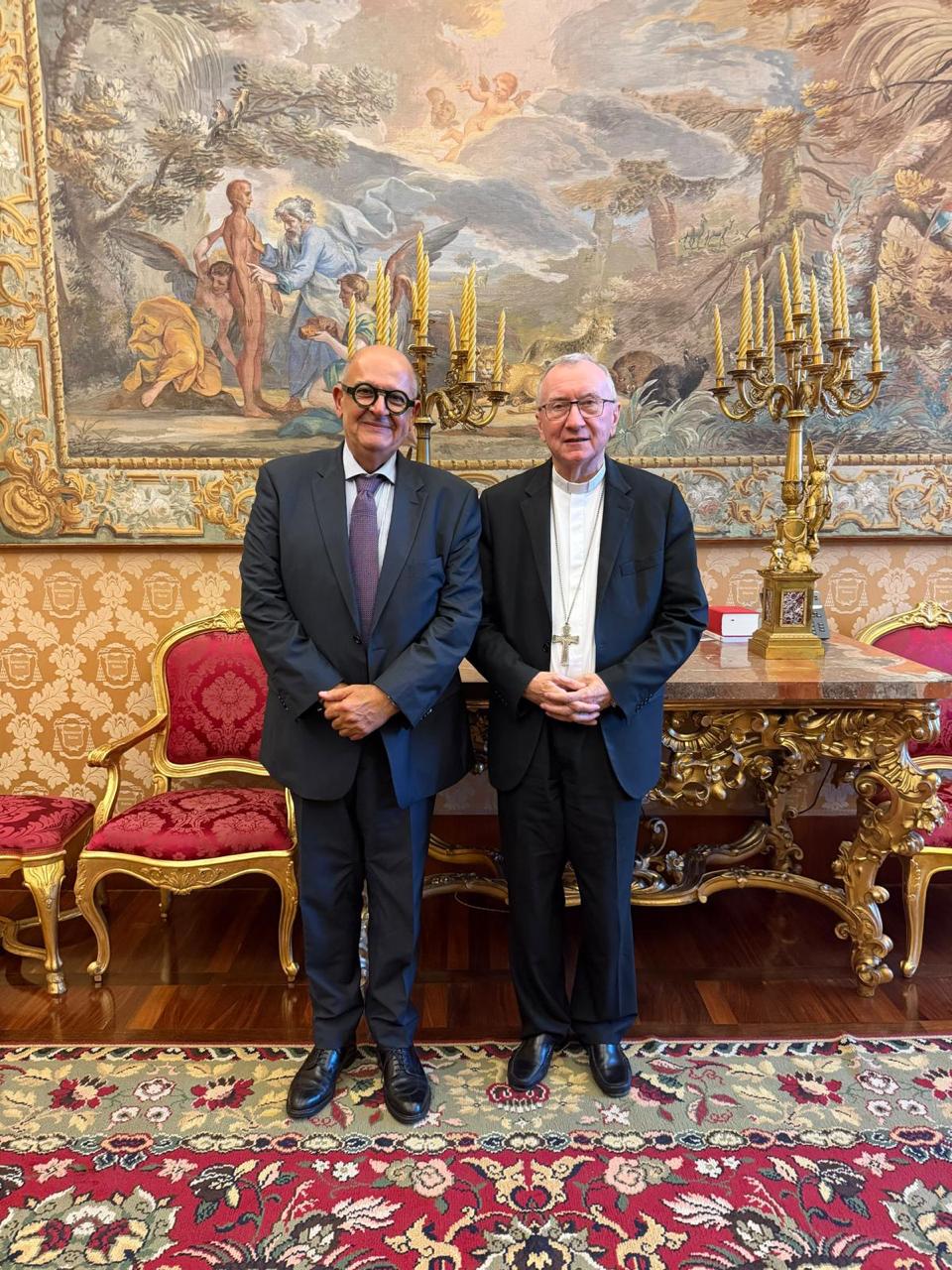
Cardinal Pietro Parolin and Jad Akhawi.
Throughout the trip, I thought a great deal about the South.
Distance does something strange. Sometimes it allows you to see what you cannot see when you are at the heart of events.
You think about the villages, the homes, the land, the people who have paid and continue to pay enormous prices, and about the question we must not avoid:
How long will the people of the South continue to pay the price for decisions larger than themselves?
For me, the state is not a theoretical idea.
Nor is sovereignty a word suited only to speeches.
I am a son of this environment, and I know what it means for a village to become a battlefield, for a home to become part of a military news report, and for geography, memories and family to be drawn entirely into the calculations of conflict.
That is why I refuse, after everything that has happened, to return to the same equation and then expect a different result.
The South needs a state.
A state that is genuinely present on the ground.
It needs an army to protect it, institutions to rebuild it, diplomacy to defend its land, and the decision to wage war or make peace to belong to Lebanon alone.
What Did We Bring Back?
Some people ask me: what did the visit achieve?
We did not return with agreements.
We did not receive magical promises.
We had not gone looking for them in the first place.
Nor do I like inflating political visits and turning every meeting into a “historic event,” as we so often do in Lebanon.
But something was achieved.
We told those we met, directly, that there are Lebanese, including Shiites, who reject the idea that the choice must be between Hezbollah and hostility toward the Shiite community.
We reject that equation.
There is another choice, and in truth it is the natural one:
The state.
A state that takes revenge on no one, that replaces neither one weapon with another nor one tutelage with another.
A state in which Shiites, Christians, Sunnis and Druze can feel that the army is their army, the Constitution their Constitution, the institutions their institutions, and that the law does not ask about their sect before granting them their rights and holding them to their responsibilities.
Returning to Beirut
But perhaps the most important impression from the trip was the one I felt upon returning.
When the plane lands in Beirut after days spent talking about Lebanon abroad, you look out of the window differently.
This small piece of land over which we have fought for generations seems too small to bear all our grand projects.
And too precious to lose.
I returned from Rome and the Vatican more convinced than ever that the world can help Lebanon, but it will not build Lebanon in our place.
Italy can help.
The Vatican can offer support.
Arabs, Europeans and Americans can stand alongside the state, the army and the economy.
But no one in the world can make the most important decision on our behalf:
That we ourselves want to become a state.
Two phrases therefore stayed with me from the trip.
The first was what I said as we entered our meeting with Cardinal Parolin:
“Blessed are the peacemakers.”
The second was one we carried with us from Beirut to Rome, and brought back with us from Rome to Beirut:
“We are Lebanese before we are Shiite.”
Between those two phrases, perhaps, lies the whole issue.
To make peace rather than wait for the next war.
And to build a country before we build the barricades of our communities.
Because after Rome, the question is no longer what the world can do for Lebanon.
The question has become more difficult:
What are we prepared to do for Lebanon?