

Training, Digital Development, AI: La Francophonie's Work in the Middle East


The International Organization of La Francophonie (OIF), which brings together 93 states and governments, supports programs in Lebanon and across the Middle East focused on promoting the French language, education, gender equality, and development. In Beirut, these efforts are coordinated by Lévon Amirjanyan, the OIF’s representative for the Middle East, who heads the regional office, which opened in late 2022. The office covers four countries: Lebanon and Egypt, both full members, and Qatar and the United Arab Emirates, which are associate members, with Lebanon serving as the regional hub for the organization’s activities.
Lebanon remains a central member of La Francophonie. A member of the OIF since 1973, the country celebrated the 50th anniversary of its membership in 2023, reaffirming its deep historical roots within the organization. In keeping with this longstanding role, Lebanon has also contributed to La Francophonie’s institutional development by hosting the Francophonie Games in 2009, while the regional office of the Agence universitaire de la Francophonie has been established in the country for more than three decades. Since 2022, more than €4 million has been mobilized for Lebanon through the organization’s cooperation and support programs.
But the organization longstanding presence is more than symbolic, taking the form of a range of practical initiatives on the ground.
According to Amirjanyan, “The OIF’s work in Lebanon is guided by a plan signed in 2021, focused on promoting the French language, education and vocational training, and women’s empowerment.” In response to the country’s successive crises, the organization also introduced a €1 million emergency plan in 2024.
In the education sector, the organization supports Lebanon’s Ministry of Education by developing digital teaching resources, expanding distance learning, and providing teacher training. The “La Francophonie avec elles” (“La Francophonie with Women”) fund, established in 2020 to promote women’s empowerment, has mobilized nearly €1.5 million in Lebanon to finance 24 projects – moe than the regional average. The OIF also supports youth and local initiatives.
Beyond its work in education and women’s empowerment, the OIF is also active in the information sector. Amirjanyan noted that “in partnership with the Ministry of Information and UNESCO, the organization is combating disinformation, providing technical and material support to the ministry, and leading a nationwide awareness campaign accompanied by audiovisual content.”
At the same time, the organization is working to expand economic opportunities across the Francophone world. According to Amirjanyan, “The OIF supports the private sector through economic missions. The 2023 mission brought together between 60 and 70 companies from 25 French-speaking countries, while a follow-up mission in 2025 led to the signing of 18 memorandums of understanding.”
Media, Culture, and Reach of La Francophonie
Alongside these institutional and economic initiatives, the OIF is also active in the media sector. “The OIF supports French-language media in Lebanon, notably by backing the relaunch in 2025 of Télé Liban’s daily French-language television news bulletin, which is considered an essential tool for preserving the French language in public broadcasting,” Amirjanyan said.
This commitment also extend to supporting local cultural organizations.
The organization’s cultural work is thus supported by the 12 Centres for Reading and Cultural Activities (CLACs) in Lebanon, which Amirjanyan described as a “true jewel” of La Francophonie because of their role in providing access to culture, knowledge, and information, including in areas far from cultural centers. More than simple libraries, these centers serves as cultural and community spaces that foster social cohesion, dialogue, and coexistence.
Part of a network of more than 300 centers across the Francophone world and established in Lebanon in 2001, the CLACs are now undergoing modernization. Amirjanyan pointed out that “a recent evaluation mission allowed the organization to consult users and local stakeholders in order to identify changes needed in response to digital transformation and evolving cultural expectations, while preserving their role as community-based spaces.”
A Growing Regional Dynamic
While Lebanon remains the organization’s main foothold in the region, its activities extends well beyond its borders.
At the regional level, Amirjanyan highlighted activities covering Egypt, Qatar, and the United Arab Emirates, with programs tailored to national contexts.
In Egypt, cooperation includes projects with major Francophone institutions, notably Université Senghor in Alexandria, which plays a central role in training development professionals across Africa and hosts students and professionnels from many French-speaking countries. In Egypt, the OIF also runs training programs for diplomats and teachers, particularly in digital technology and artificial intelligence, with a strong emphasis on strengthening public administrations capacity.
In another area of work, the OIF is also developing targeted partnerships in Gulf countries.
In Qatar and the United Arab Emirates, the organization’s efforts focus on strengthening French-language education and integrating it into national education systems, in coordination with local authorities. This is accompanied by growing interest in the French language and clear enthusiasm for La Francophonie in both countries, driven in particular by education systems and cultural cooperation.
According to Amirjanyan, this approach allows “programs to be adapted to each country’s priorities while maintaining regional coherence, in a region where La Francophonie is experiencing growing momentum and attracting increasing interest.”
A Francophonie Looking to the Future
Beyond ongoing projects, the organization is now preparing the next phase of its regional strategy. Amirjanyan emphasized the OIF priorities going forward: youth, gender equality, digital development, and artificial intelligence.
French-language training programs for Lebanese civil servants and diplomats are already in place and will continue, as part of efforts to strengthen skills and modernize public administration.
Overall, whether in education, culture, media, gender equality, or economic cooperation, the objective remains the same: to make La Francophonie a space for exchange and opportunity adapted to today’s challenges.
In Lebanon and across the region, La Francophonie remains dynamic, supported by sustained interest in the French language and multilingual education systems.
In conclusion, Amirjanyan said that this reality confirms that La Francophonie goes beyond language alone: it is a space for cooperation, training, and economic and social opportunity, with a forward-looking vision.
Collège de Nazareth at Risk of Closure
Harassment, Bullying: Women Are the Prime Targets of AI
The Philippe Chebaya Center for Children with Special Needs: A Beacon Above the Holy Valley
World Cup: Collective Emotions and Identifications in Lebanon
Studying in a State of Limbo: When Instability Becomes the Norm
Mais de Nayla Assaf
Ver tudo


Mais em Society
Ver tudo


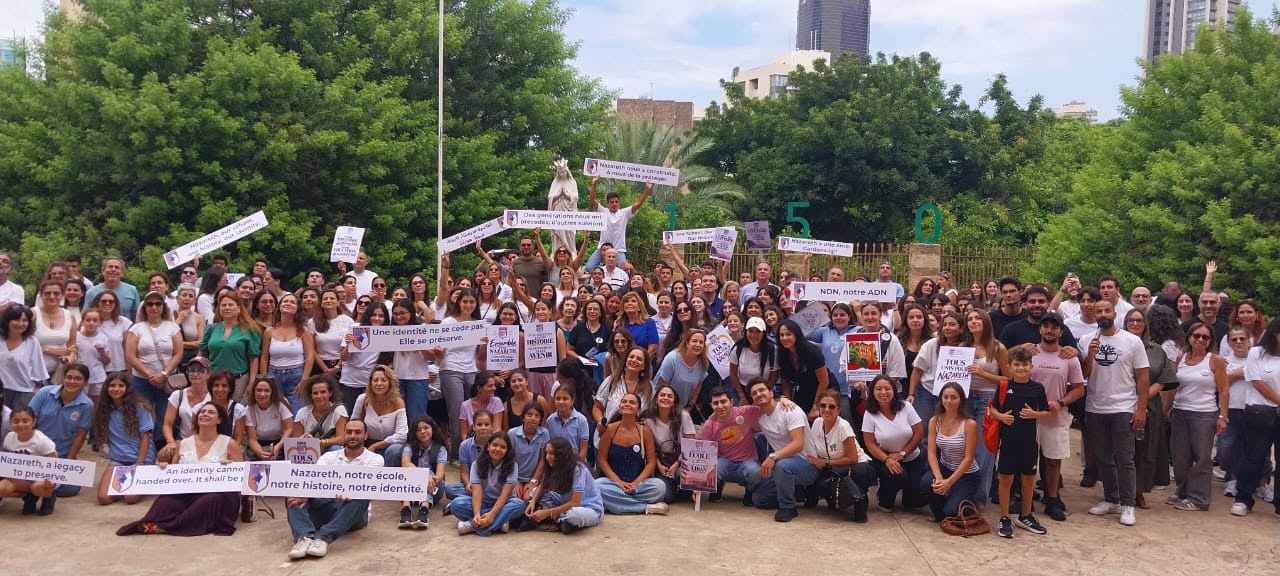

Nazareth's Extended “Family” Stands United Against the Proposed Sale

The Dragon’s Hiccup: The War Through The Eyes of a Child
Habemus: Peru, at the heart of Leo XIV's life
O mais recente do Levant Time
Ver tudo


