

UN: Paris Wants to Replace UNIFIL With a 'Different Type' of Presence

From New York, Sylviane Zehil
As France holds the presidency of the UN Security Council in September, the General Assembly’s “high-level week” is taking place against a backdrop of existential crises and growing questioning of multilateralism. In this context, Paris intends to defend an international system “based on the rule of law rather than the law of the strongest.” Among the sensitive issues on the agenda is Lebanon, with an increasingly pressing question: what should be done about UNIFIL and, above all, how can a “security vacuum” be avoided if its mandate cannot be extended for the long term?
Lebanese leaders who are in New York for the occasion will hold crucial meetings to address the issue, and Prime Minister Nawaf Salam has already discussed it with UN Secretary-General António Guterres.
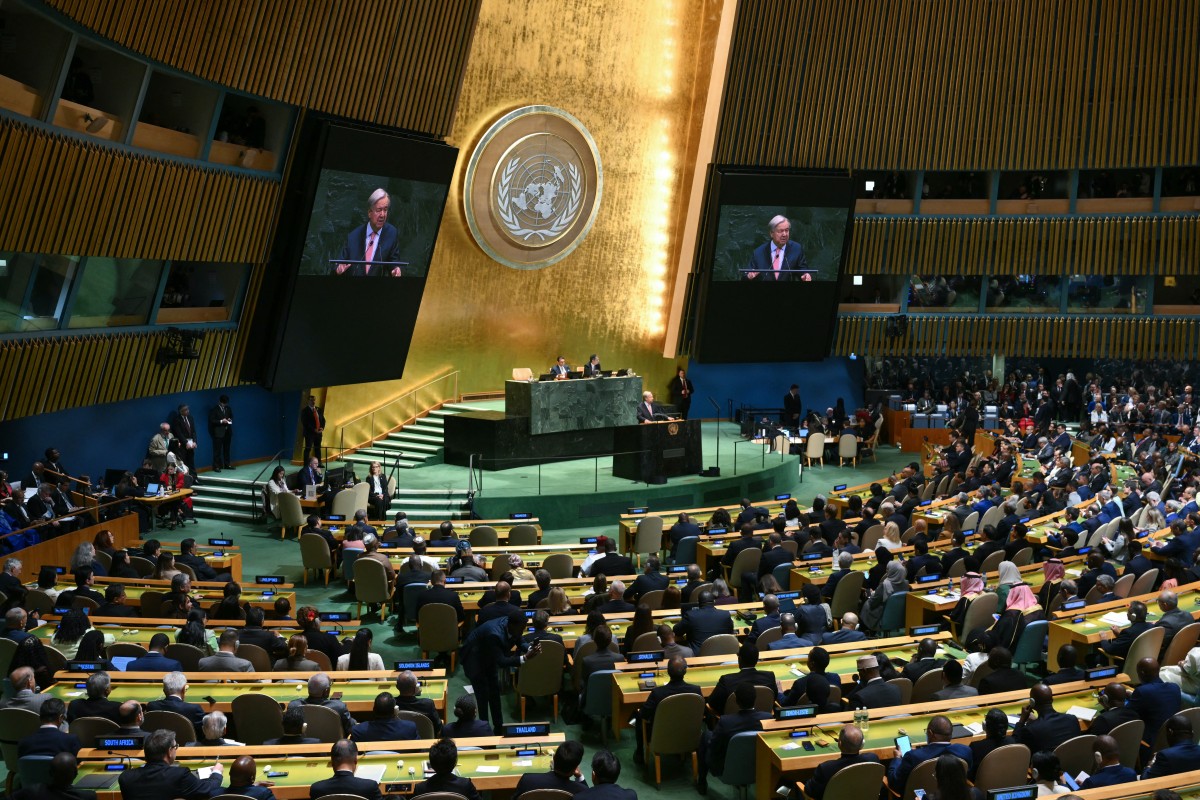
The 81st session of the United Nations General Assembly is entering its most intense political phase as France holds the presidency of the Security Council, which it assumed at the beginning of September, while also holding the G7 presidency this year.
Ukraine, Palestine, Iran, Sudan, Lebanon, the Red Sea and Yemen: French officials will address a series of ongoing crises in New York, as well as broader issues ranging from artificial intelligence to international humanitarian law, not to mention the succession of António Guterres, which is already being worked out behind the scenes.
The political framework Paris intends to set for the week is one of defending multilateralism. “At a time when multilateralism is being criticized in different ways, we remain strongly committed to multilateralism in general and to the United Nations in particular,” a senior French diplomat said during an off-the-record briefing on French priorities.
One principle is expected to be reaffirmed in New York: “We believe in the strength of an international system based on the rule of law rather than the law of the strongest.” It is against this broader backdrop that the Lebanese issue must be viewed, as the question of UNIFIL’s future is now being raised directly at the Security Council.
Maintain UNIFIL or Prepare for Another Presence?
Asked during the briefing about Lebanon’s wish to keep the United Nations Interim Force in Lebanon in place for longer, despite the resistance this option faces, the senior French diplomat initially confirmed Beirut’s request. “Lebanon has indeed asked for the Force to remain in place for a longer period.”
France plays a particular role on this issue because it is the penholder at the Security Council. “France is the penholder on this issue, which means that we are the ones who draft and negotiate the text concerning UNIFIL,” he recalled.
In the previous negotiations, Paris had succeeded in extending the Force’s mandate by a year and a half. But the diplomat pointed to a shift in positions within the Council. “There is a feeling within the Council that we should now consider a new United Nations presence rather than extend UNIFIL’s mandate.”
Beirut, by contrast, is calling for UNIFIL to remain. And France says it is prepared to support that option if it remains politically possible. “If there is a possibility of extending the mandate – and France has expressed this position – we can support such an extension.”
According to the French diplomat, the problem now lies in the balance of forces within the Security Council. “I fear there will not be sufficient support for a long-term extension or for maintaining a full mandate.” This assessment therefore opens the door to another possibility: a shorter extension that would allow the Force to remain for an additional period without prejudging the arrangement that might eventually succeed it. “If there is a possibility of extending UNIFIL’s mandate for a short period and with a sufficiently broad mandate, we will do so,” the diplomat said.
But the briefing revealed above all that the discussion is already moving beyond the simple choice between maintaining UNIFIL and ending its presence. “I think the discussion is now moving more toward something broader: a United Nations presence, but also another type of presence, perhaps an ad hoc international presence.”
The French diplomat, however, immediately brought the various options back to the objective being pursued rather than their modalities. “What is our objective here? Perhaps I should have started with that rather than with the modalities.” The answer can be summed up in a few words: “Our objective is to ensure that there is no security vacuum in Lebanon, in order to guarantee the sovereignty and territorial integrity of (Lebanon)…”
For now, therefore, the common denominator put forward by France remains the one articulated by the diplomat himself: preventing the emergence of a “security vacuum in Lebanon.”
A French Presidency Facing Multiple Fronts
The Lebanese issue is part of a much broader agenda. On Iran, high-level meetings are expected in various formats, with the Iranian president and foreign minister present at the meetings. The French diplomat’s briefing placed the issue within a regional context encompassing tensions in the Strait of Hormuz, developments in the Red Sea and the Bab el-Mandeb Strait, as well as the situation involving the Houthis in Yemen.
A Security Council meeting is also expected to focus on Ukraine, “given the situation and its deterioration,” particularly following the recent strikes near the Polish border mentioned by the French diplomat. Sudan will also be on the agenda of meetings in New York.
Palestine: Two-State Solution Among French Priorities
Palestine will rank “very high among the priorities of French officials.” Paris sees this engagement as a continuation of the New York Declaration and the resolution adopted by the General Assembly with 142 votes in favor of a text endorsing the declaration on the two-state solution.
France considers developments on the ground to have made the issue urgent. “Given the challenges facing the two-state solution on the ground, this issue is one of the concerns of French officials,” the senior diplomat said.
Artificial Intelligence, Another Major Issue at UNGA81
Beyond the crises, artificial intelligence ranks “very high on the French agenda,” with two distinct concerns. The first relates to the impact of AI and, more broadly, digital technology on children. “There is no question of denying the benefits of artificial intelligence, but we are seeing serious concerns about its impact on children,” the diplomat explained.
The second aspect is much more directly related to security. Paris wants to open a discussion on the risks associated with the development of AI, particularly “the existential threat that AI could pose to humanity as a whole.” In this regard, the senior diplomat pointed to concerns expressed by several executives of technology companies specializing in AI about both this potential threat and cyber risks.
Humanitarian Law Amid a Proliferation of Conflicts
International law and human rights are another area of concern for France. Paris is working with Jordan, South Africa, Brazil, China, Kazakhstan and the International Committee of the Red Cross on an initiative aimed at promoting respect for international humanitarian law.
The initiative stems from a particularly troubling assessment: “Not only are we seeing an increase in the number of international conflicts, but we are also seeing an extremely worrying rise in non-compliance with international humanitarian law.” The law, the diplomat recalled, lays down the “fundamental rules applicable to war.” A summit on the issue is scheduled to take place in Amman in December.
Veto Use in Cases of Mass Atrocities
France also intends to use the General Assembly to give fresh impetus to its joint initiative with Mexico to encourage permanent members of the Security Council to voluntarily limit their use of the veto in situations involving mass atrocities.
Launched in 2013 after Security Council deadlocks despite atrocities being committed on the ground, the initiative had, the diplomat acknowledged, “fallen relatively dormant in recent years.” But renewed Franco-Mexican efforts have helped revive the momentum. Some 123 of the UN’s 193 member states now support the initiative. “Symbolically, we would like to surpass the threshold of 129 states,” the diplomat explained – the equivalent of two-thirds of the General Assembly.
The aim is also to secure the support of permanent members of the Council, although this remains, he acknowledged, “obviously more delicate.”
Guterres’ Succession in the Background
Finally, another upcoming deadline is likely to be at the center of consultations in New York: the selection of the next United Nations secretary-general. António Guterres’ term will end on December 31. The Security Council is therefore in the midst of consultations and indicative votes, known as straw polls, intended to gauge support for the various candidates. The succession is expected to be a central topic of discussions on the sidelines of the official meetings.