

Israel: Inconclusive Election, Unchanged Strategic Course


Early projections from Israel’s particularly tense election day on Tuesday, October 27, failed to identify a clear winner in the first parliamentary elections held since the October 7 massacre.
Polling stations closed as scheduled at 10 p.m., despite a request from Likud to extend voting hours. Turnout among an electorate of just over 7 million reached a record 75 percent, the highest level in more than five decades.
Turnout among Arab Israelis was exceptionally high, particularly among the Bedouin tribes of the Negev, potentially bringing more than 15 Arab lawmakers into the Knesset—17 or 18, according to initial projections.
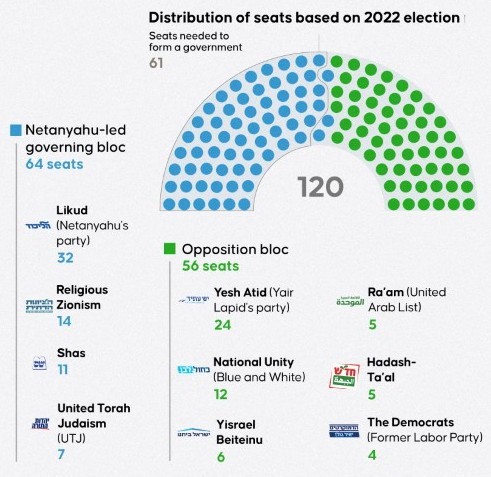
The composition of the Knesset before the October 27, 2026 elections.
Exit polls indicate that Likud came out ahead with 23 to 25 seats, compared with 21 or 22 for the party led by Gadi Eisenkot, the main rival of outgoing Prime Minister and Likud leader Benjamin Netanyahu.
But taking into account potential political alliances and the bargaining they entail, Israeli sources suggest that the opposition bloc would secure 52 or 53 seats, compared with 50 for Netanyahu’s bloc.
That projection is disputed, however, by the Likud-aligned Channel 14, which reports that a right-wing coalition could muster 60 lawmakers—one seat short of an absolute majority—with the opposition alliance taking 43 seats and Arab parties 17.
It is therefore clearly too early to draw any firm conclusions from these elections, let alone to sketch out the shape of Israel’s next government.
The final, official results allocating seats in the Knesset will not be known for another 48 hours. Even then, the tally will not establish with certainty whether Benjamin Netanyahu or his current challenger, Gadi Eisenkot, will succeed in forming a stable government backed by a majority, however narrow.
For decades, Israel’s electoral system, based on proportional representation, has produced a highly fragmented political landscape and a constellation of small parties reflecting either differences in political outlook and policy platforms or simply narrow political ambitions and calculations.
As a result, elections do not give any single party or political group even the slimmest majority needed to form a government.
Any prime minister-designate is therefore forced to engage in difficult negotiations and political horse-trading to scrape together the 61 seats needed to give the government sufficient room to maneuver.
The person tasked by Israel’s president with forming a government has 28 days to complete the assignment, with a possible 14-day extension.
If no one succeeds in forming a government within the allotted time, new elections must be held.
That possibility cannot be ruled out given the inconclusive outcome of the October 27 vote, which would allow the Likud leader to remain in office in the interim.
Little impact on strategic choices
As the precise makeup of the new Knesset becomes clearer, and pending the formal appointment of either Netanyahu or Eisenkot to negotiate with smaller parties in an attempt to form a government, speculation is rife about the potential geopolitical and regional repercussions of a cabinet formed by Likud’s opponents.
From our small Lebanese vantage point—and even from an Iranian one—the standard-bearers of the so-called “obstructionist” camp, led by the Revolutionary Guards and Hezbollah, might be tempted to welcome Netanyahu’s possible ouster in the short term.
They would soon be disillusioned, however, given Gadi Eisenkot’s character and firm positions on Israel’s overarching strategic and national security priorities.
Indeed, more generally, history has shown that when existential issues are at stake and Israel’s security is seriously threatened, Israeli leaders hold fast to their fundamental principles and strategic choices without hesitation, whatever their internal differences.
In this particular case, Mr. Eisenkot, Israel’s former military chief of staff, has already taken positions as radical and uncompromising as Mr. Netanyahu’s, if not more extreme, on Hezbollah (it bears recalling that he advocates the complete destruction of Beirut’s southern suburbs), the security situation in southern Lebanon and northern Israel, the Gaza issue—where his son and two nephews were killed—and, above all, Iran’s nuclear program and the broader Iranian question.
To top it all off, if he succeeds in forming a government, the opposition leader will undoubtedly have greater room for maneuver than the Likud leader on these explosive strategic issues, since he will not be constrained in quite the same way by the baggage that has dogged Mr. Netanyahu among sections of Western public opinion and certain American and European policymakers.
The Tehran Meeting: Iran’s Attempt to Defuse Escalation
United States - Iran, the war of last resort?
The Hebron Attack: a Boon for Netanyahu?
In Tampa, Lebanese-Israeli Talks Resume Amid Heightened Tensions
US and Qatari Support Amid Hesitation from Lebanon’s Leadership
More from Michel Touma
View All


More in Decryption
View All


Latest from Levant Time
View All


