

The Hebron Attack: a Boon for Netanyahu?


Israeli Prime Minister Benjamin Netanyahu announced a large-scale military operation in the West Bank on Friday, following an armed attack by two Palestinians on an Israeli army post near Hebron, in the south of the occupied Palestinian territory. Two soldiers were killed and three others wounded. Both attackers were shot dead.
Visiting the scene, Benjamin Netanyahu immediately ordered the West Bank sealed off as part of an operation that, he said, would involve evacuating residents, systematically searching homes and destroying infrastructure that Tel Aviv considers linked to armed groups.
With Israel's parliamentary elections just four days away, on Tuesday, could Netanyahu be seeking to exploit the Palestinian attack? The question arises in light of its repercussions. Had the attackers wanted to give him an electoral advantage, however small, they could not have chosen a better time.
National security issues are central to the Israeli prime minister's election campaign, and his party now has a new argument to defend its policies and once again present itself as the guarantor of Israelis' security.
The attack also gives him a pretext to launch a large-scale military operation in the West Bank, making good on threats he has repeatedly issued over the past few months.
Quoted by Reuters, he spoke of a military campaign whose scale, he said, could “exceed that of any operations carried out since the June 1967 war.”
The attack would thus appear to come at an opportune moment for the prime minister, who, according to polls reported by Israeli media outlets, including the Jerusalem Post and Haaretz, is trailing former Israeli army chief of staff Gadi Eisenkot. Eisenkot represents Yashar, a party founded just a year ago that positions itself in the center of Israeli politics, according to the Jerusalem Post.
According to Reuters, however, the available data does not establish whether Gadi Eisenkot would be able to secure a parliamentary majority.
Mobilizing voters
In this context, a deadly attack on Israelis could help mobilize voters concerned about security, especially since Hamas and Hezbollah, both backed by Iran, welcomed it.
It would, of course, be premature, if not reckless, to conclude that the attack will boost Benjamin Netanyahu in the polls, as his handling of security issues, particularly the war against Hezbollah in Lebanon, remains widely criticized by Israelis, especially in the country's northern border regions.
It is also worth recalling that Benjamin Netanyahu had already warned in recent weeks of security risks linked to the occupied West Bank.
According to the Times of Israel, during a visit to Tel Nof air base on September 29, he said that “Israel's enemies” might seek to strike the country before the elections, promising retaliation if they did.
On October 6, he also said that Hamas, which he described as weakened, might attempt an attack to influence the elections. Netanyahu threatened a forceful response.
Far-right ministers Itamar Ben Gvir and Bezalel Smotrich immediately called for drastic action. Smotrich ordered the demolition of Palestinian buildings near the site of the attack, while his colleague called for the “dismantling of the Palestinian Authority.” These announcements pave the way for a new phase of military pressure on Palestinians.
Deadly shooting in Jordan
Within hours, another incident, unrelated to the Hebron attack, underscored the rise in terrorist violence in the region.
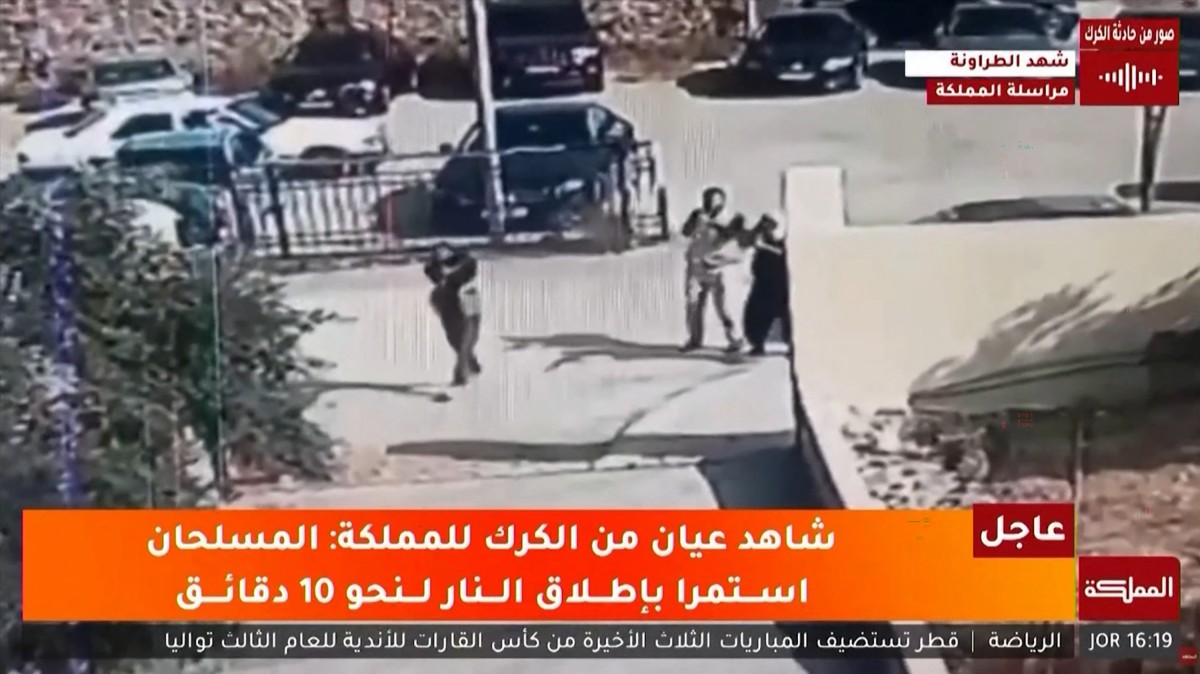
Surveillance footage aired by Jordan's public broadcaster shows three men firing repeatedly at the church from outside before advancing toward the building (via AFP).
In Jordan, a shooting carried out by suspected Islamists, according to preliminary findings of the investigation, left at least seven people dead and 28 injured at a Greek Orthodox church in the Karak region in the south of the country. The attack took place during a funeral.
King Abdullah II pledged a tough response to an act that could destabilize the country, particularly as attacks on places of worship are rare in the Hashemite kingdom. He said his country would strike firmly at “those who threaten its security.”
According to Jordanian authorities, armed men arrived in a vehicle before opening fire on people gathered for a funeral at a church in the village of Hammoud.
A witness interviewed by public television described several minutes of gunfire, with 150 to 200 people inside or near the building at the time. An intensive search for the attackers is still underway.
In Tampa, Lebanese-Israeli Talks Resume Amid Heightened Tensions
US and Qatari Support Amid Hesitation from Lebanon’s Leadership
Explosives Trafficking: Hezbollah Persists… and Confirms
Hezbollah, the Arsonist Firefighter
Europe Steps in to Help a State Reluctant to Assert Its Authority
More from LevantTime .
View All


More in Decryption
View All


Latest from Levant Time
View All


