

Hezbollah-Israel: An Endless War in Whose Interests? (9)
The military lessons of the 2006 war

This series of articles aims to provide a clearer understanding of the current situation in light of the past, free from passionate, ideological, or romanticized narratives that miss the realities on the ground, leaving readers to draw their own conclusions.
The previous eight installments offered a reexamination of events surrounding Hezbollah's rise to power since the Taif Agreement, through the Israeli army's withdrawal from Lebanon in May 2000, the establishment of a Hezbollah-controlled zone in the South, and the 2006 war. This article picks up where that conflict left off.
The Battle of Wadi Al Houjeyr, also known as the Battle of Wadi Slouqi, took place in the central sector of the Lebanese-Israeli border between August 11 and 13, 2006. It was one of the costliest engagements for the Israeli army. The Israeli forces' objective was to cross the Slouqi valley heading northward to reach the Litani River before the anticipated ceasefire came into effect.
The Slouqi valley, also known as Wadi Al Houjeyr, is a steep and narrow gorge. Hezbollah fighters made extensive use of Kornet anti-tank missiles — capable of piercing double armor — from concealed positions on the surrounding heights and in nearby villages. As soon as Israeli Merkava tanks entered the gorge, they came under crossfire from Kornet operators.
The initial lack of coordination between the attackers' infantry and armored units left the tanks exposed to the concealed missile operators. The infantry was supposed to cover the tanks' advance with mortar fire to suppress the hidden missile teams, but this was not carried out effectively.
This battle is often referred to as the "Merkava massacre" by Hezbollah supporters. Israeli losses amounted to 33 soldiers killed and dozens wounded, with around twenty Merkavas hit, two of which were destroyed. On the Hezbollah side, approximately forty fighters were killed. The Israeli army ultimately succeeded in crossing the valley on August 13; however, the ceasefire that came into effect on August 14, 2006 halted any further advance. Along this axis, Israeli troops had passed through the village of Ghandourieh and stopped north of it, just a few kilometers short of the Litani — their original objective.
Targeting bridges, roads, and infrastructure
During the 2006 war, Israel targeted 109 bridges and 130 roads across Lebanon over the course of 33 days. One objective was the tactical isolation of southern Lebanon through the destruction of bridges over the Litani River, severing communication routes between the South and Beirut. This was intended to prevent Hezbollah from sending reinforcements, ammunition, and military equipment to the front. It also served two additional purposes: the first was to prevent Hezbollah from deploying heavy missiles to parts of Lebanon beyond the South — for example, a bridge linking Baabda to Beirut was destroyed after a missile, concealed in a 40-foot container, had crossed it along the Baabda–Wadi Chahrour road; the second objective was to prevent the two Israeli soldiers captured at the start of the war from being transferred out of the country, by destroying bridges and roads leading to Syria.
The bombing of "vital" infrastructure — including Rafic Hariri International Airport and the Jiyeh power plant — was intended to cripple the Lebanese economy and pressure the Lebanese government into disarming Hezbollah. The destruction of these routes severely hampered the delivery of humanitarian aid, leaving many southern communities cut off and isolated.
This strategy was part of the Dahiya doctrine, an Israeli military tactic of asymmetric warfare that advocates the use of massive and disproportionate force against civilian infrastructure in areas serving as bases for Hezbollah, Hamas, and other armed groups, in retaliation for attacks on Israeli territory. First applied during the 2006 war and formally articulated in 2008 by Gadi Eisenkot, the Israeli Chief of Staff, this approach treats villages or neighborhoods from which missiles are fired not as civilian areas, but as military bases.
The causes of Israel's tactical failures
An Israeli government inquiry commission, chaired by retired judge Eliyahu Winograd, was tasked with examining Israel's political and military failures during the 2006 war against Hezbollah. The commission's final report concluded that the conflict represented a strategic and military failure for Israel, citing shortcomings in command and preparedness. As a result, Israel overhauled its ground doctrine, accelerated the development of a short-range missile defense system known as the Iron Dome, and rolled out an active protection system called Trophy across its armored vehicles. This system, later sold to the U.S. military, works by intercepting anti-tank missiles before they strike the vehicle's hull.
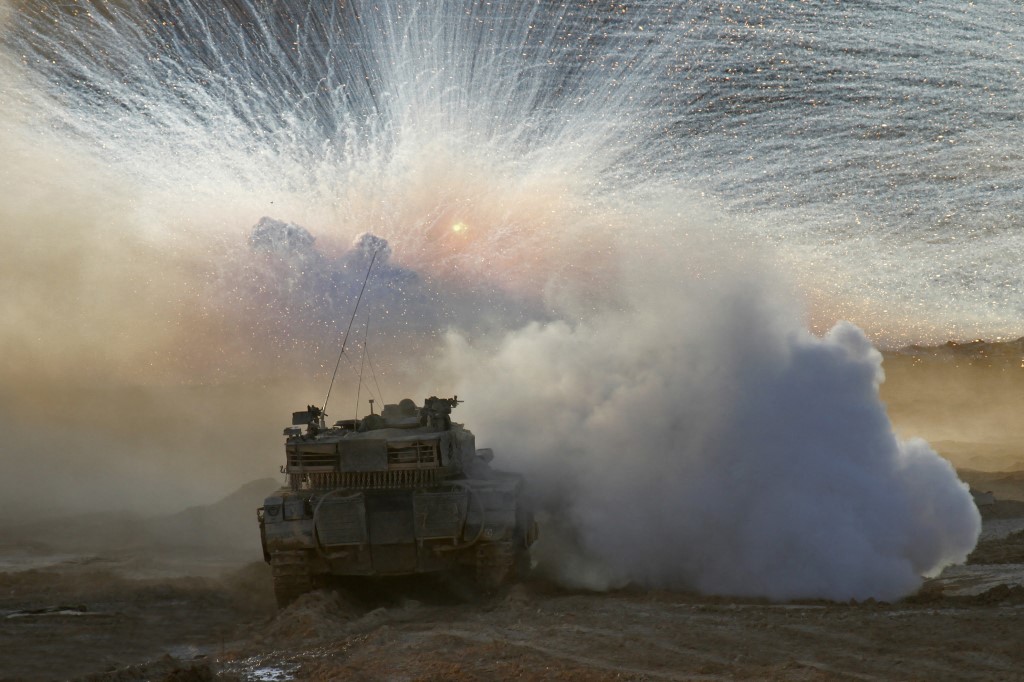
A Merkava tank during exercises in the Negev. (AFP)
The Winograd Report revealed the vulnerability of the Merkava tank to RPG-29 rockets and to Hezbollah's precision Kornet and Metis-M missiles, all of which use tandem warheads — dual-charge designs capable of penetrating the Merkava's dual-layer internal and external armor. The external armor is reactive, meaning it explodes and deflects conventional anti-tank missiles, but tandem-charge missiles are designed to overcome this and pierce through to the interior of the tank.
During the 2006 war, 52 Merkava tanks were struck by these munitions, resulting in the deaths of 30 soldiers. Of those, five were completely destroyed, while 24 were penetrated and 23 suffered minor damage. All 47 of the damaged tanks were later repaired and returned to service. Beyond the effectiveness of tandem-charge rockets and missiles, the Winograd Report found that the Merkavas were hit primarily due to systemic tactical errors in how they were deployed. The report also criticized the lack of coordination between the Israeli air force, infantry, and armored units, as well as the inadequate preparation of reservists, who had not conducted any armored maneuvers in six years.
A first in military history
The large-scale use of RPG-29 rockets and Kornet and Metis missiles — all fitted with tandem warheads — marked a turning point in military history. Although they had been used sporadically before, during the Chechen wars in the 1990s and against American forces in Iraq in 2003, the 2006 conflict was the first time a militia demonstrated the effectiveness of deploying such weapons en masse against tanks equipped with reactive armor.
Furthermore, Hezbollah's sophisticated tactics and its preparations for this war highlighted the extent of Iranian involvement in Lebanon and provided a masterclass in asymmetric warfare strategy. The Ukrainians almost certainly drew lessons from this conflict, as their tactics during the early weeks of the 2022 Russian offensive closely mirrored those of Hezbollah in many respects — except that their tandem-charge anti-tank missiles were Western-made (the Javelin, the equivalent of the Kornet, and the NLAW, the equivalent of the Metis-M).
Read more on this topic:
Hezbollah-Israel, an endless war serving whose interests? (8)
Hezbollah-Israel, an endless war serving whose interests? (7)
Hezbollah-Israel, an endless war serving whose interests? (6)
Hezbollah-Israel, an endless war serving whose interests? (5)
Hezbollah-Israel, an endless war serving whose interests? (4)
Hezbollah-Israel, an endless war serving whose interests? (3)
Hezbollah-Israel, an endless war serving whose interests? (2)
Hezbollah-Israel, an endless war serving whose interests? (1)
Hezbollah-Israel: An Endless War in Whose Interests? (20)
The Trump-Xi Summit: Between Pragmatism and Necessity
The Conflict in Yemen: Geopolitical and Strategic Considerations
Yemen: The Mecca Pact Moves from Theory to Military Action
Hezbollah-Israel: An Endless War in Whose Interests? (19)
Plus de Khalil Helou
Voir tout


À lire aussi dans Strategia
Voir tout


Les derniers articles de Levant Time
Voir tout


