

Lebanese Moderation Needs a Project
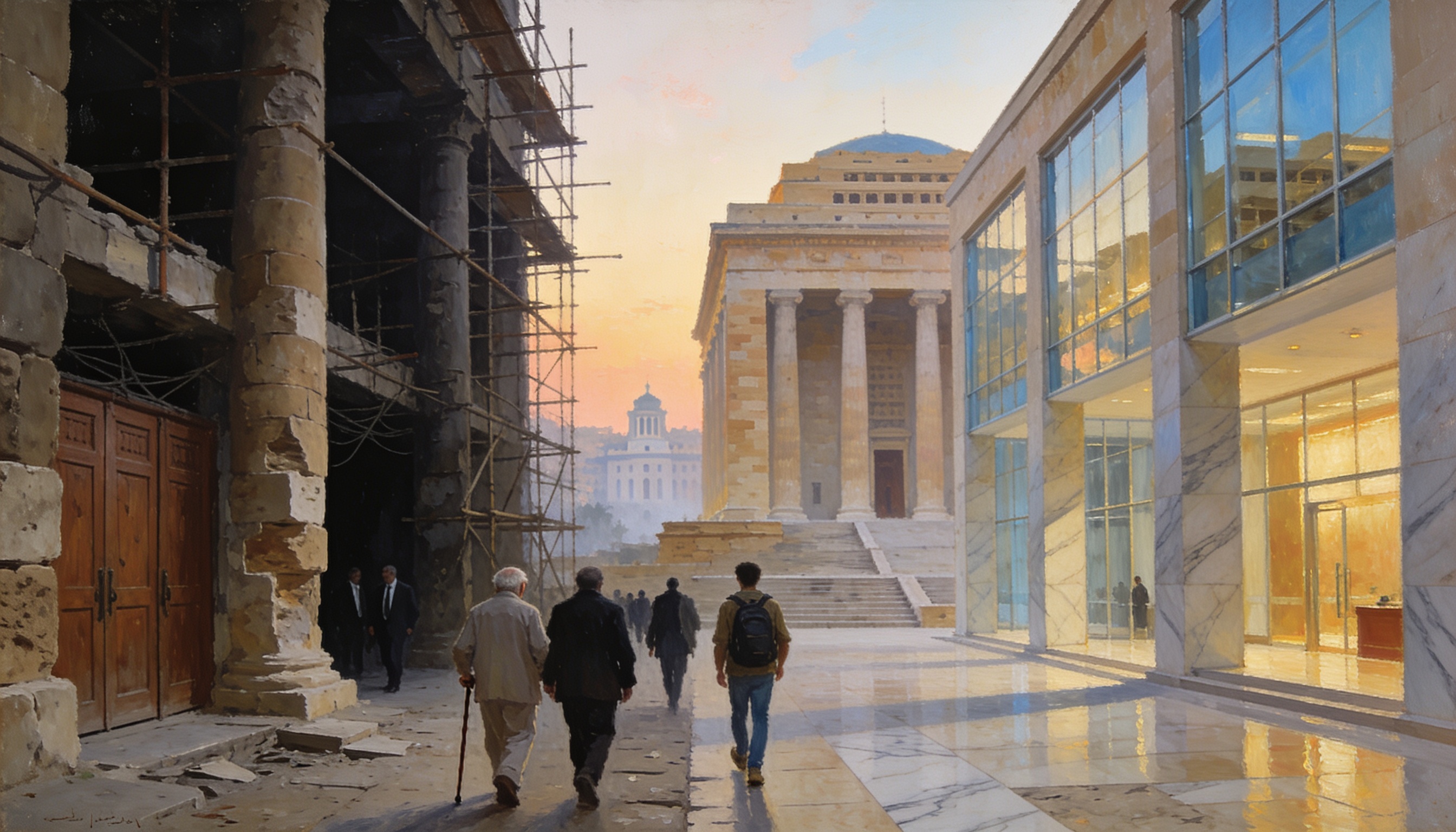
In Lebanon, moderation is summoned whenever the country approaches the brink of explosion, only to recede once the distribution of power begins. Moderates are asked to calm tensions, smooth over differences, and keep the doors of dialogue open, while the forces most capable of obstruction are left to determine the terms of the settlement. In this sense, moderation is assigned a role in containing crises without necessarily having the ability to alter the conditions that produce them.
This is where its fundamental crisis lies. A moderation that limits itself to preventing the worst remains bound by other people’s agendas. It waits for escalation before calling for calm, for obstruction before seeking a way out, and for division before proposing common ground. These roles may be necessary in moments of danger, but they are not enough to build a future. Lebanon needs a form of moderation that has a vision of government, that can take the initiative, confront challenges, and organize, and that can explain to people what will change in their lives if they place their trust in it.
For that to become possible, moderation must be freed from the confusion that equates it with simply standing halfway between opposing sides. In disputes over spending priorities, economic policies, or the management of public utilities, multiple legitimate choices exist, and compromise is part of democratic politics. But when the issue concerns the primacy of the state, the submission of everyone to the law, and citizens’ right to choose their representatives without intimidation, compromise should concern the means of applying these rules, not the principle of adhering to them. Here, moderation is clear about its objective, gradual in its methods, and accountable for the consequences of its actions.
This distinction is essential when it comes to Hezbollah’s weapons. The state’s monopoly over military force and over decisions of war and peace is a basic condition for the existence of a national authority accountable to its citizens. Upholding this principle does not require hostility toward Hezbollah’s social base, nor does it justify ignoring Israeli attacks or the fears experienced by the people of southern Lebanon. Rather, it requires a serious answer as to how they are to be protected, how the army is to be strengthened, and how the conditions for stability, return, and reconstruction are to be secured. Firmness in principle must be accompanied by political, security, and social action that makes the transition to the state both possible and credible.
Yet moderation loses its credibility if it is firm toward weapons while remaining tolerant of the capture of institutions. Calls for a single authority are inconsistent with treating the administration as a system of political shares, the judiciary as a shield, and public funds as a source of influence. The state that the Lebanese are being asked to trust must itself change. President Joseph Aoun’s inaugural address linked the monopoly of arms with reform of the administration. The political task is to turn that connection into a program of action, so that citizens feel that restoring the authority of the state also means restoring their rights within it.
This is where the deeper issue emerges. Citizens may want the state, yet remain tied to the leader or party that meets an immediate need. When access to medical treatment, employment, or the completion of an administrative procedure depends on mediation, the political relationship becomes part of managing everyday life. It is not enough to urge people to free themselves from clientelism without providing them with a reliable alternative. Those who can afford to do without an intermediary can easily condemn dependency. Those who need one to gain admission to a hospital pay for their independence with their own and their family’s security.
Building moderation therefore requires reducing the cost of citizens’ independence. Every public service delivered as a clearly established right, every job made available on the basis of merit, and every administrative procedure completed without intervention expands the space in which Lebanese citizens can make political choices freely. In this sense, institutional effectiveness becomes part of changing the balance of power. Political loyalty takes on a different meaning once it is no longer a condition for obtaining the most basic rights.
For the same reason, moderation needs a clearly defined economic and social content. The word “reform” is not enough unless it is explained who bears the burdens, who receives protection, and how opportunities are distributed. In the financial crisis, for example, progress toward an agreement with the International Monetary Fund is a path with clear legislative and financial requirements. But a political project must also be judged by its position on the distribution of losses, the protection of small depositors, accountability, and the restoration of financing for productive activity. Any settlement that hides these choices behind technical language leaves people outside the decision that will determine their future.
Moderation has sometimes been associated in many people’s minds with the ability to reach an understanding with everyone. Yet any serious reform will collide with the interests of groups that benefit from the status quo, and any removal of a privilege, opening up of competition, or subjection of appointments to publicly declared criteria will generate opposition. The moderate therefore needs to accept the cost of taking a position. Anyone who makes the approval of all political forces a condition for action gives every vested interest the power to block it. This confrontation can be pursued within the law, with clear arguments and openly declared alliances, without sectarian mobilization or accusations of betrayal.
This leads to the link that is so often missing: organization. It is not enough to have respected figures, experts with solutions, or a public exhausted by conflict. The political capacity of a moderate current requires institutions that bring these people together around common priorities, distribute responsibilities, choose representatives, and hold them accountable after they reach power. It also requires a permanent presence in municipalities, trade unions, universities, and neighborhoods, where trust is built through accumulated work.
Nor should this presence reproduce networks of loyalty under a new label. If moderates provide services in exchange for support, they have adopted the very mechanism they criticize. Their role is to help people gain access to their rights, expose the reasons those rights are obstructed, and work to make them available to everyone. They also need transparent financing, internal rules for accountability, and leadership rotation. A project that calls for a state of institutions should demonstrate in its own structure the ability to move beyond the dominance of a single individual.
It is also wrong to assume that a ready-made moderate majority exists, waiting for someone to speak on its behalf. Fear of war does not mean agreement on defense policy, and rejection of corruption does not automatically produce agreement on economic reform. Such a constituency must be built through dialogue over interests and choices and by testing cooperation on specific issues. It may bring together people who disagree on many matters but agree on the primacy of the state and on the rules of political competition and accountability. This agreement allows them to manage their differences without turning them into mutual threats.
Moderation also cannot be confined to one sect or place on a single community the permanent burden of compromise. It needs partners within different constituencies who acknowledge their fears without turning them into justifications for permanent privileges. It needs a discourse that protects people’s right to their identities and affiliations while affirming that their political and civil rights do not pass exclusively through the leaders of those communities.
In this sense, moderation becomes a project for changing the way power is exercised: from bargaining over shares to competition over programs, from protection granted by an influential patron to a right guaranteed by an institution, and from settlements that postpone conflict to rules that allow it to be resolved. Such a project requires patience, but it also requires declared deadlines and objectives, so that gradualism does not become yet another pretext for delay.
The real test of Lebanese moderation begins with its ability to produce this organized force and to present commitments for which citizens can hold it accountable. The calmness of its discourse then becomes an expression of confidence and capacity, and dialogue becomes a means of achieving a clear objective. Moderation that possesses nothing more than a call for moderation, by contrast, will remain in demand when explosion draws near and marginalized when the time comes to decide what follows.