

Power Passes. The Homeland Remains.
From Assala’s Return to Syria to the Question of Patriotism in Lebanon
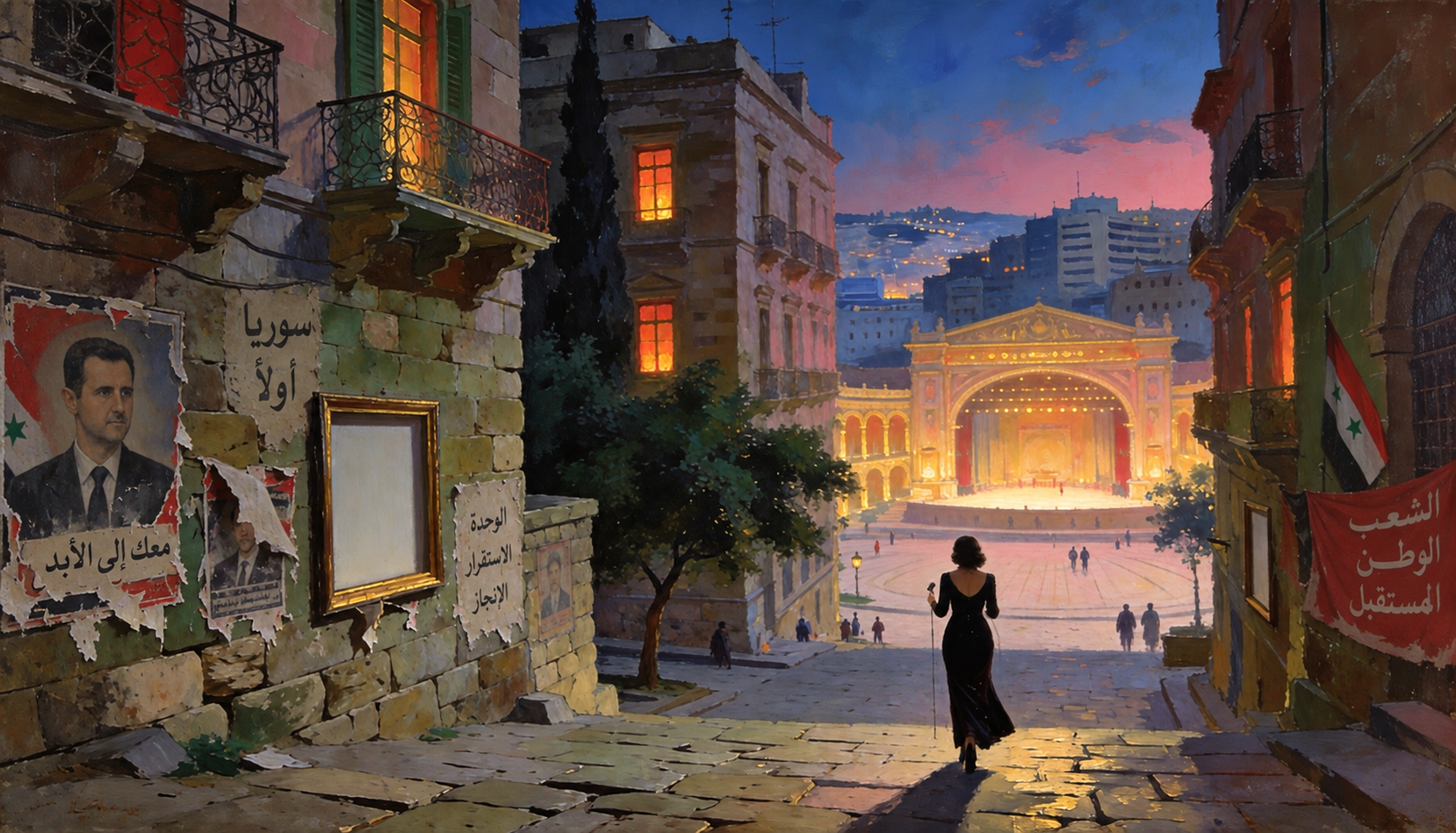
Assala Nasri’s return to Damascus, after an absence of nearly sixteen years, was not simply that of an artist returning to a stage from which she had long been absent. There was something in that image that went beyond music and nostalgia. As though the years separating her last concert in Damascus from her return before a Syrian audience had suddenly been condensed into a single question: who truly remained with Syria, and who was really standing with the power that ruled it?
Assala broke with Syria’s official cultural scene when, beginning in 2011, she chose to oppose Bashar al-Assad’s regime and support the protest movement. That choice led to a long rupture with Syria’s official institutions and kept her away from the stages of her own country. When she returned to Damascus after the change of regime, she was therefore not an artist rediscovering her homeland because power had changed. She was an artist who, throughout those years of absence, had continued to insist that her dispute was with the regime, not with Syria.
Others took a different path. Among them was Raghda, who openly supported Bashar al-Assad and defended the Syrian regime. Assala once summed up their disagreement in a particularly revealing way: she said that she stood with the revolution and with the people, while Raghda stood with the regime.
But the importance of this comparison today lies neither in putting the two artists on trial again nor in handing out retrospective certificates of patriotism or treason. The real question lies elsewhere. What is the homeland? Who represents it? Does standing with those in power necessarily mean standing with the state? And does opposing those in power mean opposing the homeland?
Homeland, State and Power
Here we leave Assala and Raghda behind, and even Syria itself, to address a broader political question. In countries where institutions are weak, where regimes endure and leaders gradually come to merge with the landscape itself, a dangerous confusion takes hold between three notions: the homeland, the state and political power.
The homeland is the land, the people, memory, the public interest and a shared future. The state is the set of institutions and laws meant to administer that homeland in the name of its citizens. Political power, meanwhile, is exercised by those who run those institutions at a particular moment.
The homeland remains. The state is meant to endure. Power changes.
The problem begins when the boundaries between the three disappear. Criticising the president then becomes equivalent to attacking the state, opposing the government becomes an act of betrayal toward the homeland, and disagreeing with a party is presented as an attack on a community or a group. Conversely, defending a leader becomes proof of patriotism, even when that leader’s choices conflict with state institutions or the interests of citizens.
This is precisely what makes Assala’s story politically more interesting than artistically. She was absent from Damascus while remaining Syrian. Power changed. She returned to her city. Many things had changed. Damascus was still there.
The image recalls a simple truth that we often forget in our part of the world: power is not the homeland.
From Damascus to Beirut
The question becomes distinctly Lebanese here. In Lebanon, the boundaries between patriotism and political affiliation, between the state and the party, are often blurred. National causes become banners almost monopolised by a community, an organisation or a leader.
Lebanese art itself offers particularly revealing examples.
Take Fairuz. For decades, she sang far more often of Lebanon than of any Lebanese government. Presidents and cabinets came and went, war erupted and ended, parties rose while others declined, yet her songs remained part of a shared Lebanese memory. Beirut was there. Lebanon was there. And in her songs, Lebanon had no need to carry the name of a president, a party or a leader.
That is where the strength of this model lies: loving the homeland without reducing it to those who govern it.
Ziad Rahbani chose a different path. He never concealed politics behind his art. He made politics part of it. Close to the left and the Lebanese Communist Party, he defended the Palestinian cause before later adopting positions favourable to Hezbollah and the Syrian regime. Yet at various moments he did not hesitate to criticise certain political practices of his own allies.
This comparison does not make Fairuz more patriotic than Ziad, nor Ziad more committed than Fairuz. They embody two different ways of linking art and politics. Fairuz chose, to a large extent, to make her voice a space in which Lebanese people of different views could still come together. Ziad chose to enter the political arena with his ideas, commitments, criticisms and contradictions.
Both choices are legitimate. The problem is not that an artist takes a political position. It begins when a position turns into allegiance.
Julia Boutros offers another model. A central part of her artistic career was built around Palestine, resistance and the rejection of occupation. After the July 2006 war, the link between her artistic discourse and the resistance represented by Hezbollah became even stronger, to the point that the song “Ahibbai” drew on words from a speech by Sayyed Hassan Nasrallah.
But this experience raises a question that goes beyond Julia herself: what happens when a national cause becomes associated, in the public mind, with a single party?
Resistance to occupation can be a national cause. That does not mean that every political choice made by the party that champions that cause automatically becomes a national choice. Nor does opposing that party’s domestic policies necessarily mean opposing resistance itself.
This is where one of the most dangerous forms of confusion appears: the shift from supporting the cause to supporting the organisation, from the organisation to its leadership, and then to treating every criticism of that leadership as an attack on the cause itself.
But this logic is not confined to one camp. On the opposite side of Lebanon’s political divide, Elissa has never hidden her political choices. She has voiced clear positions, including support for the Lebanese Forces and criticism of Hezbollah. She also supported the October 17 uprising.
The standard, however, should remain the same. If we reject reducing Lebanon to Hezbollah, we cannot reduce it to the Lebanese Forces or to any other party either. If support for resistance gives no party the right to monopolise patriotism, opposition to Hezbollah gives no other camp the right to monopolise sovereignty or the state.
Resistance does not belong to one party. Sovereignty does not belong to one party. The state does not belong to one party. And Lebanon certainly belongs to no one.
The Problem Is Not Taking a Side
No one is asking the artist, the intellectual or the citizen to have no opinion, or to remain forever in the middle. Neutrality is not a virtue in every circumstance. At certain moments, taking a position may even become a moral or political duty.
The problem is not that Assala took a position, nor that Raghda chose the opposite side. Nor is it that Julia believes in resistance, that Elissa embraces a different political choice, or that Ziad Rahbani was a man of the left with clear political commitments.
The real question arises when the person or party one supports comes into conflict with the principle one claims to defend.
Can one support a party when one believes it is right, then oppose it when one believes it is wrong? Can one defend resistance in the face of occupation, then debate its weapons when the issue concerns the state and decisions of war and peace? Can one invoke sovereignty against interference by a state one opposes, then defend that same principle when the influence comes from a state one regards as an ally? Can one defend judicial independence when it reaches one’s adversary, then defend it with equal force when it reaches one’s ally?
That is where the difference between allegiance and citizenship begins to emerge.
The Citizen and the Partisan
The partisan always runs the risk of starting with the person or the party, then searching for the principle that will justify the position. The citizen should do the opposite: begin with the principle, then decide, on that basis, whom to support and whom to oppose.
This does not mean, of course, that party affiliation is incompatible with citizenship. Political parties are a natural part of political life. Joining them, defending their ideas and working to bring them to power are all part of democratic life.
But the party remains a political instrument. It is not a homeland. The leader remains a political figure. He is not the state. The government remains a temporary authority. It is not the Republic.
The problem begins when this relationship is reversed: when the party ceases to be an instrument serving the state and the state becomes an instrument serving the party; when the leader ceases to be subject to criticism and accountability, and defending him becomes in itself a test of national loyalty.
Patriotism Is Not a Song
Perhaps the word “patriotism” itself needs to be stripped of a few misconceptions.
Patriotism is not a song about Lebanon, nor an image of the flag, nor a speech about martyrs. Nor is it the monopoly of words such as resistance, sovereignty or independence. It does not mean always standing with those in power. Nor does it mean always standing against them.
It is perhaps both simpler and more demanding than that: making the homeland the constant, while leaving everything else open to criticism, challenge and change.
Changing one’s view of a president without changing one’s view of the state. Disagreeing with a party without turning against the community from which it draws its support. Supporting a cause without granting permanent immunity to those who claim to embody it. Opposing those in power without feeling that one is opposing one’s country.
And the Homeland Remains
Let us return, finally, to the image with which we began.
After nearly sixteen years, Assala returned to Damascus. Power had changed. The faces, slogans and portraits had changed. But Damascus remained.
That image perhaps says more than many theoretical debates about patriotism.
Political leaders come and go. Governments change. Regimes can fall. Parties rise and decline. Alliances shift. And the leader who at one moment appears to be an eternal part of the landscape may, a few years later, become a chapter in a history book.
The homeland is what is supposed to remain after all of them.
That is why the question to ask an artist, an intellectual or a citizen may not simply be: “Whose side are you on?”
The harder question is this: when the person or party you support comes into conflict with what you believe to be the interest of your country, what remains of your position?
That is where the difference between belonging and allegiance, between support and citizenship, begins.
And perhaps patriotism begins precisely there: when the homeland remains the only constant, while all those who govern it, organise politically within it or claim to speak in its name remain open to debate, criticism and replacement.