

Middle East Conflicts Take Center Stage at the UN General Assembly
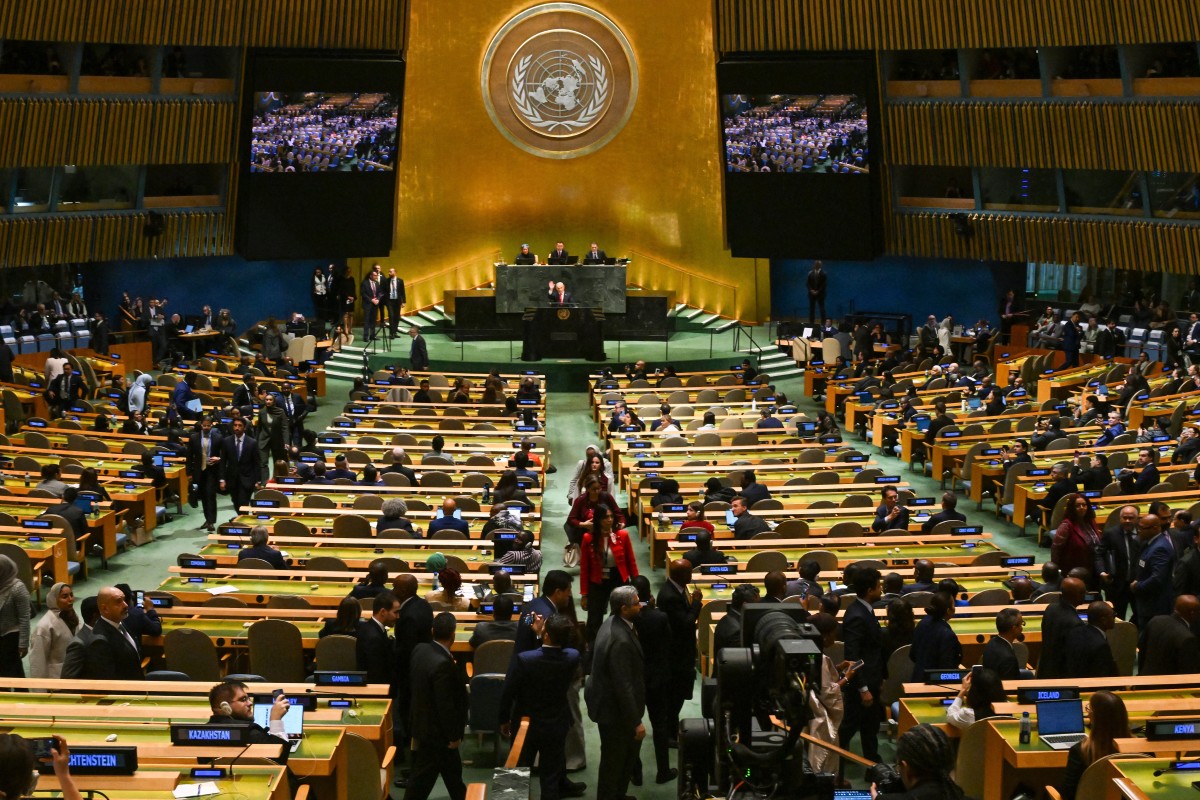
To follow and understand the war—or rather, wars—in the Middle East during the week of September 21–27, 2026, one had to look instead… to New York. Regional conflicts heavily shaped some of the most closely watched speeches at the 81st session of the United Nations General Assembly, including those by U.S. President Donald Trump, Israeli Prime Minister Benjamin Netanyahu, Iranian President Massoud Pezeshkian, Lebanese Prime Minister Nawaf Salam, and Palestinian Authority President Mahmoud Abbas (speaking remotely).
Beyond the speeches, the plenary assembly provided an opportunity for important bilateral meetings, two of which stand out: a U.S.-Iranian meeting that failed to produce the hoped-for results, and a Lebanese-Iranian meeting that, according to various sources, turned sour.
The Iran file
Unsurprisingly, the war in Iran featured prominently in the much-anticipated address delivered by the U.S. president at the United Nations on September 22. His remarks can be summed up as a mix of threats and an opening for diplomacy. President Trump described Iran as the “leading sponsor of terrorism,” strongly defending his war against the Islamic Republic regime. However, he contrasted his ability “to obliterate” the country with the possibility of reaching a nuclear agreement.
This narrow opening with the Iranians quickly took concrete form in New York in a three-hour meeting between Trump’s envoys, Steve Witkoff and Jared Kushner, and an Iranian delegation that included Foreign Minister Abbas Araghchi. Trump himself described the meeting as “positive” that same day.
But that spirit did not last: a new peace proposal submitted by Iran, which calls for reopening the Strait of Hormuz within seven days, was rejected this week by the U.S. president. According to Reuters, Trump believes Iran is losing the war and is seeking an agreement only out of financial desperation.
The Wall Street Journal even reported this week that President Trump is considering resuming the bombing after the midterm elections in November. Trump himself reaffirmed this week that the war would end after the elections, without saying how.
The speeches by the Iranian president and the Israeli prime minister offered no better prospects. The former stressed that Iran does not want to fight, but that it will “never bow down” to U.S. threats, while defending his country’s right to civilian nuclear power. No major concessions appear likely.
Netanyahu’s speech, meanwhile, was particularly provocative toward Iran, predicting “the imminent fall of the murderous Iranian regime.” This war began on February 28 with joint strikes by the U.S. and Israeli militaries, before the Israelis were later sidelined by U.S. decision.
It should also be noted that this week in the United States saw Chinese President Xi Jinping’s highly anticipated visit to Washington, where Trump received him with great pomp. With regard to the war in Iran—traditionally a Chinese ally—the visit resulted in a joint statement by the two powers on the need to prevent Iran from developing nuclear weapons and to ensure that no actor imposes transit fees on international waterways, notably the Straits of Hormuz and Bab el-Mandeb. This statement runs counter to two of Iran’s main demands. Will this shift in China’s position have a long-term impact on the conflict between the United States and Iran?
The debate over Lebanese sovereignty
The war in southern Lebanon between the pro-Iranian Hezbollah and Israel, stemming from the war in Iran, was naturally a key theme in New York this week in the Lebanese prime minister's address, attended by Foreign Minister Joe Raggi. Nawaf Salam's speech targeted both Israel's war in the south and Iran's enduring influence through its allied militia.
“No one speaks on behalf of Lebanon, and no one negotiates on its behalf,” he insisted from the UN podium, reiterating the Lebanese state's determination to retain an exclusive monopoly on arms. He also called on the international community to guarantee Lebanon's sovereignty and, in particular, secure Israel's withdrawal from the south of the country.
The same tone prevailed in a meeting between Salam and Iranian President Pezeshkian on the sidelines of the plenary assembly, attended by the Lebanese and Iranian foreign ministers. According to multiple press reports, the exchange was tense, particularly when Lebanese officials requested a change of ambassador in Beirut. Mohammad Reza Chibani, Iran's designated envoy, was declared persona non grata by the Lebanese government.
On Monday, Salam is due to meet Secretary of State Marco Rubio in Washington to reiterate the same Lebanese demands. Will he be able to shake up the status quo, at a time when US-Iranian negotiations are at a standstill and Israel is awaiting the outcome of parliamentary elections that could change its counterpart in direct Lebanese-Israeli talks?
Dialogue breaks down between Israelis and Palestinians
The third issue prominently featured at the UN was the Israeli-Palestinian conflict. Between Netanyahu, who delivered his address to an almost empty hall, and Abbas, who gave his remotely after failing to obtain a US visa, an agreement appears more distant than ever. Each presented a diametrically opposed view of the conflict that has been ongoing since Hamas's October 7, 2023 operation.
Netanyahu, who is preparing for a particularly tight election in October, fired arrows in every direction. He maintained that “the survival of the Jewish state” is at stake.
For his part, Mahmoud Abbas warned of a “new Nakba,” referring to Israeli attacks not only in Gaza but increasingly in the West Bank.