

Military Escalation Intensifies, From Iran to South Lebanon


While the United States had appeared to be relying solely on economic warfare against Iran, the US military abruptly carried out strikes on Iranian territory on Tuesday in retaliation for attacks targeting oil tankers, setting off a spiral of violence over the course of the week. In Lebanon, Israel released several civilians held in its prisons, while its army seized the strategic Ali el-Taher hill and continued its heavy strikes in the area it controls in the south of the country.
The week from August 31 to September 6 was marked by a sharp acceleration of events in the Middle East, after the previous one had seemed defined by relative stagnation.
On the Iranian front, the US military carried out targeted strikes inside Iranian territory as early as Tuesday evening, the first in nearly a month.
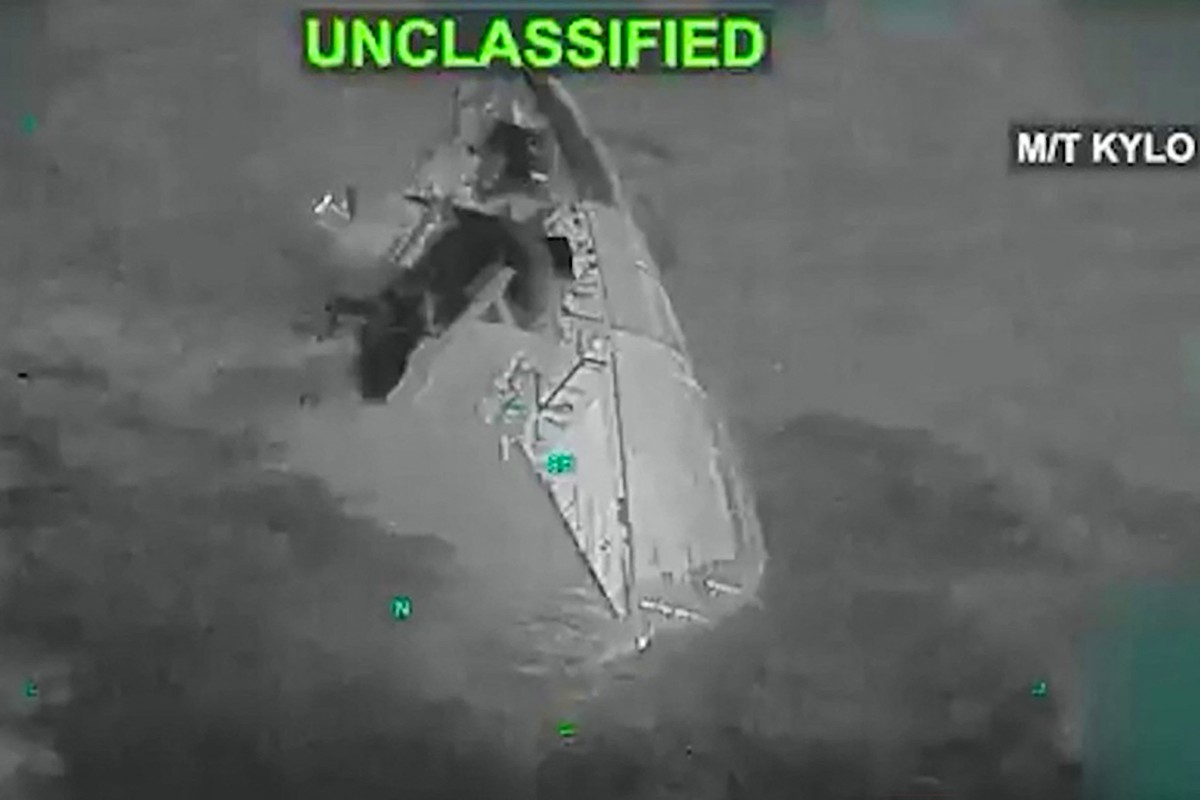
This screen grab, made on September 6, 2026 from undated video footage released the same day by US Central Command, shows what CENTCOM says is one of the Iranian oil tankers it destroyed in response to attempted missile attacks on naval vessels. (CENTCOM via AFP)
However, the relatively limited pace of the strikes suggests that the US administration has opted for an escalation that remains controlled, while continuing its blockade and economic pressure on Tehran.
Even so, tensions continued to rise throughout the week. Explosions were heard on Saturday on the highly strategic island of Kharg, through which most of Iran’s oil exports pass.
US President Donald Trump, for his part, threatened to strike the Kuh-e Kolang nuclear site — “Pickaxe Mountain” in Persian — a heavily fortified facility located deep underground, not far from Natanz, Iran’s main uranium-enrichment site.
Earlier in the week, he had enshrined the “tanker for tanker” equation, pledging to target an Iranian vessel every time the Islamic Revolutionary Guard Corps struck an oil tanker in the Strait of Hormuz.
That is precisely what the US military did on Saturday, setting two Iranian vessels ablaze.
Politically, Donald Trump further hardened his tone toward Tehran. After saying in an interview that talks had been permanently frozen “because an agreement with them is not worth the paper it is written on,” he said on Saturday that the “conflict” with Iran was not a “war,” but “something ordinary” for the United States.
A way of rattling the Iranians while at the same time reassuring the US public ahead of the midterm elections.
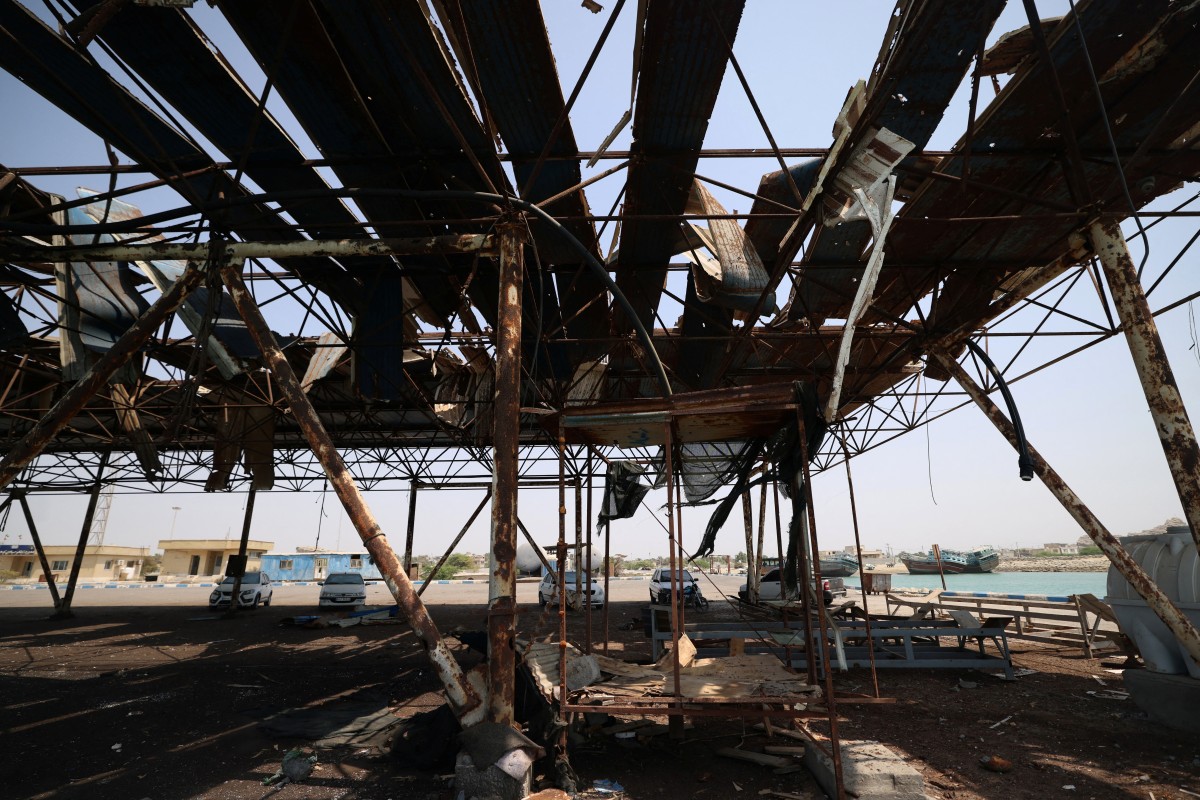
A port, along with storage facilities and warehouses, was damaged following a US military strike carried out on September 6, 2026 in Iran’s southern Hormozgan province, which borders the Strait of Hormuz. (AFP)
At the same time, the US news outlet Axios published a report on Saturday suggesting that the United States is already looking beyond this conflict, which began on February 28.
Citing US officials and other informed sources, the outlet said the Trump administration is developing a broader strategy for the post-war Middle East. According to the report, it would be based on creating a regional alignment aimed at containing Iran, bringing an end to the regional fallout from Hamas’s October 7, 2023 attacks in Gaza, and expanding the circle of normalization between Israel and countries in the region.
The threat against Kuh-e Kolang, which brings the Iranian nuclear issue back to the fore, echoes an announcement by the International Atomic Energy Agency (IAEA), which said on September 1 that Iran had still not reopened its sites to inspectors following the strikes of May 2025.
It should be recalled that despite the scale of the Israeli-American offensive against Iranian sites, it is almost certain that the stockpile of enriched uranium remains intact and has been moved to a safe location by the Iranian authorities, which remain committed to what they consider their right to develop a nuclear program.
Following the IAEA announcement, the United States, together with France, Britain and Germany, said they intended to submit a resolution to the UN Security Council condemning Iran’s failure to comply with its non-proliferation commitments.
This display of unity stands in contrast to the chill that has prevailed between Washington and its European allies since the beginning of the conflict.
For their part, the Iranians appear to be responding to the upheaval in much the same way as before: by striking neighboring countries, notably Kuwait, the United Arab Emirates and Jordan, without directly targeting Israel.
Heavy strikes in southern Lebanon
On the Lebanese front, Israel is intensifying its destruction operations in villages in the south, even using explosive barrels in some cases.
Lebanese President Joseph Aoun urged Washington and the international community to “put an end” to Israeli attacks on Lebanese territory, which killed seven people on Sunday against the backdrop of a fragile truce.
The strikes hit several localities in the Nabatiyeh region. Twenty people were also wounded, including children, according to the Health Ministry. One strike also destroyed the former Ghandour hospital, which had been out of service for years.
Release of detainees and capture of Ali el-Taher
But the major event of the week in the south was the Israeli capture of the strategic Ali el-Taher hill in the Nabatiyeh region.
The site served as a major Hezbollah headquarters, consisting of an extensive network of tunnels from which fighters from the Shiite party operated, along with, according to some reports, Iranian fighters.
On Thursday evening, the Israelis announced that they had taken control of the complex. On Sunday, Israeli Defense Minister Israel Katz said that tunnels still had to be blown up.
This military “success” may not have come as a surprise after weeks of bombardment, but Hezbollah’s reaction was more unexpected.
After long insisting that it would refuse to give up this strategic hill — as had the Iranians, who had also threatened to intervene — the Shiite party ultimately sought to play down the significance of the development through its media outlets and allied networks, without officially confirming the loss of the site, which it had refused to preserve by handing it over to the Lebanese army.
The other major surprise of the week was Israel’s release of five Lebanese and Syrian civilians held in its prisons.
The move came following a visit to Tel Aviv by US Ambassador to Lebanon Michel Issa.
According to the Israeli prime minister’s office, Thursday’s announcement “follows efforts by Israel and Lebanon to locate and repatriate the remains of leaders of the Jewish community who had been abducted and killed in Lebanon” between 1984 and 1986.
Here too, Hezbollah’s reaction raises questions. While describing the move as positive but insufficient, the party once again turned on the Lebanese authorities, accusing them of “submission to the enemy” and holding them “responsible” for the disaster in the south.
It even warned them against “internal conflicts.” Could the party’s military setbacks push it to turn increasingly toward the domestic front?
Finally, the Israeli army made an important statement on Sunday, saying it was considering reducing its occupation zone in southern Lebanon, moving from the current “yellow zone” to a “grey zone.” Such a development would, according to this assessment, reflect a reduced threat from Hezbollah.
The measure has not yet been approved by Israel’s political leadership.
Yemen and Palestine
The week was also particularly tense in Yemen, where clashes between Houthi rebels and government forces continued to intensify, culminating in an especially deadly Saturday in which more than 60 people were killed in a single day, bringing the death toll since Thursday to around 200.
The Houthi offensive is aimed in particular at taking control of areas bordering the Bab el-Mandeb passage, which would give this Iranian ally additional leverage over another major strategic chokepoint after the Strait of Hormuz.
In Palestine, particularly troubling comments by Israel Katz on Gaza marked the week. He claimed, without providing evidence, that most of the territory’s residents wanted to leave, stressing that Israel was “ready for such an evacuation” on a mass scale.
A sign that the ordeal of Gaza’s residents may be far from over.
Finally, it is worth noting that the IAEA announced on September 1 that facilities discovered in Deir el-Zor, Syria, indicate that Bashar al-Assad’s former regime had secretly been preparing an advanced nuclear program that could have led to the production of an atomic weapon with the help of North Korean experts.
From Yemen to Lebanon: Iran Wages a Covert Proxy War
Escalation in Yemen; explosives seized in Lebanon: Iran reactivates its proxies
When Terrorism Enters the Middle East Conflict…
Middle East Conflicts Take Center Stage at the UN General Assembly
The Houthis Continue Their Escalation Against Riyadh
More from LevantTime .
View All


More in Weekly essentials
View All


Latest from Levant Time
View All


