

Paris is Reported to Have Presented a Definitive Solution Project
The Lebanese government determined to impose an arms monopoly


The Lebanese government undertook intensive diplomatic activity on Friday, March 6, in an attempt to put an end to the rampant degradation shaking the country, following the reopening of the South Lebanon front by Hezbollah, on the night of the 1st to March 2, disregarding all warnings addressed to Lebanon on this plan in recent weeks. Faced with this new suicidal adventure by the formation allied with the Pasdaran, the paramilitary and security activities of the pro-Iranian party were banned on Monday by the government of Nawaf Salam. But Hezbollah remains completely deaf to official injunctions and remains deeply engaged, under instruction from the Islamic Republic of Iran, in a regional war to which Lebanon is completely foreign.
The outcome of the standoff between the state and Hezbollah will be decisive for the fate of a Lebanon that has been living, since Thursday, under the threat of an intensification of raids carried out by Tel Aviv against several regions of the country, in retaliation for the pro-Iranian group's attacks against northern Israel.
Prime Minister Nawaf Salam, who received Western and Arab ambassadors accredited to Beirut on Friday morning, reaffirmed his government's determination to hold the decision of war and peace and to implement its decision to impose a monopoly on weapons. He outlined the official measures taken for this purpose and asked them to request their respective governments to intervene with Israel to spare civilian infrastructure in particular, insisting that Lebanon was drawn into this war against its will.
While tens of thousands of displaced people from South Lebanon and the southern suburbs of the capital remain homeless, after being ordered by Israel on Thursday to evacuate the areas where they live, Nawaf Salam warned his interlocutors of the seriousness of «the humanitarian catastrophe» looming on the horizon.
At the same time, Lebanese Foreign Minister Joe Raggi undertook intensive diplomatic contacts to try to curb a potential large-scale Israeli offensive.
Meanwhile, an unofficial Hezbollah spokesman, Jaafari Mufti Ahmad Kabalan, implicitly criticized the state for «its defeatism», calling on it to «assume its national responsibilities» in the face of the war with Israel.
A French project
In this context, the pan-Arab channel Al-Hadath reported on Friday morning information according to which France transmitted to Lebanon a definitive solution project based on the following points: Hezbollah's announcement that it ceases combat and lays down its arms; deployment of the army in the southern suburbs and in Hezbollah strongholds in the South and in the Bekaa to seize the formation's weapons within a maximum of two weeks; the weapon collection operation would be carried out under the supervision of the United States; the Lebanese state would officially announce that it is prepared to enter into peace negotiations with Israel.
According to the pan-Arab channel, Tel Aviv has given the Lebanese authorities until the end of the week to respond to this solution project, failing which attacks against Hezbollah would be intensified.
However, sources from the pro-Iranian formation, quoted by Al-Hadath channel, affirm that Hezbollah «will react to any descent of the Lebanese army into its arms caches, as if it were an Israeli attack».
Israeli pressure remains strong
On the Israeli side, military pressure remains strong. Israeli air forces, which carried out a series of violent raids against the southern suburbs and several regions of the Bekaa and the south of the country on Thursday night to Friday, targeted the predominantly Sunni city of Saida and the Dahr el-Baydar international highway on Friday. These strikes killed four people in Saida, where Hamas leaders were targeted. Hezbollah had previously launched several rocket barrages against northern Israel.
Faced with this scenario, will official Lebanon succeed in withdrawing the country from a catastrophe made inevitable by Hezbollah's excessive vassalage to Tehran? The outcome of the race against time in which the authorities are engaged remains uncertain.
Through its Defense Minister, Tel Aviv announced that it would continue its military operation in Lebanon «until the battle with Hezbollah is decided». In other words, until Iran is brought to its knees.
According to Israeli media, citing army officers, Tel Aviv has noted a decrease in the frequency of ballistic missile launches against Israeli territory. «That's a good thing, but we shouldn't be satisfied with it. A lot of work remains to be done,» an Israeli security official was quoted as saying by Kan.
US President Donald Trump also expressed satisfaction with the progress of the military offensive against Iran, believing it was going «better than initially planned. According to him, the operation should still last «a few weeks», despite internal opposition in the United States to the war against Iran. However, the majority in the Senate and House of Representatives remains favorable to this war, as shown by Thursday's vote.
The US House of Representatives thus rejected a draft resolution aimed at limiting President Trump's powers and preventing him from continuing the war against Iran without congressional approval.
France Avoids a State of Emergency but Prepares for the Worst
A Nobel Peace Prize to Save International Law in Peril
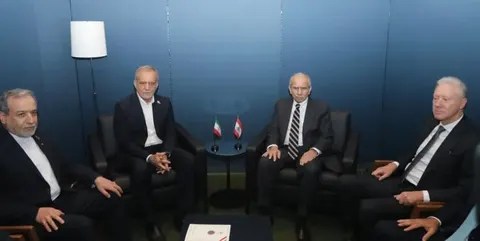
A Lebanese-Iranian Meeting in New York, but Several Political Messages
“No State Can Have Two Armies and Two Decision-Making Authorities,” Salam Says in New York
Trump Pulls Back at the Last Minute From Strikes on the Houthis
Mais de Tilda Abou Rizk
Ver tudo



Mais em Today's Essential
Ver tudo


O mais recente do Levant Time
Ver tudo


