

A Lebanese-Iranian Meeting in New York, but Several Political Messages
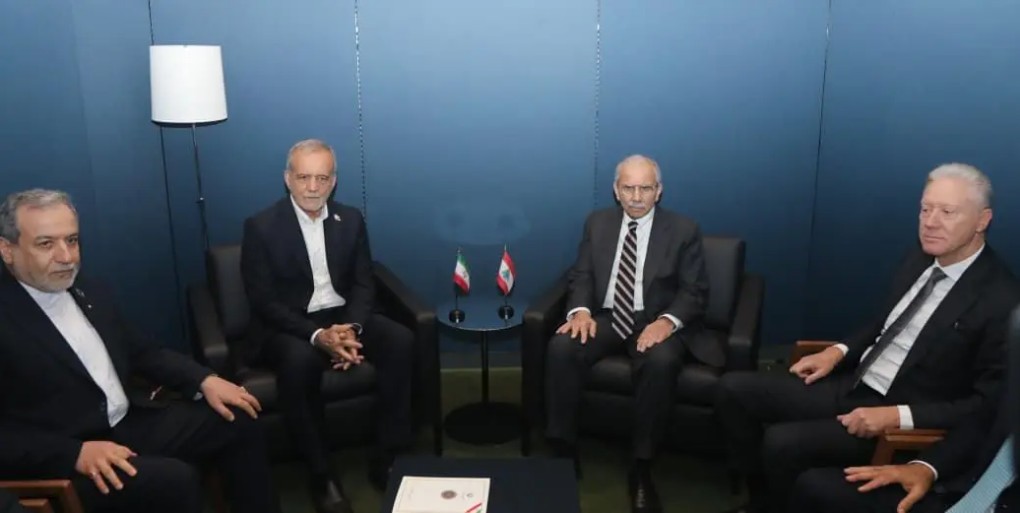

On Thursday, Lebanon bluntly asked Iran to stop meddling in its internal affairs through Hezbollah and to keep their bilateral relations on a state-to-state footing. That was the essence of the message Lebanese Prime Minister Nawaf Salam conveyed to Iranian President Massoud Pezeshkian during their meeting on the sidelines of the UN General Assembly, attended by Lebanese and Iranian foreign ministers Joe Raggi and Abbas Araghchi.
Against the backdrop of the acute crisis that has persisted for more than six months between Beirut and Tehran, the Lebanese-Iranian meeting in New York would normally be considered highly significant. But divisions within Iran’s leadership—where decision-making power, as is well known, lies not with the president and his foreign minister but with the Islamic Revolutionary Guard Corps—and differing Iranian views on how to handle regional issues, diminish the scope of the exchange.
Its importance therefore lies in its symbolism, especially as the meeting took place at the express request of the Iranian delegation, but also in some of the political messages it conveyed.
It primarily gave Lebanon the opportunity to reiterate before one of the highest authorities of the Islamic Republic what it has been demanding for months: respect for its sovereignty.
“We want a state-to-state relationship,” the Lebanese prime minister stressed, insisting that Lebanon cannot be an “arena” for regional conflicts or “a space for exchanging messages between” foreign powers. He called for “turning a new page” between Beirut and Tehran, “based on mutual respect, non-interference in internal affairs, and the pursuit of common interests.”
Another important signal emerged from the meeting: by directly calling on President Pezeshkian to appoint a new ambassador to Lebanon to replace Mohammad Reza Chibani, whom Lebanon’s Foreign Ministry had declared persona non grata, Nawaf Salam demonstrated Beirut’s firmness and, above all, the unity of the leadership on issues affecting its sovereignty, at a time when the pro-Iranian axis had sought to portray the Chibani affair as a partisan matter.
Along the same lines, the prime minister defended the restoration of state authority over the entire territory and the importance of a state monopoly on arms.
For his part, the foreign minister said that the Lebanese delegation had “clearly presented its sovereign position to the Iranian officials.” “I see no problem with meeting any party and shaking hands with it,” Joe Raggi continued, explaining that “negotiations and dialogue generally take place with the party with which one has a problem, precisely in an effort to resolve it.” According to him, the discussions focused mainly on “the conditions needed to establish stronger relations between Beirut and Tehran, based on mutual respect and, in particular, respect for Lebanese sovereignty.”