

The Lebanese Army Faces the Test of International Support
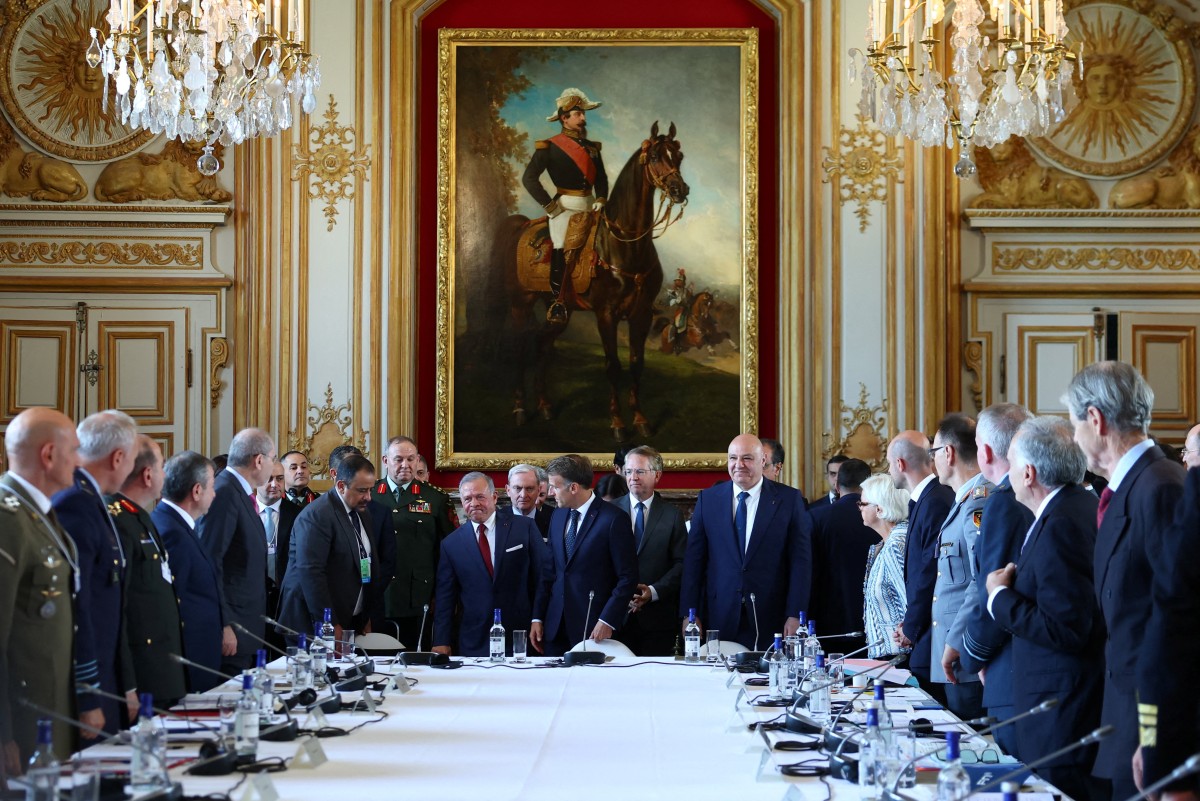

Thursday was a distinctly Lebanese day in Paris, where Lebanese President Joseph Aoun called on participants in the preparatory meeting for the international conference in support of the army to “draw up a roadmap and a precise timetable” for the conference, an initiative launched by President Emmanuel Macron. Its date, however, has yet to be determined.
The meeting, held at the Hôtel des Invalides, was part of the Aqaba Process launched in 2015 by Jordan’s King Abdullah II to strengthen security and military cooperation against terrorism.
Abdullah II attended the meeting alongside representatives of the United States, including US Ambassador to Beirut Michel Issa and the head of the Lebanon Military Coordination Group, General Joseph Clearfield, as well as senior officials from Arab countries and the European Union.
The commander of the Lebanese Armed Forces, General Rodolphe Haykal, also attended.
The significance of this meeting lies in the fact that it comes at a time when Lebanon, grappling with a multidimensional crisis that has dragged on since 2020 and a devastating war triggered by a group that neither recognizes the authority of the state nor agrees to submit to it, is firmly committed to rebuilding its institutions.
To achieve this, it needs the help of its Arab and international partners.
That was, in fact, the essence of President Aoun’s message. At the outset of his speech, he declared that “Lebanon and the Lebanese have chosen the state.”
Not all of them, of course, since Hezbollah, which is entirely beholden to Iran, remains a major obstacle to extending state authority throughout the country through the regular armed forces.
Those forces are still not sufficiently equipped to carry out this mission, which will be made even more difficult by UNIFIL’s departure at the end of the year.
These were the challenges the head of state laid out at Les Invalides, stressing the importance of the partnership being sought, which he placed within the framework of the Aqaba Process.
“It provides us with an important framework for coordinating efforts and jointly identifying needs and priorities,” he said, warning that UNIFIL’s departure at the end of its mission “must not create a security vacuum, but rather foster a stronger presence by the state and its institutions, particularly the army.”
The army has admittedly begun securing certain sectors, particularly in the three pilot zones designated in the June Lebanese-Israeli framework agreement.
Its mission, however, remains severely hampered by a lack of resources that only substantial international assistance can remedy.
The support conference, which is expected in principle to be held in October, must therefore serve as a test of Lebanon’s partners’ willingness to provide the army with the technical and military resources it needs to carry out its mission successfully.
It should also serve as a test of the government’s seriousness and political ability to assert its authority wherever possible, in implementation of its two decisions of March 2026, when it announced the “immediate prohibition” of all Hezbollah military and security activities, and of April 9, when it decided to make Beirut a “demilitarized city, free of illegal weapons.”
In any event, for international assistance to the army to be effective, it must be sustained over the long term, Joseph Aoun stressed, noting that Lebanon has so far honored, to the best of its ability, the commitments it made under the framework agreement with Israel.
For him, only a “long-term partnership based on clearly defined commitments” would enable the army and security forces “to plan and strengthen their capabilities instead of managing their needs from one crisis to the next.”
“We are committed to ensuring that this support is accompanied by the highest levels of transparency and accountability,” President Aoun stressed. “We are ready to work with our partners on a clear and transparent mechanism that sets priorities, monitors the implementation of commitments, ensures that aid reaches those who need it, and makes it possible to measure its results and impact,” he pledged, emphasizing that “the Lebanese state will subsequently have to assume a growing share of the funding for its security and military institutions as it restores its public finances.”
The president highlighted this concern for transparency because Lebanon has, for many years—particularly since the economic and financial collapse of 2020—ceased to receive international aid due to the endemic corruption that led to that collapse.
Tripartite meeting and Israeli threats
According to various media reports, the meeting at Les Invalides resulted in an agreement to support the army and security services.
The participants had previously discussed the needs of Lebanon’s security institutions on the basis of a comprehensive report presented by Lebanon.
The talks were preceded by a one-on-one meeting between Aoun and Macron, during which they reviewed the situation in southern Lebanon, where Israeli attacks and demolitions continue unabated, as well as the post-UNIFIL era.
The one-on-one meeting was followed by a tripartite summit with King Abdullah, during which they reviewed all the military upheavals in the region and their impact.
In a statement, the Lebanese presidency reported a convergence of views on the need to “step up diplomatic efforts to reduce tensions.”
Meanwhile, in Tel Aviv, Israeli Prime Minister Benjamin Netanyahu renewed his threats against “the Iranian regime” and its proxies.
Claiming that they “still seek the destruction of Israel,” but that “their capabilities have been greatly diminished,” he said that “work remains to be done: bringing down the regime in Iran and eliminating Hamas and Hezbollah, which we intend to deal with.”
While the situation on the ground in the region remains unchanged, the U.S. news site Axios reported that U.S. President Donald Trump plans to hold a meeting on Tuesday, on the sidelines of the 81st session of the UN General Assembly, with Gulf leaders who will be in New York.
According to Axios, the aim of the meeting is to “discuss the next steps in the war against Iran” and Washington’s ideas for “a postwar strategy.”