

The Escalation is Spreading, French Interests Threatened


Fears of a military conflict between Iran and the axis formed by Israel and the United States getting bogged down are being confirmed as developments on the ground accelerate and political and military confrontation between Tehran and Washington intensifies.
On the fourteenth day of the war raging since February 28, Washington and Tel Aviv insist on their determination to annihilate the military capabilities of Tehran, which is reacting by expanding the scope of its attacks, just hours after the bellicose televised message from the new Iranian Supreme Leader, Mojtaba Khamenei, who was nevertheless injured in the violent strike that killed his father, Ali Khamenei. Diplomacy still seems to have no place in this tug-of-war whose outcome remains uncertain.
For the first time since the beginning of the conflict, French targets in the region are being targeted by Iran. Yet, traditionally, Paris maintains cordial relations with the Islamic Republic, while remaining critical on certain issues.
It would be interesting to note that the attack was not carried out directly by Tehran, unlike the one that targeted a British base in Cyprus on March 2. The missiles, launched by Iran, had been intercepted by Israel, according to British Defense Minister, John Healy.
An occult pro-Iranian group calling itself Ashab el-Kahf thus claimed, on Friday, the nocturnal drone attack against a French base in Erbil, Iraq, where one French soldier was killed and at least five others were wounded. According to this group, it is a reaction to the deployment of the aircraft carrier Charles de Gaulle in the Gulf. An initiative that French President, Emmanuel Macron, had taken “for defensive purposes.”
Ashab el-Kahf also announced its intention to target all French interests in the region and not only in Iraq.
The attack on the French base should not, however, be solely attributed to a response to the deployment of the Charles de Gaulle. Iran is primarily seeking to send a message to President Macron, who had sharply criticized it last week, calling Ali Khamenei, the former Supreme Leader killed by Israeli-American strikes, a “butcher.” Emmanuel Macron had also attacked Hezbollah, blaming it for dragging Lebanon into a war that does not concern it.
Thus, at a time when Washington and Tel Aviv continue to insist on their determination to annihilate Tehran's military capabilities, the Mullahs' regime strives to show that it maintains them and that it still has the ability to increase pressure on its “enemies” by intensifying its missile and drone attacks and by continuing to block the Strait of Hormuz, much to the chagrin of the United States.
Hours after the threats from the new Iranian Supreme Leader, who promised to plunge the region into chaos, Iranian attacks intensified against American bases in Saudi Arabia, where 56 drones were intercepted overnight from Thursday to Friday, according to Riyadh, in the United Arab Emirates and Kuwait, where a missile directly hit a residential building.
Turkey also announced that NATO intercepted an Iranian missile fired in its direction in the eastern Mediterranean basin.
In Israel, military officials, quoted by media, however, said they had observed a decrease in the frequency of Iranian missile and drone attacks, particularly against Israeli territory.
However, it remains under fire from Hezbollah attacks, which launched several volleys against northern Israel overnight from Thursday to Friday and then again on Friday, further plunging Lebanon into a spiral of violence that it remains unable to curb.
In retaliation, Israel did not content itself with bombing the sectors and villages where the pro-Iranian formation is located or carrying out targeted assassinations, as in Nabaa, north of Beirut, on Friday morning, but undertook to execute its threat to strike Lebanese civilian infrastructure. First targets: two bridges at the Litani in South Lebanon, one of which connects the districts of Tyre, Nabatiyeh, Bint Jbeil and Zahrani and is therefore of strategic importance.
Meanwhile, UN Secretary-General Antonio Guterres began an official visit to Lebanon. In the current circumstances, this is a mere formality, as the UN has no leverage or room for maneuver to end the ongoing conflict, or intervene to extricate Lebanon from the threat that Hezbollah poses to the country's long-term security.
In a message on his social network, Truth Social, President Trump reaffirmed that Tehran is on the verge of capitulation. “We are totally destroying the terrorist regime of Iran, militarily, economically and otherwise.” “The Iranian navy is gone, their air force is no more, missiles, drones and everything else are decimated, and their leaders have been wiped off the face of the earth,” he added.
Donald Trump repeated this same message during a virtual meeting of G7 leaders. According to the Axios website, he would have evoked a very close defeat. Hours earlier, Mojtaba Khamenei, despite being injured in the strike that killed his father, Ali Khamenei, affirmed that there was no question for Iran of “bending.”
France Avoids a State of Emergency but Prepares for the Worst
A Nobel Peace Prize to Save International Law in Peril
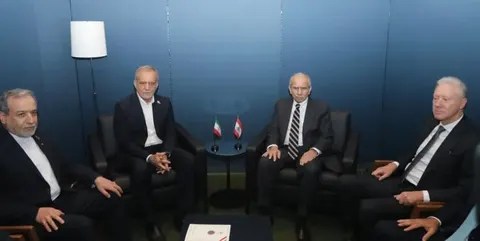
A Lebanese-Iranian Meeting in New York, but Several Political Messages
“No State Can Have Two Armies and Two Decision-Making Authorities,” Salam Says in New York
Trump Pulls Back at the Last Minute From Strikes on the Houthis
More from Tilda Abou Rizk
View All



More in Today's Essential
View All


Latest from Levant Time
View All


