

NATO 3.0: The Awakening of the Ottoman Giant Within the Alliance (2/2)

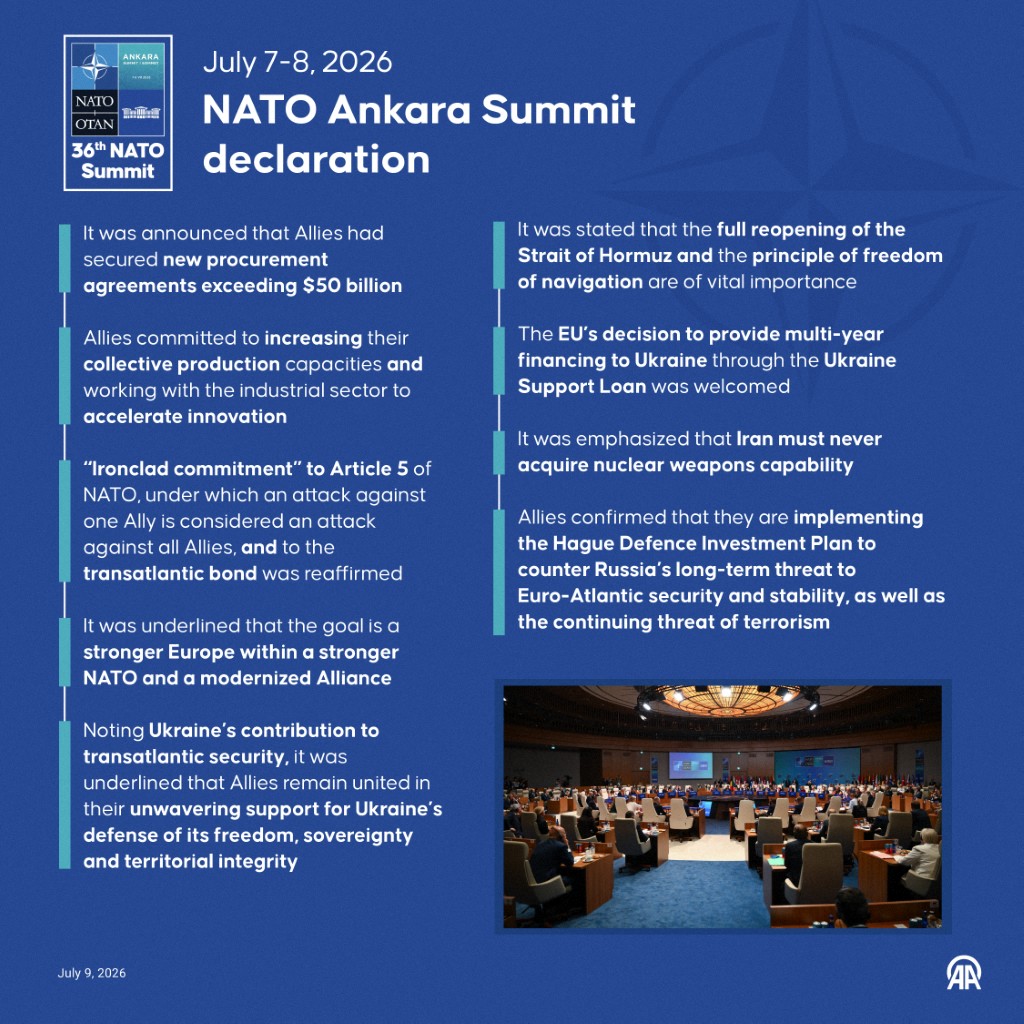
July 8, 2026 will go down as a pivotal date in the history of the Atlantic Alliance. The "Ankara Declaration," published at the close of the NATO summit held in Turkey, highlighted a profound transformation — technological, financial, and geopolitical alike. This shift to NATO 3.0 refocuses the organization on a doctrine of informational superiority and high-intensity territorial defense, with Turkey affirming itself as the southern cornerstone.
A financial revolution: the Bank for Defence and Resilience
One of the summit's most innovative aspects is its response to the financial challenges of rearmament. Although the European Union established the 150-billion-euro SAFE fund (Security Action for Europe) for defence in 2025 — from which Canada and Turkey are excluded — the Atlantic Alliance had to find its own solution to bring these countries on board. Against a backdrop where member states are committing to raising defence spending to as much as 5% of GDP, nine countries — including Turkey and Canada — announced the creation of theBank for Defence, Security and Resilience.
This institution, headquartered in Canada, will have an impressive financing capacity of $134 billion. Its primary objective is to provide preferential-rate loans to support dual-use infrastructure projects (both civilian and military), as well as to strengthen cybersecurity and fund the direct rearmament of member countries.
The Informational Doctrine: AI and the 'Combat Cloud'
The Ankara summit marks a shift away from a traditional military vision — focused on the number of armored vehicles and divisions — toward a doctrine centered on decision-making superiority.
For NATO, this means its armed forces must understand a situation, decide, and act faster and more effectively than the adversary.
It is no longer solely a matter of material superiority: the concept rests on three pillars.
1) Data mastery: the instantaneous fusion of sensor data (satellites, drones, radars, cyber sources) analyzed by artificial intelligence.
2) Accelerating the command cycle: through digital wargaming — strategic simulations that pit human teams against highly realistic scenarios — plans are tested without real-world risk, logistical and tactical weaknesses are identified, and AI analyzes every decision to provide actionable intelligence to military headquarters.
3) Protection against cognitive warfare: measures to shield leaders and populations from manipulation and disinformation.
Within this framework, the Warfighting Cloud is taking shape: a transatlantic, interoperable combat cloud that connects all allied sensors in real time.
Fighter jets, naval vessels, ground-based radars, and satellite constellations all feed their data into it, delivering an instant, comprehensive picture of the battlefield.
This infrastructure, deeply integrated with AI, is enshrined in the summit's final declaration: advanced AI models will be embedded in the planning and execution of operations.
The goal is straightforward: to shorten the decision-making loop so that NATO can respond more quickly than its adversaries to increasingly complex and fast-moving threats.
A record-breaking industrial agenda: AWACS and Drone Edge
The industrial dimension of the summit demonstrated unprecedented momentum, with more than $50 billion in contracts signed in a single day.
Two major announcements illustrate this drive to modernize. First, the replacement of NATO's aging fleet of American-built AWACS radar aircraft.
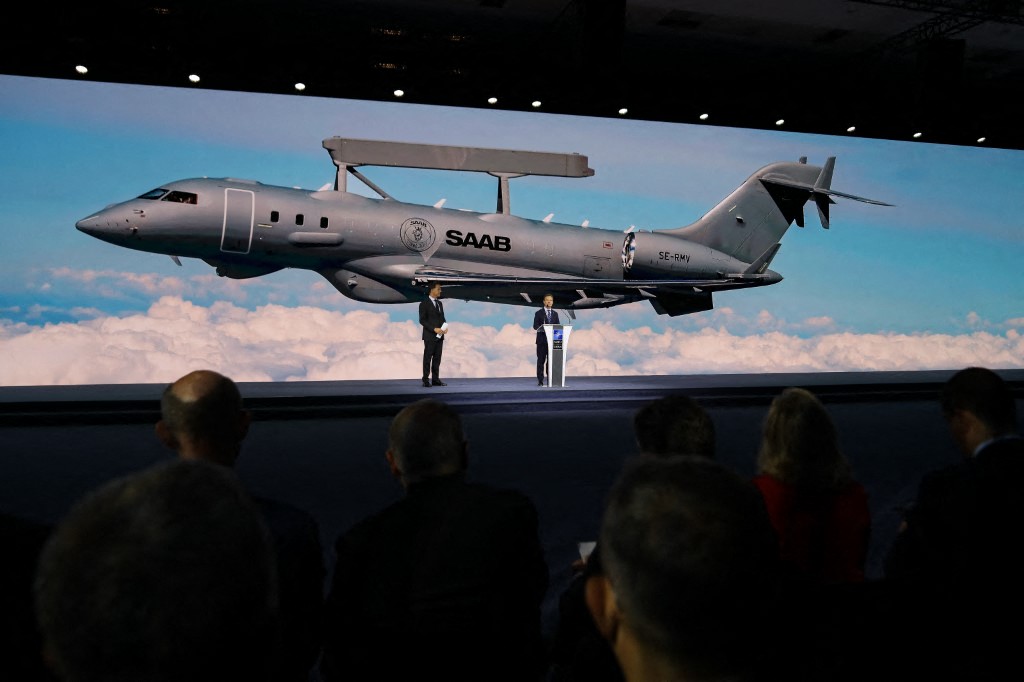
NATO selected theGlobal Eyesystem from Swedish manufacturer Saab (pictured). This is a highly strategic choice: theGlobal Eyeis one of the few systems capable of detecting and tracking the new generation of hypersonic missiles, which have become a central concern for European security.
Additionally, the 'NATO's Drone Edge' initiative was launched with a massive budget of $40 billion over five years.
This sweeping plan aims to procure autonomous and unmanned systems across all domains: aerial drones, maritime drones, and ground robots.
Within this framework, the Alliance has already confirmed the purchase of high-altitude 'Triton' reconnaissance drones from American manufacturer Northrop Grumman, bolstering surveillance of borders and strategically significant areas.
American disengagement and European autonomy
The Pentagon has begun a partial physical withdrawal from the European continent, in line with the American security strategy announced at the end of 2025.
The United States is pulling one of its two aircraft carriers assigned to the NATO area.
They are also withdrawing one of every two strategic bombers and cutting their F-15 fighter fleet in Europe by a third. TheReaper,drones, critical for surveillance, are also seeing their presence cut in half.
This withdrawal effectively forces European nations to step up and shoulder a greater share of their own defense.
This is the very essence of NATO 3.0: an Alliance in which European allies, Canada, and Turkey are no longer mere junior partners, but the pillars of collective defense — particularly in managing conventional threats on European soil and other threats on its southern flank.
A high-intensity closing communiqué
The Ankara Declaration reaffirms Article 5 — 'an attack on one ally is an attack on all' — while emphasizing support for Ukraine and preparedness for high-intensity warfare.
For 2026, allies — primarily European ones — will allocate €70 billion to equipping and training Ukrainian forces, with a commitment to renew this in 2027.
The declaration also takes aim at Iran, asserting that it must never acquire nuclear weapons and demanding respect for freedom of navigation through the Strait of Hormuz.
NATO 3.0 refocuses the Alliance on deterrence and defense. Combining technological innovation, sovereign financial tools, and greater European responsibility in the face of partial American withdrawal, NATO is preparing for confrontations where data and autonomy will make all the difference.
Turkey the summit's big winner — but…
Turkey emerges from the summit as a central player in NATO 3.0, securing significant diplomatic and industrial gains, though not all of its ambitions were fulfilled.
As the summit's host nation, it has strengthened its role as an East–West pivot and joined the nine founding members of the newDefense and Resilience Bank,which manages $134 billion — a potential lever for its defense industry.
The emphasis on the 'Drone Edge' initiative ($40 billion) and the integration of artificial intelligence validate its strategy centered on autonomous systems (drones, etc.) and position its companies as key partners.
Washington also agreed to the sale of engines for Turkey's future Kaan fighter jet, valued at $700 million. However, despite a diplomatic shift toward gradually lifting restrictions on the sale of Western military components and American F-35s, removing the Congressional veto in Washington remains essential for these intentions to be realized.
Hezbollah-Israel: An Endless War in Whose Interests? (20)
The Trump-Xi Summit: Between Pragmatism and Necessity
The Conflict in Yemen: Geopolitical and Strategic Considerations
Yemen: The Mecca Pact Moves from Theory to Military Action
Hezbollah-Israel: An Endless War in Whose Interests? (19)
المزيد من Khalil Helou
عرض الكل


المزيد في Strategia
عرض الكل


الأحدث من Levant Time
عرض الكل


