

Lebanon-Syria, or the Communicating Vessels!
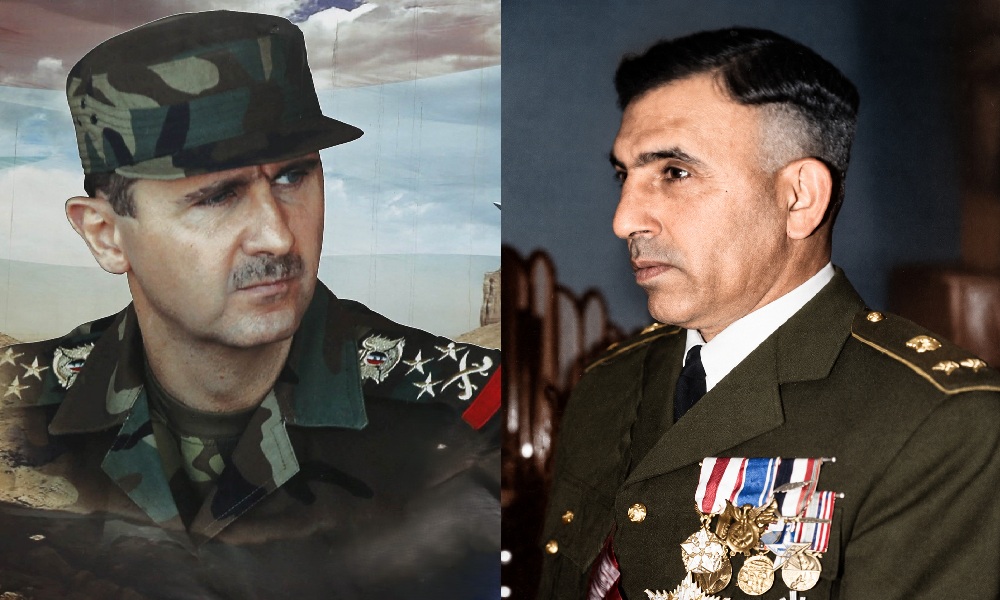
Would we dare draw a parallel between the respective careers of two deposed dictators, namely Adib Chichakli and Bashar al-Assad? Both ruled Syria with an iron fist (1), only to beat a miserable retreat, abandoning their followers to the wrath of the people. The first slipped away in February 1954; the second was spirited out, without fanfare or fuss, in December 2024. The same pattern, seventy years apart!
But the comparison does not end there. Both dictators, after all, tried to regain a foothold in Syria from a Lebanese base. In denial, neither could bring himself to doubt his popularity among a people he had brutally repressed, nor the enthusiasm Syrians would supposedly display should he ever return to power.
Yet, as so often before, it was from Lebanon that Syrian conspiracies were hatched to restore fugitive leaders to the helm of their country. For it bears repeating: since the 1950s, the Land of the Cedars—with its notoriously loose standards when it comes to the caliber of outcasts seeking refuge within its cramped borders—had become a favored staging ground for conspiracies against the regimes in power in Damascus (2).
Lebanon, the rear base
At the beginning of this September, Lebanese authorities arrested a former Syrian colonel and four accomplices. Found in possession of small arms and explosives, they are suspected of plotting attacks against Syria’s new authorities. The affair is all the more serious because the network is reportedly being directed from Moscow by a former Syrian army general, a close associate of Bashar al-Assad who, like him, has taken refuge in Russia. More troubling still, the suspects are said to have received military training in Lebanon from Hezbollah fighters.
The alleged purpose of the network was reportedly to foment unrest along the Syrian coast, a predominantly Alawite region and the historic heartland of the Assad clan. Were such actions intended to restore Bashar al-Assad to power—or merely to sow disorder and assert the distinct identity of minority populations huddled into their coastal enclave on the Mediterranean? But that is not the point.
Lebanon, the weak link and the soft underbelly
Any Syrian activist, exiled in Lebanon either by choice or by force, naturally tends to make himself at home. Before long, he behaves as though in conquered territory, making full use of whatever networks and opportunities are available to reposition himself in the political game of his own country. Has our Lebanese territory not served, for decades, as a springboard for Syrian opposition figures, a battleground for rival Baathist factions and, moreover, as strategic depth for the Damascus regime? It was in Lebanon, after all, that Syrian officers such as Sami al-Hinnawi in 1950, Ghassan Jadid in 1957, and Muhammad Umran in 1972 were assassinated, to name but a few (3).
Lebanon has therefore always faced a daunting dilemma: by providing the hunted losers with a more or less secure refuge, it has also served as their rear base for an eventual attempt to reclaim power. And, consequently, Lebanon has had to expose itself to the wrath of whichever regime happened to be in power in Damascus—the very regime against which plots were being hatched in Beirut and its immediate surroundings.
An exceedingly uncomfortable predicament for a country of asylum such as ours, even as the self-righteous never tire of lecturing us. For, according to them, it is up to the Lebanese authorities, supposedly intent on ushering in sound relations with Syria, to put an end to the machinations of Syrian exiles. These troublemakers, they argue, poison relations with our neighbor and elder sister. But what, exactly, can we do about it?
But why Lebanon?
To return to Chichakli: having handed in his resignation in 1954, he secretly returned to Lebanon in 1955, under the protection of the Syrian Social Nationalist Party (SSNP, or PPS), in an attempt to make another bid for power in Damascus. When his coup failed, he quietly disappeared. As early as 1952, his opponents Michel Aflaq, Salah al-Din al-Bitar and Akram al-Hawrani had themselves fled to our country. They would conspire against him so relentlessly that he eventually managed to persuade our government to expel them.
That tells you just how attractive Beirut has always been in the eyes of the banished. And geographical proximity and porous borders alone do not explain the attraction. There is, of course, the pluralism of our political system; our press, more or less emancipated from the constraints of censorship; the hospitality of our confessional communities, which offer refuge; and, above all, the fact that Beirut is a “city that makes noise”—a city where international media immediately amplify the slightest incident.
And, to put it bluntly, it is the very nature of our political system—liberal, chaotic, yet welcoming—that lends itself to such permissiveness and tolerance of the other, qualities that are anathema to repressive regimes.
What else but an admission of helplessness?
Bless you, Lebanese! You are stuck where geography has trapped and hemmed you in. Better still, where history has shaped you—and even wounded you, body and soul. You cannot escape this Syrian fate any more than the elites of Damascus, Homs or Aleppo can renounce their Lebanese ambitions.
You have to live with it. Good luck!
1 — But the regime of Adib Chichakli never reached the level of horror sustained for more than half a century by the Assad dynasty.
2 — A personal recollection: As law students in 1965, we never missed the chance to spot Akram al-Hawrani at the “Dolce Vita” café in Raoucheh. The eager waiter would mischievously whisper in our ears that he was preparing a coup d’état and that we should not disturb him.
3 — If I leave some out, it is because the list of assassinations ordered by the Assad dynasty is simply too long to be recalled in its entirety.