

The Name Nawaf Salam Would Not Say
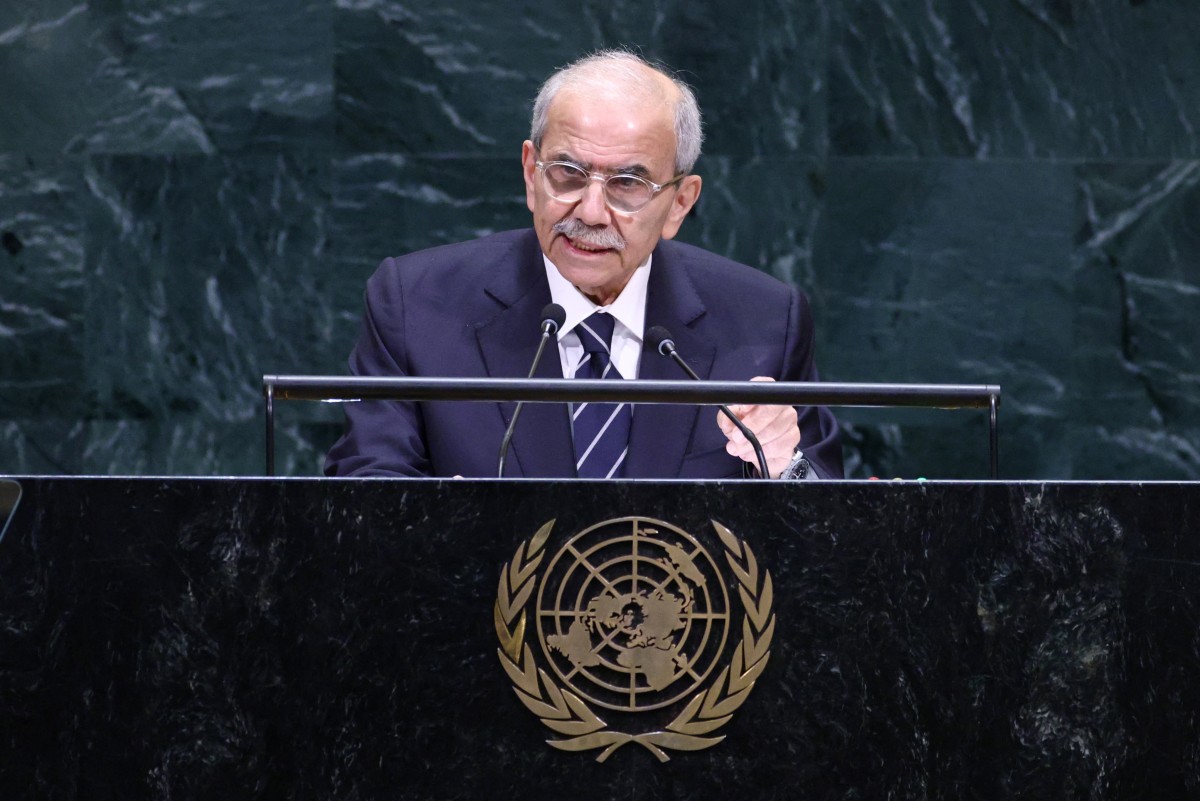
Prime Minister Nawaf Salam went to the United Nations and spoke at length about sovereignty. He called for Israel’s withdrawal from Lebanese territory, reaffirmed the state’s exclusive authority over weapons and the decision of war and peace, and insisted that no one has the right to negotiate on Lebanon’s behalf. These are all principles that a Lebanese prime minister should defend.
But there was one remarkable omission from his speech: Hezbollah.
Not once did Salam name the organization whose weapons make the very principle he was defending necessary. He spoke of “arms outside the state,” of wars Lebanon did not choose, and of the need to restore national decision-making. Yet the actor that possesses those arms, has repeatedly made decisions of war and peace outside the state, and has tied Lebanon’s security to Iran’s regional strategy remained unnamed.
This was not a semantic omission. It was a political one.
Salam correctly demanded Israel’s complete withdrawal from Lebanese territory. Israeli occupation and attacks on Lebanon must end. But a serious Lebanese strategy must also confront the question that follows: how did Lebanon arrive here?
The current Israeli military presence cannot be discussed as though it appeared in a historical vacuum. Lebanon’s sovereignty had already been compromised before Israeli troops crossed the border. Hezbollah maintained an armed structure outside the state, controlled territory and military infrastructure beyond meaningful government authority, and possessed the ability to take Lebanon into war without the consent of its constitutional institutions.
This is precisely why saying “the state must monopolize weapons” is no longer enough. Everyone knows which weapons are being discussed.
The problem with Salam’s formulation is therefore not what it contains, but what it avoids. By refusing to identify Hezbollah directly, the speech transformed a concrete political and security problem into an abstract constitutional principle. Lebanon does not suffer from some mysterious proliferation of unidentified weapons. It faces a specific armed organization, backed by Iran, that has claimed for itself authorities that belong exclusively to the Lebanese state.
There is an additional contradiction. Salam declared that “no one speaks in the name of Lebanon” and “no one negotiates on its behalf” except the Lebanese state. That is an important principle. But the same logic must apply to war. No one should be permitted to fire in Lebanon’s name, determine its military alliances, build an independent military infrastructure or decide when Lebanese territory becomes a battlefield.
A state cannot demand recognition of its sovereignty abroad while negotiating the meaning of sovereignty at home.
Salam also presented Israeli withdrawal and the extension of state authority as reciprocal and phased objectives. Diplomatically, this may appear balanced. Politically, however, Lebanon must be careful not to recreate the circular formula that has protected Hezbollah’s arsenal for decades: weapons are justified by occupation, while occupation and military escalation are then used to justify retaining the weapons.
That circle must be broken.
The Lebanese government should be able to say two things simultaneously and without hesitation: Israel must withdraw from Lebanese territory, and Hezbollah must surrender its weapons to the Lebanese state. Neither proposition invalidates the other. On the contrary, together they constitute the only coherent definition of Lebanese sovereignty.
Salam had an opportunity at the United Nations to articulate precisely that position. Instead, he chose the language of implication.
Lebanon no longer has the luxury of implication.
The country has paid too high a price for euphemisms such as “resistance,” “national defense strategy,” and “exclusive state control of weapons” when everyone understands the actual question being avoided.
Restoring sovereignty begins with restoring meaning to words. An occupation should be called an occupation. An Israeli violation should be called an Israeli violation. And an armed organization operating outside the authority of the Lebanese Republic should be called by its name.
That name is Hezbollah.