

Who, then, claimed the annexed Golan?
In the current Syrian context, a fundamental question arises with particular urgency: who called for the return of the Golan? Who else could it be but Syrian President Ahmed al-Charaa? But why on earth did the Syrian president reopen the Golan “cold case” when he had so many other priorities to deal with?
In his view as a former jihadist, appealing to world opinion at the UN General Assembly meeting on September 23 was not merely a reminder of the Israeli-Syrian dispute dating back to June 1967. So what got into him, when in an interview the previous day he had stressed that direct Israeli-Syrian negotiations had taken place under U.S. auspices and that the two sides had reached 90% of a security agreement? (1)
A few dates…
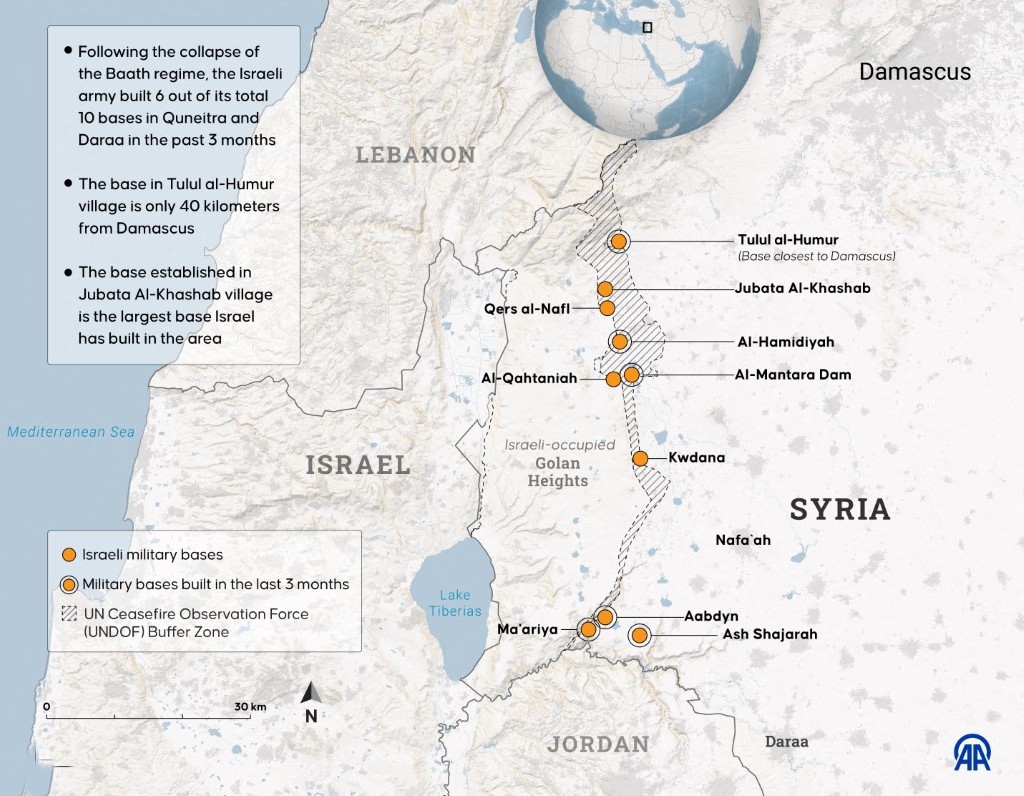
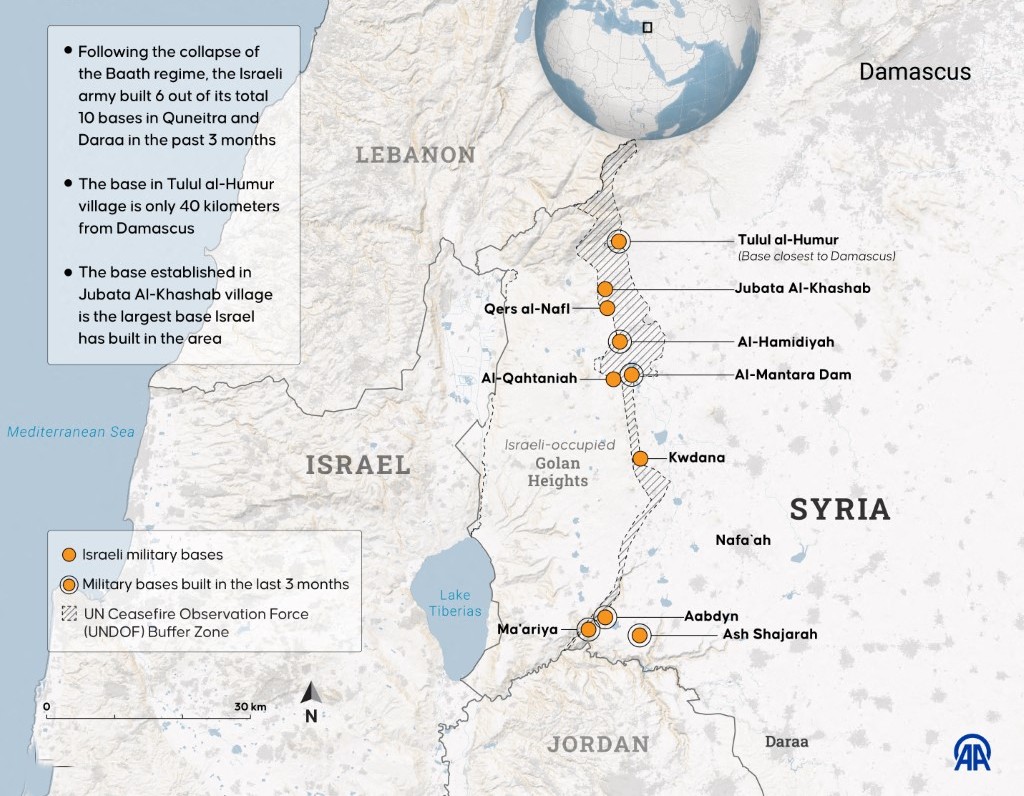
The point is that this dispute requires a distinction between, on the one hand, the territories occupied since 1967 and then annexed in 1981 by the Jewish state, and, on the other, the territories on the Syrian side of Mount Hermon, where the IDF deployed in the hours following the fall of the Assad regime on December 8, 2024.
What did Ahmed al-Charaa say, after all, but that the Golan “will remain Syrian,” expressly invoking Security Council Resolution 497, which had declared Israel’s 1981 annexation null and void? Yet the Syrian president’s intention was by no means belligerent, since he reaffirmed Damascus’s commitment to the 1974 Disengagement Agreement while at the same time demanding that Israeli forces withdraw to their positions prior to December 8, 2024.
But Israel, which is unencumbered by legal principles or judicial precedents, had considered the Disengagement Agreement invalid from the moment Bashar al-Assad’s regime fell. From there, the IDF proceeded to deal with matters in its own way, allowing itself, on one pretext or another, to carry out around 500 airstrikes, more than 1,200 incursions, and 300 arrests on Syrian territory.
UN wording and Israel’s response
Syria’s position, which respects international law, was fully in line with UN Secretary-General Antonio Guterres’s statement, who last July described the expansion of the Israeli occupation as “totally unacceptable,” maintaining that the Golan remains Syrian land.
Just as Antonio Guterres’s statement did not please the Israelis, neither did the Syrian president’s declaration at the UN. Their defense minister, Israel Katz, immediately responded in unequivocal terms that the strategic Golan Heights were “an integral and eternal part of Israel” and that, consequently, the Jewish state could not withdraw from either Mount Hermon or the security zone. His remarks came with a warning: should Syria attack Israel, “any territory we take this time will remain in our hands forever, in accordance with the laws of war.”
Israeli-Turkish rivalry and a convergence of interests?
The Syrian president’s remarks, which were anything but threatening, were nonetheless skillful. Al-Charaa was not demanding the Golan, knowing that he could not retake it by force; he was merely reiterating his country’s inalienable rights in this regard. But all this came at a time when Turkish-Israeli relations were deteriorating, with Ankara seeking to fill the space left vacant by Tehran in the Syrian-Lebanese arena. That was unacceptable in Tel Aviv’s eyes.
With Bashar al-Assad removed from the picture, events moved quickly and alliances were overturned. As early as last June, Washington was encouraging the Syrian regime to intervene militarily against Hezbollah inside Lebanon itself. That would have played into Israel’s hands. But it was Erdogan who, it seems, held back Ahmed al-Charaa’s hand, even though the latter had more than one reason to settle scores with the Party of God, which had been heavily involved in the Syrian civil war (2). Yet Reuters has just reported that last September, representatives of Hezbollah and the Syrian government met at least once in Turkey to resolve their differences (3).
What does this mean?
Since Damascus is somewhat of a Turkish proxy, Turkey will act as a mediator and encourage these contacts between yesterday’s adversaries, as it is committed to Syria’s territorial integrity. Thus, under neo-Ottoman tutelage, al-Charaa will have to bury the hatchet with the ayatollahs’ party. And, in the face of the Israeli adversary, Damascus’s and Hezbollah’s interests will gradually converge. But to what extent, you might ask?
1- Let us recall that a security agreement is neither a definitive territorial settlement nor a peace treaty!
2- As recently as June 2026, al-Charaa himself reiterated that Hezbollah’s intervention in Syria remained an open “wound.” But he added that Syria was ready to sit at the same table as Hezbollah if doing so served the interests of Syria and Lebanon.
3- According to some sources, Tehran was kept out of these negotiations. But who would believe that, and who can imagine Hezbollah shedding its ties to Iran?