

Riyadh steps up its offensive against the Houthis
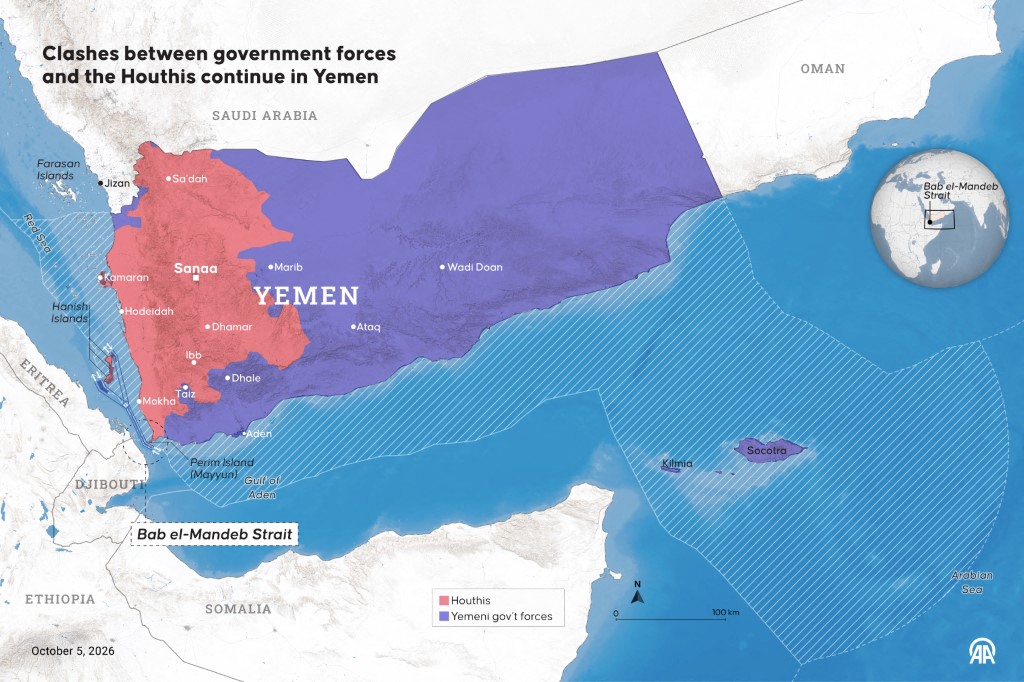

Following recent advances by pro-Iranian militiamen toward the regions bordering the Red Sea, the Saudi-led coalition launched a large-scale counteroffensive that had already borne fruit by Monday.
For several weeks now, amid relative calm on the Iranian-American front—the U.S. forces have not launched direct attacks on Iranian territory since early September—the Yemeni front has seen the most movement. Until now, however, this had favored the pro-Iranian Houthis, who had unexpectedly made considerable advances toward the Red Sea, threatening to disrupt passage through the Bab el-Mandeb Strait, after the near-closure of the Strait of Hormuz due to the conflict in Iran. Last weekend, militia fighters had already succeeded in encircling the Yemeni city of Taiz, cutting it off from Aden, where Yemen's official government is based.
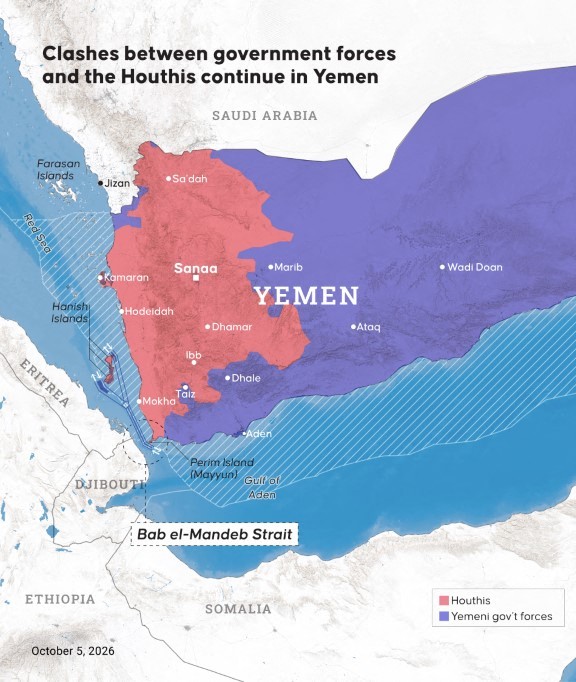
Against this bleak backdrop for Yemen's official forces, Monday, October 5, will be remembered. The day before, Yemeni President Rashad al-Alimi had announced the launch of an offensive to retake all the territory seized by the Houthis since 2014, including the capital, Sanaa. The aptly named “Dawn of Yemen” offensive therefore began on Monday. According to Reuters and several media outlets, Yemen's regular army was able to retake within hours the positions seized by the Houthis around the Bab el-Mandeb Strait.
The turning point came with the announcement by the Riyadh-led military coalition that it was joining the offensive launched by its Yemeni ally. It has more than a hundred combat aircraft, which carried out strikes on Houthi-controlled areas, providing continuous cover for Yemeni soldiers deployed on the ground.
Even Sanaa was not spared, and Houthi media confirmed a strike on the capital that, according to them, killed one person—a female student.
In the evening, according to Saudi channel Al-Hadath, government forces said they had retaken the city of Mokha and its port, and were advancing toward the capital using “the most modern combat methods,” the channel reported.
Clearly, the Houthis have not lost their defiant spirit. During the day, they fired shells toward Bab el-Mandeb.
They had previously caused an interruption in oil transport through Saudi Arabia's East-West pipeline. They even claimed to have struck a site belonging to Saudi oil giant Aramco the day before.
In a defiant tone, they warned in the evening that Saudi airspace was “not safe” for civil aviation, their news agency reported, according to AFP, issuing a warning to airlines.
The kingdom under pressure
If the coalition decided to join this official Yemeni counteroffensive, it is because Saudi Arabia has every reason to respond after the number and severity of Houthi attacks against its economic interests and its territory.
Logically, the Americans—who have traditionally armed the Saudis—should not become directly involved in the fighting, since U.S. President Donald Trump has no interest in opening a new front just weeks before the midterm elections. However, in the evening, U.S. Secretary of State Marco Rubio said that “Saudi Arabia has the right to defend itself,” adding that the United States has commitments to the Saudis and intends to honor them. In other words, winds of change may already be blowing across the Gulf, with additional restrictions on Iranian proxies.
Until then, the Houthis had appeared to spare the United States, focusing their attacks solely on the Saudis. They had even suspended their attacks on Israeli territory, the last of which dated back to early June. In this respect, they seem to be following an Iranian strategy whose main concern is control of an additional strait rather than direct confrontation with the Americans and Israelis.
Can the Saudis count on their partners in the Mecca Joint Defense Agreement, signed in August 2026? The intensification of this new offensive against the Houthis coincides with the second meeting, on October 5, of the strategic political defense committee created under the agreement, held in the Saudi capital. Ministers and chiefs of staff from the three countries were present.
How far will this offensive go? Will the Houthis truly emerge weakened? We will have to wait for the following days to find out.
In any case, Monday, October 5, ended with reports carried by the media that government forces had retaken all areas along the Bab el-Mandeb and that dozens of Houthi fighters were fleeing the outskirts of Taez, which they had captured the previous day. The situation is therefore one to watch…