

The U.S. Withdrawal from Iraq Ushers in a Period of Uncertainty
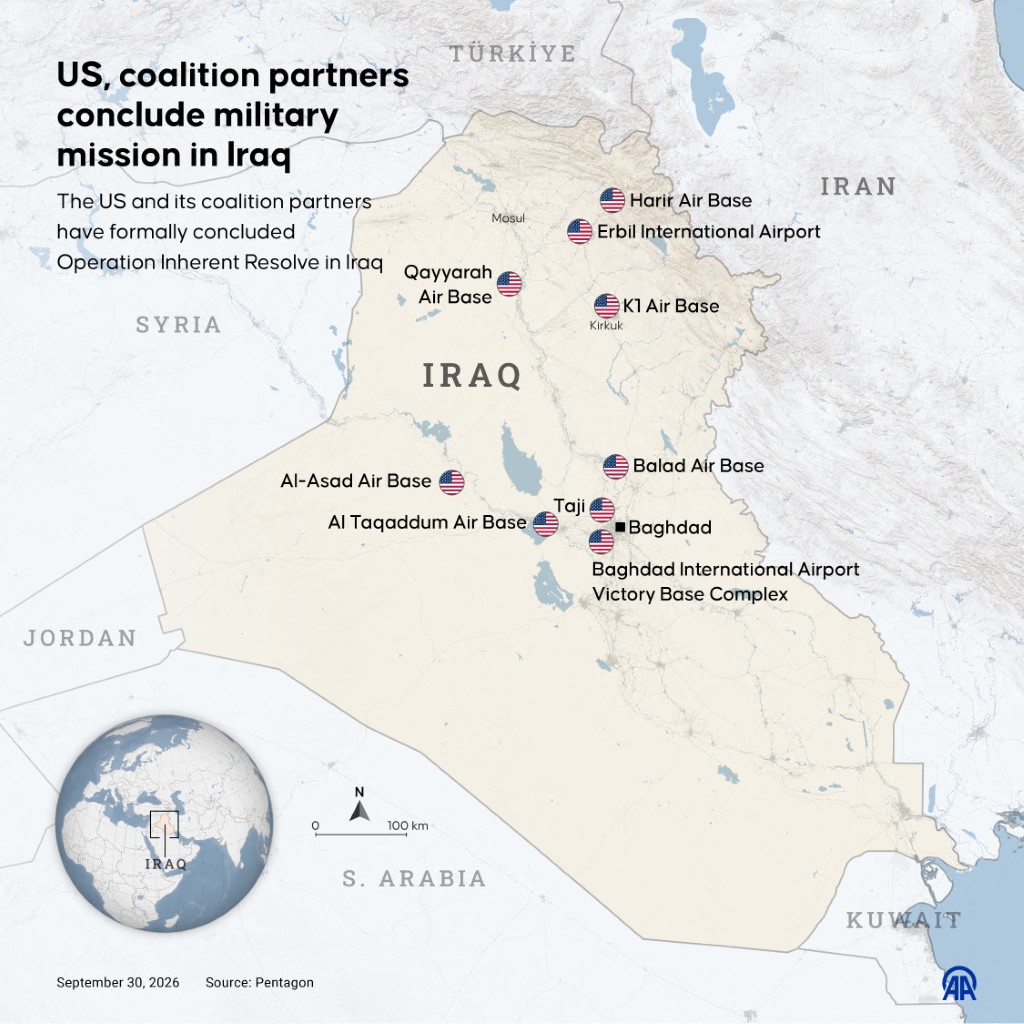

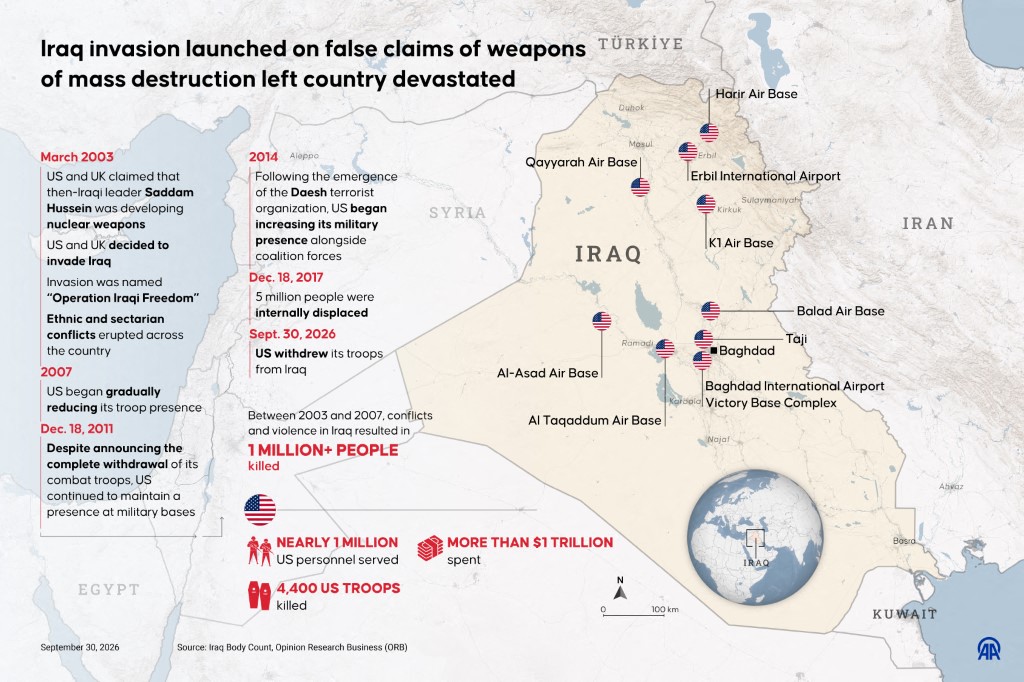
The hardest part has just begun for Iraq, where the United States, together with its international coalition partners, completed a full withdrawal from the country on Wednesday, pursuant to a decision agreed with Baghdad in September 2024 under the administration of U.S. President Joe Biden.
During its twelve years in Iraq, the Washington-led coalition trained Iraqi forces to work alongside the political authorities to protect the country from Iranian and jihadist ambitions.
Although it enjoys Washington’s unwavering support, Ali al-Zaidi’s government is entering a period of great uncertainty, given the major challenges standing in the way of its goal of restoring full sovereignty.
The most important of these is, of course, disarming the pro-Iranian armed factions. Another concerns the persistent threat of a resurgence by forces affiliated with the Islamic State group (ISIS). Will Baghdad be able to fill the security vacuum left by the coalition’s departure and prevent pro-Iranian militias or ISIS sleeper cells from exploiting it? That is the question.
Iran’s reaction to the completion of the coalition forces’ withdrawal is, moreover, highly telling. On Thursday, the Islamic Revolutionary Guard Corps hastened to hail a “historic victory,” portraying the withdrawal as an “expulsion” that, in its view, marks the start of a process that will lead to the departure of U.S. forces from the entire region.
For the IRGC, the U.S. withdrawal is “the result of the action of the Resistance groups,” which will allow “the Iraqi people to take responsibility for their own security.”
This rhetoric is reminiscent of Hezbollah’s discourse in Lebanon, where the “popular will” it regularly invokes to justify its actions is in fact merely an expression of Iranian control.
Lebanese-Iraqi similarities
The similarity between Lebanon and Iraq in this respect is beyond question. Both countries have, at least in principle, been engaged since the start of the regional war in a process that should eventually lead to the disarmament of Iran’s military assets on their respective territories. Here too, the resemblance is striking: Beirut and Baghdad still lack a clear roadmap for achieving this objective.
A brief reminder is in order: in August 2025, the Lebanese government set December 31 of that year as the deadline for disarming Hezbollah and armed Palestinian groups. The Lebanese army requested additional time and proposed a phased timetable to “extend the state’s sovereignty over the entire territory.” As 2026 draws to a close, Hezbollah continues to adamantly reject even the idea of disarmament.
In Iraq, Ali al-Zaidi had set September 30 as the date for disarming the armed factions so that it would coincide with the end of the international coalition’s mission. On Thursday, he postponed it to June 30, which may partly explain Iran’s triumphalism.
Having significantly lost influence in the region as a result of the Israeli-American war waged against it—especially following the fall of Bashar al-Assad’s regime in Syria—the Islamic Republic now sees its chances increasing of once again tightening its grip on both countries, where it still has political, administrative, security, and military allies.
It is betting in particular on the erosion of U.S. President Donald Trump’s popularity ahead of the November midterm elections and on the emergence of a governing coalition in Israel after the October parliamentary elections.
The U.S. withdrawal from Iraq, in particular, would remove, in Tehran’s eyes, an important military counterweight and allow it to make use of the nine-month deadline set by Ali al-Zaidi to reassert itself in the country through its proxies. The Iraqi government has nevertheless made it clear that no attacks on countries in the region may be launched from its territory. It remains to be seen how much room it has to enforce its decisions and dismantle armed groups, especially if the regional conflict resumes.
The situation in Iraq is more complicated than in Lebanon, insofar as pro-Iranian armed groups are represented within the security apparatus itself.
These include Kataib Hezbollah and Harakat al-Nujaba, affiliated with the Popular Mobilization Forces, which helped repel the advance of داعش groups and were integrated into Iraq’s security apparatus after those groups were defeated, pursuant to a law passed by Parliament.
The Shiite cleric Moqtada al-Sadr, who announced last May the dissolution of his armed faction, Saraya al-Salam, and its integration into the state, reiterated on Thursday his call for armed groups to follow suit, but his influence over them is virtually nonexistent.
Given the concerns, in both Iraq and Lebanon, about measures that could disrupt balances that have been in place for decades, the question remains whether it is possible to neutralize Iranian influence there without a more favorable regional context making it possible.