

Yemen: A Military Conflict with Uncertain Outcomes

Syrian President Ahmad al-Sharaa was in Riyadh on Tuesday, where he was received upon arrival by Crown Prince Mohammed bin Salman for talks focused on regional developments and bilateral relations.
This was Mr. Sharaa’s third visit to Saudi Arabia, the first country he visited in February 2025 after overthrowing Bashar al-Assad. He returned to the kingdom in April of the same year as part of a tour of the Gulf countries. The aim of that tour, which also included Qatar, the United Arab Emirates, Bahrain, Kuwait, Türkiye, Jordan and Egypt, was to reintegrate Syria into its natural Arab environment.
Mr. Sharaa’s visit to Riyadh comes as Saudi Arabia is engaged in an open war with the Houthis in Yemen. His trip is certainly not related to the conflict, but at the same time, it cannot be entirely separated from it.
His visit, it should be stressed, comes amid regional geostrategic shifts and a realignment of the balance of power that Iran is precisely seeking to counter. Through the Houthis, the Islamic Republic is putting its future as a regional power on the line, as it sees its influence significantly diminished after having succeeded, in a predominantly Sunni environment, in establishing a network of Shiite proxies that helped bolster its regional power.
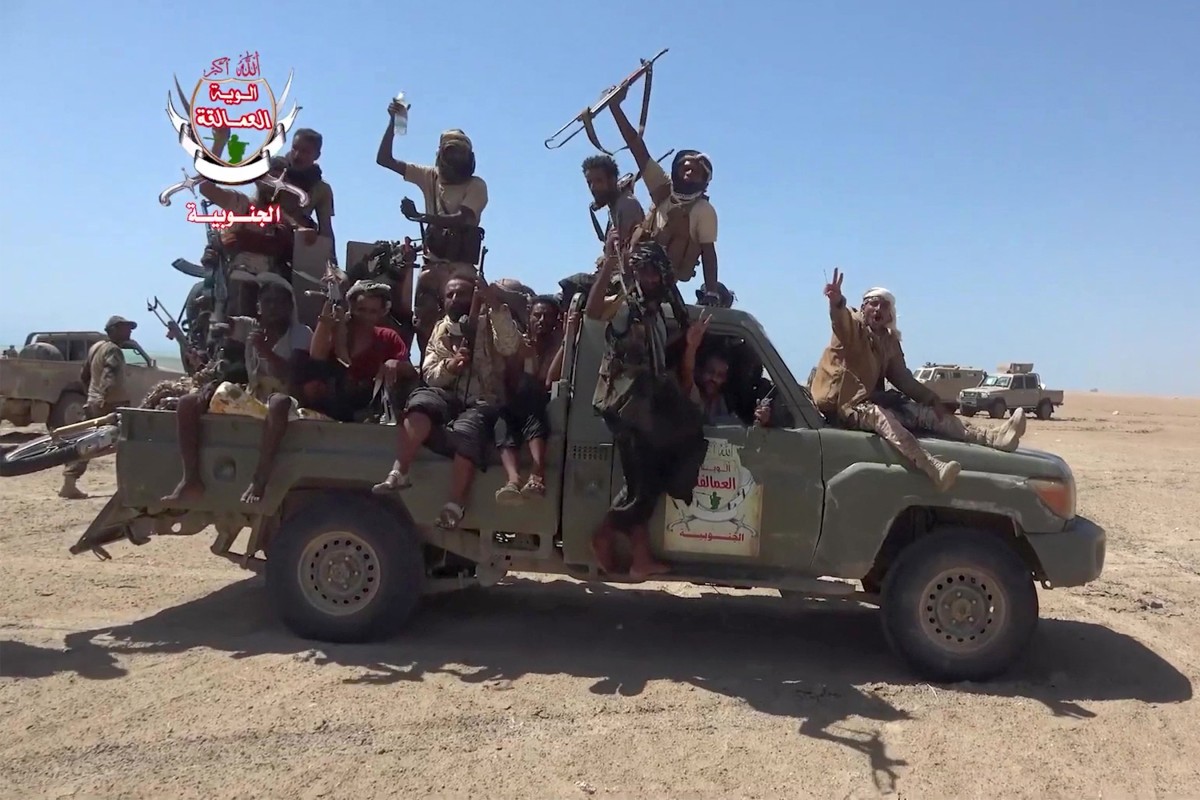
In Yemen, Iran is therefore playing for the highest stakes. On the ground, Yemeni government forces, backed by Riyadh, which has mobilized hundreds of aircraft for this purpose, say they are advancing. On Tuesday, they said they had retaken strategic positions around the Bab el-Mandeb Strait on the Red Sea, which the Houthis had managed to control in late September.
Information on the matter, however, remains contradictory. The pro-Iranian group denied the Yemeni forces’ claim. Its spokesman said the group had repelled “several Saudi attempts to advance toward Bab el-Mandeb.” He also claimed an attack on Riyadh airport using drones, ballistic missiles and cruise missiles. On the night from Monday to Tuesday, the Houthis had targeted three other airports in the south of the kingdom.
The Saudi General Authority of Civil Aviation remained silent on the attack targeting Riyadh airport, but reported strikes on the three other airports, saying three people had sustained minor injuries and that there had been material damage.
The Houthis also warned airlines that Saudi airspace was “not safe.”
An Expanded Sunni Coalition?
Although they may have inflicted significant losses on the pro-Iranian group, government forces and Riyadh are struggling to achieve military superiority without the international support they have been denied. President Donald Trump, who once again expressed his support for Saudi Arabia on Tuesday in its war against Iran’s allies, does not want to become involved in a conflict that could spiral out of control.
Türkiye, Pakistan and Saudi Arabia, meanwhile, have agreed to “immediately begin implementing the mutual defense agreement” signed in Mecca in August. On Monday, Ankara and Islamabad said they would provide Riyadh with “the agreed-upon military forces and capabilities and rapidly deploy them in the kingdom.”
But the announcement primarily points to “a defensive deployment” aimed at intercepting Houthi missiles and drones, Hamish Kinnear of Verisk Maplecroft told AFP. Ankara and Islamabad, he noted, remain “reluctant to be drawn into a war with Iran and keen to preserve their role as mediators between Washington and Tehran.”
The lukewarm stance of Riyadh’s two allies could be seen as a boon for an Iran determined to maintain its grip on Yemen, which shares a border with Saudi Arabia, and to keep up pressure on both Riyadh and maritime trade in the Red Sea, without directly intervening in the conflict.
The question is whether, in light of the shifting balance of power in the region, Iran’s strategy is sustainable. It could, in fact, have the opposite effect and accelerate the process set in motion by Washington when it launched its war against the Islamic Republic: neutralizing Tehran’s military power and weakening its influence. At the same time, it could contribute to consolidating, and even expanding, the Sunni coalition around Saudi Arabia. The recent rapprochement between Riyadh and Abu Dhabi, following a period of tensions, points in that direction.
The Islamic Republic no longer has a foothold in Syria. It has been weakened in Lebanon, where the power of its military arm, Hezbollah, is now limited to verbal sparring and threats of retaliation, as once again demonstrated by a speech delivered by its leader, Naim Qassem, on Tuesday. The same is true in Iraq, where the process of disarming pro-Iranian armed factions is underway, despite the posturing of some of them.