

Iran: the Dangerous Game of Regional Escalation in the Face of US Sanctions


The escalating tensions in Lebanon, Gaza, the Red Sea, and the Strait of Hormuz are fueling fears of a scenario that Iran and its allies have already employed before: a series of military provocations that would gradually intensify to counter the American economic D-Day. The Israeli military says it is preparing for a possible "multi-front flare-up," on the eve of a series of Jewish holidays beginning on September 11.
While Iran is careful not to provoke Israel directly—to avoid a retaliation that would cost it dearly—it would not hesitate to encourage its allies to act as troublemakers, should the American economic vice tighten further around it.
That does not yet appear to be the case, however, as Pakistan made clear on Thursday through its Foreign Ministry spokesperson, Tahir Andrabi, that Islamabad "is not obligated to comply with unilateral U.S. sanctions against Iran, unless they are imposed by the United Nations."
In practical terms, this means Pakistan intends to continue its trade with Tehran, despite U.S. President Donald Trump's threat to sanction any country that maintains any form of economic exchange with the Islamic Republic.
According to the Pakistani spokesperson, Islamabad believes that the American sanctions "are not in line with international law and that disputes (between the U.S. and Iran) must be resolved through dialogue."
The spokesperson fails to note, however, that this so-called "dialogue" has been ongoing for more than twenty years—specifically since 2006, when the UN Security Council demanded that the Islamic Republic halt its uranium enrichment.
For three consecutive years starting in 2006, the UN Security Council adopted increasingly severe sanctions against Iran due to its refusal to comply with UN directives…
Nevertheless, Islamabad's stance represents the first official position taken by a state in response to the economic D-Day announced on Monday by President Trump against Iran.
Growing tension
On the ground, tensions have escalated on nearly every front.
In Gaza, the situation involving kites, balloons, and drones launched into Israeli territory nearly spiraled out of control. Israeli Prime Minister Benjamin Netanyahu and his Defense Minister Israel Katz both warned Hamas that airstrikes would intensify if such launches continued.
In the Red Sea, two strategic sites providing access to the equally strategic Bab el-Mandeb strait—the port of Mokha and the town of al-Khawkha on Yemen's western coast—were targeted in fierce Houthi strikes and remain the scene of intense fighting between the pro-Iranian group and the Yemeni regular army.
In the Strait of Hormuz, vessels venturing into U.S.-secured shipping lanes continue to be targeted by attacks.
In Lebanon, a woman was killed and six others—including a young girl—were wounded in Israeli airstrikes targeting the town of Arabsalim in the Nabatiyeh district, just hours after Hezbollah launched booby-trapped drone attacks against Israeli forces stationed near the strategic hill of Ali Taher in the same district.
Exchanges of fire and airstrikes intensified on Thursday, targeting numerous villages in southern Lebanon.
The escalation is all the more alarming given that Israeli military operations are no longer confined to the so-called security zone.
Israeli Chief of Staff Eyal Zamir announced a raised alert level among his troops and outlined operational plans "on all fronts, from Iran to Lebanon and through to Gaza," in response to the risk of a "multi-front flare-up."
Mediation attempts, but…
This situation is an indicator of the failure, so far, of mediation attempts that have resumed between Tehran and the United States. Following the Pakistani Chief of Army Staff, Field Marshal Syed Asim Munir, and Omani Foreign Minister Sayyid Badr Al-Busaidi, who were received consecutively on Monday and Tuesday in Tehran, it is now Doha's turn to attempt to revive diplomatic efforts.
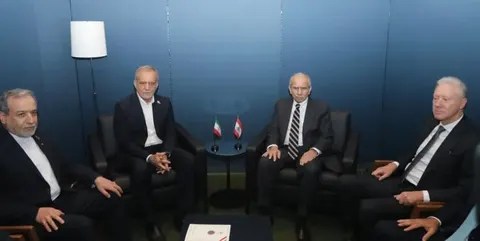
Qatari Prime Minister Mohammad bin Abdulrahman Al Thani traveled to Iran on Thursday, where he held two meetings with President Massoud Pezeshkian and the Speaker of the Iranian Parliament, Mohammad Bagher Ghalibaf.
Are we once again witnessing a race against the clock between diplomacy and the military option? It should be noted that the latter remains a last resort for Washington, according to American officials — but for Iran, where internal pressure is beginning to mount significantly, the calculation is rather delicate: either endure the sanctions or escalate pressure on the ground.
This is where Lebanon is particularly affected, and where Hezbollah's role becomes increasingly sensitive, as the state continues to indefinitely postpone the question of disarming the pro-Iranian militia.
President Aoun indirectly addressed the (verbal) standoff with this group on Thursday, citing an "internal conflict" between "those seeking to strengthen state institutions and those who benefit from their weakness" — without outlining any possible roadmap to actually resolve that conflict.
Beirut continues to pin its hopes on direct talks with Israel, which are set to resume in September in Rome, according to Italian Foreign Minister Antonio Tajani, though no specific date has been given.
To understand the core of Lebanon's problem, one must follow the statements of the US Ambassador to Lebanon, Michael Issa, who again stressed on Thursday the priority of disarming the pro-Iranian party, while also highlighting the regional dimension of the issue.
"Hezbollah," the US Ambassador noted, "must hand over its weapons, and the state must be the sole authority."
"As for guarantees, they require that sovereignty rest exclusively with the state and that defense also falls under its purview."
"As long as the state holds authority, controls its institutions, and maintains relations with other states, it can always call upon them for the assistance it may need," the US diplomat said following a meeting with the Druze Cheikh Akl, Sami Aboul-Mona.
But for this to be possible, Hezbollah must break away from Iran — which is no easy feat, the diplomat acknowledged. "So far, Hezbollah refuses to engage with the state, with us, or with Israel, because it simply takes its orders from Iran," he emphasized.
The Nobel Prizes and the Search for a Glimmer of Light in Human Behavior
Iran: Executions of young people, a favored tool of repression
A Chinese Perspective on Lebanon's Collapse
Dahr el-Baidar Explosives: Toward the End of Complacency?
Lebanese Moderation Needs a Project
Mais de Tilda Abou Rizk
Ver tudo



Mais em Analyze
Ver tudo


O mais recente do Levant Time
Ver tudo


