

The Education Crisis: When the State Fails Twice
Just days before the start of the school year, public schools and secondary schools found themselves facing a problem that should have been settled before they even opened their doors: which teachers does each school need, and how many teaching hours does it require?
The problem arose after the Ministry of Education decided to postpone the return of contract teachers paid through school and secondary-school funds, as well as the so-called “auxiliary” teachers, until a survey of needs had been completed and any surplus identified. As a result, around 3,500 teachers are waiting to find out what will happen to their teaching hours, while some schools have been forced to shorten their schedules because of teacher shortages.
A historical perspective
If we look back at a chapter of Lebanese political history that remains very much alive, the main force behind the battles over haphazard recruitment and contracting in public education was the political system itself, with its sectarian quota-sharing. Speaker of Parliament Nabih Berri and the Amal Movement, together with the other components of the ruling establishment, were among the principal sponsors of this system.
The surge in haphazard recruitment: in the years preceding the collapse, particularly between 2014 and 2018, ahead of the parliamentary elections, the public education sector was flooded with more than 5,000 teachers through indiscriminate appointments and contracts under various forms of “contract employment.” This was compounded by the invention of the category of “auxiliary teachers,” a hybrid status devised to employ political protégés while providing education to refugees with international support. They were denied the benefits of the Cooperative of Civil Servants in order to limit the state’s legal responsibility toward them.
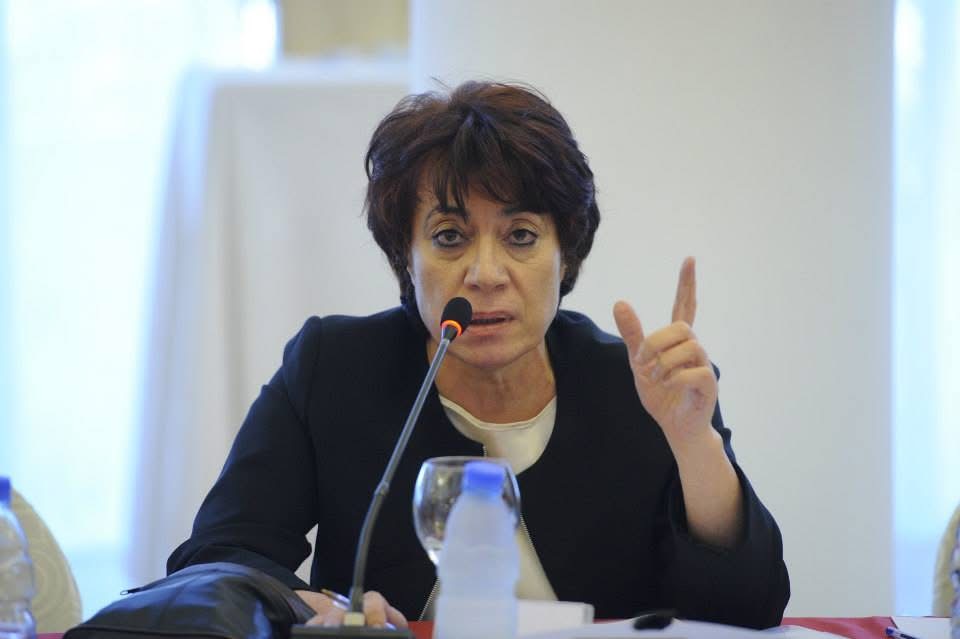
The structural gap, the backdoors and patronage channels: drawing on the experience of teacher Mona Jahmi, she points to structural corruption whereby tenured teachers in subjects such as mathematics, physics and languages are shifted, under political pressure, into positions as supervisors or as heads of laboratories and libraries. In other words, into jobs involving little or no actual teaching, almost sinecures. They work only 12 hours and then go on to teach in the private sector, while the state signs new contracts, wasting public funds, with political protégés to fill the classes left vacant.
Back to the current problem
What is happening in public education in Lebanon today is not a temporary crisis caused by a poor administrative decision or a technical delay in “assessing needs.” What we are seeing is the accumulated collapse of a system suddenly laid bare, because the authorities have once again decided to deal with the consequences of chaos rather than its causes.
Around 3,500 contract and auxiliary teachers suddenly found themselves outside the classroom at the start of the school year after their contracts were suspended under the heading of “reassessing actual needs.” On the surface, the decision appears rational: the war has changed the distribution of students, some schools have closed, others have been turned into shelters, and resources clearly need to be reorganized. But the problem lies not in the principle itself, but in the timing, and in what this belated timing reveals about a structural dysfunction.
The state, which for years did not know how many teachers it needed or how to distribute them, suddenly decided to “discover” this on the eve of the school year.
This is not reform. It is a declaration of bankruptcy.
Contract teachers, for their part, present themselves as victims of an arbitrary decision, and that description is not without merit. The decision came late, leaving thousands of families in agonizing uncertainty and threatening the orderly functioning of schools that were in fact forced to shorten their schedules because of staff shortages. But this account, however partly justified, is not enough.
Because the question that must be asked, perhaps for the first time in earnest, is this: how were these teachers hired in the first place? And how qualified are they?
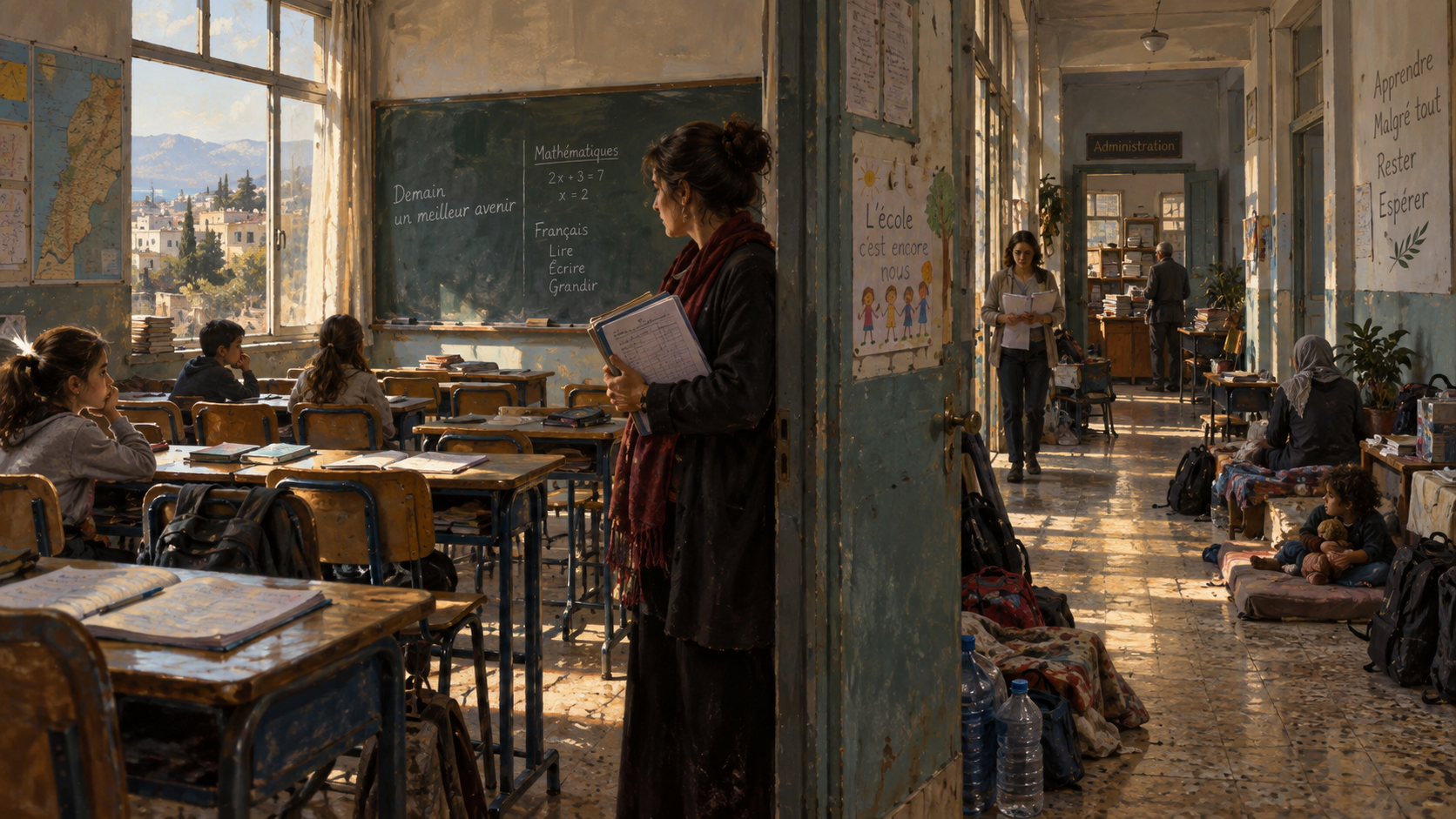
Another layer of the crisis then emerges, even more painful. The schools themselves are no longer fit for teaching: corridors filled with displaced people, shortages of water and diesel fuel, poor sanitation, and an impossible overlap between life in displacement and school life. Mona says: “You cannot teach amid the smells of cooking and constant movement,” adding that “distance learning is the worst educational experience.”
At this point, all the administrative arguments fall away. We are facing a reality that borders on catastrophe: children without stability, without psychological support, and without even a minimum educational environment. Violence is increasing, concentration is deteriorating, and memory itself is beginning to fracture under the pressure of displacement and social disintegration.
And yet the authorities insist on treating the issue as nothing more than a contracts file.
But the teacher’s own testimony does not absolve the education system either. It goes further, first and foremost, by revealing what people usually avoid saying: “There is a culture of carelessness in public education,” as well as a glaring dysfunction in the distribution of staff. Teachers are assigned to administrative positions or given no real duties, while some of those who remain teach carelessly, as the colloquial expression has it, even though their performance in private education is excellent because of monitoring and follow-up.
Meanwhile, contracts are used to fill shortages in essential subjects, sometimes through direct political intervention: “A call from a politician… Give him a contract, even if it is only for a few hours.” Yet this is supposed to be the responsibility of the Civil Service Board.
This is precisely where the problem comes into focus.
Contracting, which is supposed to be a flexible tool for filling shortages, has become one of the gateways to clientelism. And the paradox is that the very authorities, or their extensions, that allowed this unregulated system to balloon are now invoking the resulting chaos in order to freeze it.
In other words, they are punishing the consequences of what they themselves created.
The double crisis
Contract teachers are paying the price of arbitrary decisions.
And the education system is riddled with political recruitment and mismanagement.
More dangerous still, however, is that a moment that could have become an opportunity for genuine reform, through redistribution, tenure based on clear criteria and an end to the disorder, is being reduced to mere crisis management, postponed like every other crisis in Lebanon.
In the background lies something deeper than all of this: the absence of the state as a fair regulator.
Schools in the South are no longer merely educational institutions. They have become shelters. Parents do not even have documents proving their children’s educational level. Some do not know which grade their children should be enrolled in.
This is not a detail. It is the collapse of the most basic relationship between the citizen and the state.
When things reach this point, the debate over a “contract” or a “teaching hour” begins to resemble a technical discussion taking place on collapsing ground.
What this crisis reveals, quite simply, is that Lebanon’s authorities always fail twice.
They fail when they manage public sectors according to the logic of quota-sharing and clientelism. Then they fail again when they try to “reform” them without touching the roots of that very logic.
Between these two failures, teachers are lost, the education system disintegrates, and an entire generation is left to face its fate.
What is ultimately threatened is Lebanon’s own future, when this generation grows up burdened by all these deficiencies and all these problems.
In one word: a catastrophe.