

Iran Deal: Trump Delays Response Amid Outcry


The first draft of the memorandum of understanding between Washington and Tehran that was leaked to the press and media on Saturday evening sparked widespread outrage on Sunday.
Many Republican senators, including several heavyweight members of Congress, as well as analysts, commentators, and influential circles warned against the serious geopolitical consequences of this proposal. Some did not hesitate to denounce on social media what they unanimously called a 'capitulation of the United States to the Islamic Republic of Iran'.
Did this outcry and these warnings coming from all sides online push President Trump to apply serious brakes to the approval process for the memorandum, or did the White House chief realize that certain clauses were indeed unacceptable and detrimental to the credibility of the United States as a superpower?
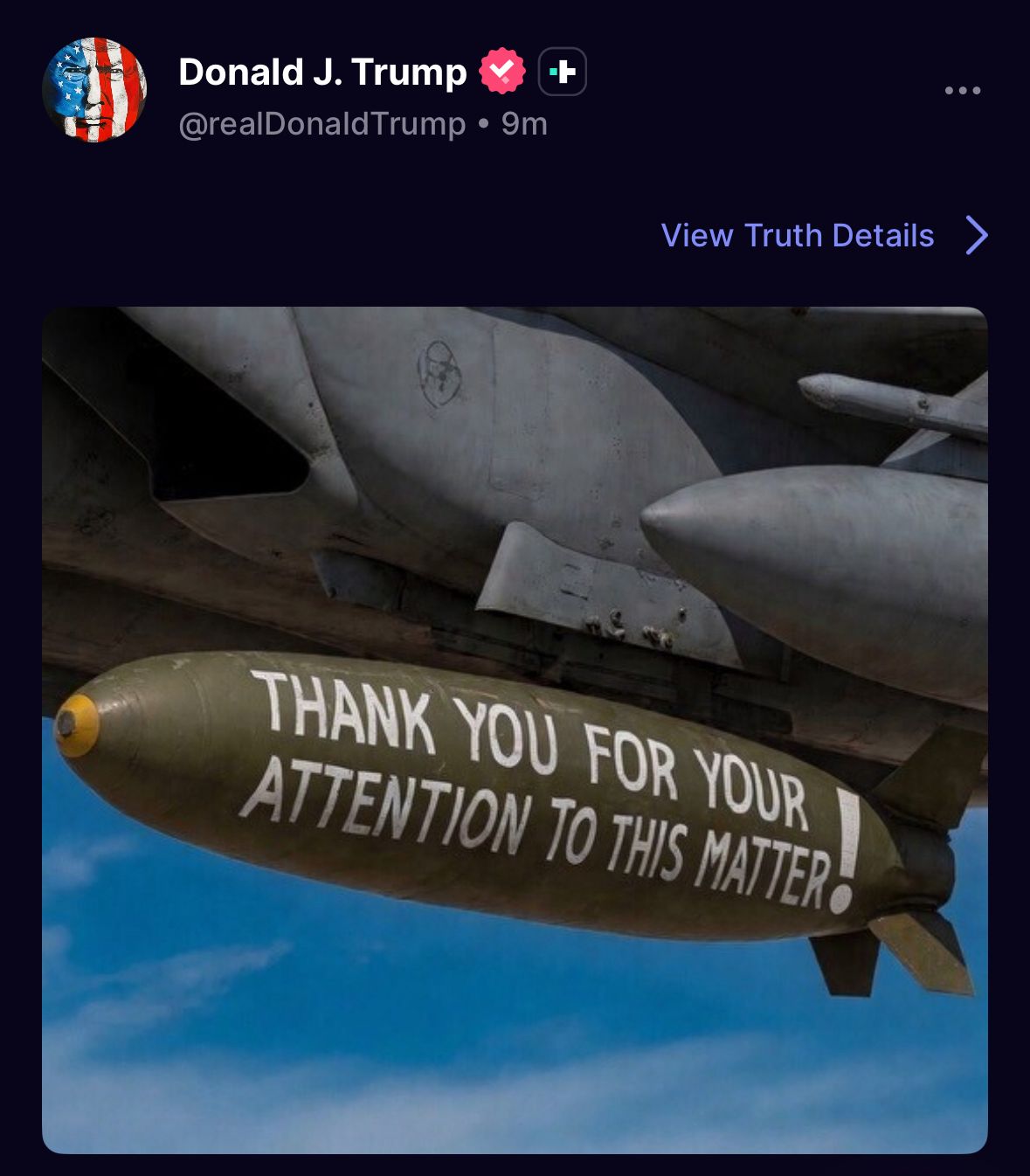
On his Truth Social network, Trump posted an AI image of an F-15 carrying a bomb with the words in English, 'thank you for your attention to this matter': a threat of possible return to war if Iran does not accept US conditions.
It is certainly difficult to provide an answer to such a question, but this does not change the facts: on Sunday, President Trump clearly indicated that he had instructed US negotiators to 'not rush' in concluding the memorandum.
'Both parties (the US and Iran) must take their time to reach a well-studied text,' the American president clarified, indicating that 'negotiations are continuing on certain details and certain issues.' 'Time is on our side,' he asserted without further details.
If the memorandum draft sparked so much criticism, it is because it appeared, according to the version that reached the media, to satisfy Iran across the board, namely: cessation of hostilities and unlocking part of Iranian assets (nearly $25 billion) without any formal and official Iranian commitment concerning the main American demands on nuclear matters, uranium enrichment, ballistic missiles, the fate of Iranian proxies, regional stability, or also the case—completely overlooked by US negotiators themselves—of political prisoners and mass executions of teenagers, young people, and university students.
According to the version of the agreement disclosed Saturday evening, nuclear and enriched uranium matters were to be 'discussed' only during a 30 or 60-day truce period.
Given that these matters have actually been under discussion for 20 years, the memorandum draft presented no guarantees regarding a definitive settlement of this dispute pending for more than two decades. Hence the wave of criticism that emerged on Sunday.
It should be noted in this context that the preliminary agreement proposal would provide for the reopening, without conditions, of the Strait of Hormuz during the 30 to 60-day negotiation period, as well as an effective ceasefire in Lebanon, which Israel contests.
In Lebanon, the ceasefire in question
Questions remain open then, particularly regarding the other front, between Hezbollah and Israel in Lebanon.
What is known is that there is a clause in this framework agreement on a ceasefire in Lebanon, 'with the right given to Israel to prevent Hezbollah from rebuilding its arsenal'.
According to observers, Israel, which had thus far ignored ceasefires negotiated directly with Lebanese authorities in Washington, could hardly contradict a directive coming directly from the American president in the context of negotiations on the main front in Iran.
All reports coming from Israel show growing concern about the outcome of this conflict.
Israeli Prime Minister Benjamin Netanyahu doubled down, asserting that "Iran will never possess nuclear weapons."
According to information provided to Israeli media on Sunday, Netanyahu allegedly pressed Trump for freedom of action on all fronts, particularly in Lebanon, and reportedly received his approval.
Questions remain open. What does the cessation of hostilities mean? Will it include Israeli withdrawal from territories occupied during this conflict? What does this right granted to Israelis to prevent Hezbollah from rearming mean? Will it keep Lebanon in a perpetual state of neither war nor peace? And what about Hezbollah's disarmament, decided by the Lebanese government, if the party believes it owes the ceasefire to its Iranian ally rather than Lebanese authorities?
And above all, what is the future of these direct negotiations between Lebanon and Israel? It should be recalled that before Sunday's dramatic developments, all eyes were on the first Lebanese-Israeli-American security meeting in Washington on May 29, and the upcoming direct negotiations on June 2 and 3.
Rubio threatens Qassem
In Beirut, Hezbollah leader Naïm Qassem said in a speech that "the people have the right to take to the streets, overthrow the government, and resist with all their strength this Israeli-American project."
Qassem again called on the Lebanese government to abandon direct negotiations with Israel, seeing it as a "gain without reciprocal benefit for Israel," and reaffirmed Hezbollah's refusal to disarm.
Qassem's remarks provoked a sharp reaction from U.S. Secretary of State Marco Rubio, who condemned "in the strongest terms Hezbollah's irresponsible call for the overthrow of the democratically elected Lebanese government." He denounced what he called "a deliberate campaign to destabilize the country and maintain power." Rubio stated in a statement that the movement "is actively attempting to plunge Lebanon back into chaos and destruction."
According to Rubio, "the threats of violence and overthrow made by Hezbollah will not go unanswered. The era when a terrorist group held an entire nation hostage is coming to an end." American sanctions
This week also saw American sanctions against numerous Hezbollah figures, including lawmakers and former ministers, as well as, for the first time, military officials from the Lebanese Army and General Security. The sanctioned military personnel are all considered close to Hezbollah or the Amal movement, with the American statement specifying that they owed allegiance to these parties as much as to their institutions and that they communicated sensitive information to them.
The message to Hezbollah is nothing new, but the message sent to Parliament Speaker and Amal chief Nabih Berry is clear. His "grey" position in recent Lebanese developments has earned him this American warning.
The message is also directed at the Lebanese Army, which is sending a delegation to Washington next week and which has often been criticized for "suspected complicity" with the Shiite militia. Will the army be forced to reconsider its delegation and reassess its positions?
As for General Security, Interior Minister Ahmad Hajjar has asked the director general to conduct investigations into the officers in question.
Meanwhile, on the ground, the situation remains explosive in the South as civilians pay the price: dozens of deaths have been reported this week.
Entre-temps, sur le terrain, la situation reste explosive au Sud alors que les civils payent le prix: on déplore des dizaines de morts cette semaine.
Civil Defense announced Saturday the collapse of its main building in Nabatiyeh under Israeli airstrikes. The Israeli military declared throughout the week that it had destroyed Hezbollah infrastructure and expanded its operations to the Bekaa Valley, while acknowledging casualties among its soldiers and officers caused by the Shiite party's drones. Over the weekend, Israeli evacuation notices multiplied for dozens of villages and towns, both in the South and in the Bekaa Valley.
From Yemen to Lebanon: Iran Wages a Covert Proxy War
Escalation in Yemen; explosives seized in Lebanon: Iran reactivates its proxies
When Terrorism Enters the Middle East Conflict…
Middle East Conflicts Take Center Stage at the UN General Assembly
The Houthis Continue Their Escalation Against Riyadh
Mais de LevantTime .
Ver tudo


Mais em Weekly essentials
Ver tudo


O mais recente do Levant Time
Ver tudo


