

Aoun consolidates his position and denounces the "suicidal impulse" and foreign allegiance.


For the first time since February 28, Lebanon experienced a day of calm: no Israeli raids, no exchanges of fire on the southern border, and no fighting in the border villages where the Israeli army maintains a presence. The only exception was the Israeli drone attack that killed one person in Kunin, in southern Lebanon.
The focus is now on assessing the casualties—who continue to be recovered from the rubble—and the material damage in the southern suburbs of Beirut, as well as in accessible southern towns, to which displaced people have returned en masse. The ten-day truce between Tel Aviv and Beirut, brokered by US President Donald Trump, appears, at first glance, to be a respite in a war that is far from over, as Israeli Prime Minister Benjamin Netanyahu noted on Wednesday, since the underlying causes of the armed conflict remain.
Lebanon has certainly taken a significant step by announcing a series of measures aimed at a lasting resolution to the problem posed by the presence on its soil of an autonomous armed militia, entirely subservient to the Islamic Republic of Iran. However, the authorities continue to proceed with extreme caution on this front, for various reasons, primarily related to the desire to preserve the sacrosanct internal balance and avoid upheavals in stability.
Mixed Statements
The remarks of President Joseph Aoun, the first since the establishment of the truce, those of Interior Minister Ahmad Hajjar, and especially the tone they both used, reflect this concern. Lebanese leaders remain uncompromising on the broad outlines of the new policy they have defined and much more discreet about the implementation mechanisms, which ultimately depend on the bilateral discussions taking place in Washington, as well as the US-Iranian talks in Islamabad. Joseph Aoun and Ahmad Hajjar, as well as the Speaker of Parliament, Nabih Berri, a Hezbollah ally, sought to reassure the public regarding their priority of internal cohesion, avoiding contentious issues such as the direct negotiations with Israel, currently being prepared under Washington's auspices, and the disarmament of Hezbollah, which is nevertheless essential to free Lebanon from Iranian hegemony and the risk of new wars.
The process is indeed underway, Joseph Aoun reaffirmed in a message to the nation, just hours after virulent criticism from the Hezbollah parliamentary bloc against the new Lebanese political direction. "Today, we negotiate for ourselves and we decide for ourselves. We are no longer a pawn in anyone's hands, nor a battleground for others." “We will never return to that state of affairs,” he declared from the outset, noting the support of the majority of Lebanese for these policies.
The head of state attacked Hezbollah without naming it, criticizing its rhetoric that presents “resistance” as the only bulwark for Lebanon: “To those who jeopardize the future of the country and its people, I say: enough is enough. Only the project of the state is the strongest, the most sustainable, and the safest for all.” He continued: “We are all in the same boat. Either we reach port together, or we all sink, but no one has the right to commit such a crime, under the cover of any slogan, out of suicidal impulse or loyalty to a foreign power,” in a clear allusion to Iran, to which Hezbollah belongs.
Moreover, Joseph Aoun did not mention Iran, which had been quick to claim credit for establishing the truce, when he praised the "tireless" efforts of Lebanese officials, Arab countries, particularly Saudi Arabia, Western states, and President Trump to impose a ceasefire on Israel.
Still addressing Hezbollah, he emphasized that the planned negotiations are "neither a sign of weakness nor a concession," but rather are motivated by the desire to protect Lebanon "by all means and, above all, by our refusal to die for anyone other than Lebanon." In this context, he stressed that Beirut will not make any concessions on its rights, particularly territorial rights, thus dispelling fears of the entrenchment of the "security zone" established by Tel Aviv in southern Lebanon to protect the towns north of its territory.
While President Aoun reaffirmed earlier the importance of the upcoming "delicate and decisive" talks with Tel Aviv, he merely outlined the Lebanese state's objectives in this dialogue as "consolidating the ceasefire, withdrawing Israeli forces from areas where they maintain a presence in the south, extending state authority throughout the country, and releasing Lebanese prisoners."
"Amal with Israel and the settlement of disputes between the two countries regarding certain border points." Not a word on the disarmament of Hezbollah, which is nevertheless at the heart of the upcoming discussions. The head of state only promised a deployment of the army and security forces in the south, "after the Israeli withdrawal," assuring that they "will put an end to the armed demonstrations and will be the only forces present on the ground."
In any case, Lebanon is preparing to embark on a path fraught with obstacles. In this context, it is still unclear what precise agenda the Lebanese negotiator, Simon Karam, will take with him to Washington, and who will establish it. All attention is currently focused on this element, in light of reports that the matter is being handled exclusively by the Presidency of the Republic, based on contacts established with the Amal-Hezbollah tandem, which, as is well known, is hostile to direct dialogue with Tel Aviv.
Full Reopening of the Strait of Hormuz
A dialogue that, if it begins under favorable conditions, would extend the truce by ten days, the US State Department promised on Tuesday.
The truce began on two significant notes: first, Iran announced the full reopening of the Strait of Hormuz, in what Tehran presented as a sign of goodwill linked to the announcement of the ceasefire in Lebanon. According to Iranian Foreign Minister Abbas Araghchi, this maritime passage will be open to all commercial cargo ships for the duration of the truce in Lebanon.
Welcomed by President Trump, the Iranian initiative actually serves two tactical purposes: it signals an openness toward Washington in the context of the ongoing efforts to revive bilateral US-Iranian negotiations. The United States, however, made it clear that it would not lift the blockade imposed on Iranian ports, at least not before a serious agreement with Tehran, which immediately reiterated its threat to close the Strait of Gibraltar, though without following through.
The Iranian decision also reflects Tehran's desire to demonstrate its continued control over the Lebanese situation, to the detriment of local authorities. President Joseph Aoun responded bluntly to this in his address to the nation. Donald Trump, in turn, took care to reiterate on Wednesday, when discussing the Iranian issue, that it is separate from the Lebanese one. The American president made this point when he announced on his Truth Social network that the United States intended to recover all the nuclear "ash" caused by American B-2 bombers in Iran, without any financial compensation. He clarified that this agreement, like the one concerning the reopening of the Strait of Hormuz, “is not linked to Lebanon” and that Washington “will work separately with Beirut to resolve the Hezbollah issue.”
Exchange of Threats
The second significant point relates to the exchange of threats between Hezbollah and Tel Aviv, at a time when a discord appears to be emerging between Israel and Washington regarding the handling of the two issues: Lebanon and Iran. President Trump stated categorically that Israel would no longer attack Lebanon, while Israeli leaders insisted that the war against Hezbollah was not over. The pro-Iranian group announced that it remained vigilant and “kept its finger on the trigger,” warning Israel against violating the truce or assassinating members of the group.
For their part, Israeli Prime Minister Benjamin Netanyahu and his Defense Minister, Israel Katz, asserted that the war is not over and that Tel Aviv remains committed to achieving Hezbollah's disarmament through military or diplomatic means.
Both also affirmed that the Israeli army will maintain a presence in the area it now controls along the border and will continue dismantling Hezbollah's military infrastructure there.
In this context, Benjamin Netanyahu reiterated that the road to peace remains long. "We began this journey with one hand holding a weapon and the other outstretched toward peace," he said, before announcing that his country had "for the first time established a security zone along its entire northern border." This now extends to Mount Hermon, as the Israeli army revealed in the evening that it had conducted a last-minute military operation in Lebanon, just before the ceasefire came into effect at midnight on Thursday night, in order to seize control of a strategic position on Mount Hermon. This position is located 12 kilometers from the Israeli side of the mountain, which is shared by Lebanon, Syria, and Israel, and 30 kilometers from the Beirut-Damascus road. It overlooks the entire Bekaa Valley and remains far from the Lebanese villages in the region still according to the Israeli army.
France Avoids a State of Emergency but Prepares for the Worst
A Nobel Peace Prize to Save International Law in Peril
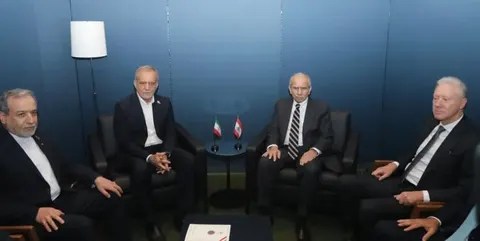
A Lebanese-Iranian Meeting in New York, but Several Political Messages
“No State Can Have Two Armies and Two Decision-Making Authorities,” Salam Says in New York
Trump Pulls Back at the Last Minute From Strikes on the Houthis
Plus de Tilda Abou Rizk
Voir tout



À lire aussi dans Today's Essential
Voir tout


Les derniers articles de Levant Time
Voir tout


