

Washington Negotiations: A Step-by-Step Approach
Extended 45-day 'ceasefire'; meeting on May 29 at the Pentagon to launch a 'security process'
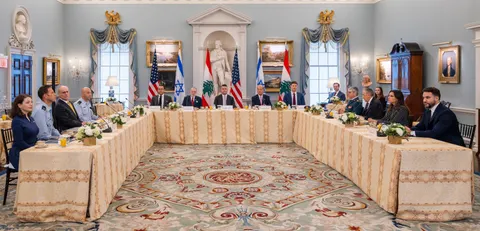


Obviously, one could not have expected spectacular results or decisions from the third round of direct Lebanese-Israeli negotiations held Thursday and Friday at the State Department in Washington. However, it must be acknowledged that the mere fact that these bilateral face-to-face discussions took place in Washington under the auspices of the US Administration represents a significant breakthrough in itself.
Beyond this politically symbolic parameter, some positive signs emerged Friday evening following the marathon meetings held by the Lebanese and Israeli delegations. The State Department emphasized that the exchanges took place in a 'positive atmosphere that even exceeded our expectations.'
In the same vein, Lebanon's embassy in the federal capital stated that it 'welcomes the outcome of the discussions' with Israel, clarifying that these negotiations are part of a 'political process' that should lead to a favorable resolution of the current conflict in the direction of restoring Lebanese state sovereignty 'through its own forces.' As for Israel's ambassador to Washington, he declared that the chances of success in negotiations with Lebanon are 'high.'
Concretely, Friday's marathon meeting produced practical measures: an extension of the cessation of hostilities for a 45-day period; a summons for military officers and experts from both countries to a meeting on May 29 at the Pentagon to launch 'a security process between Lebanon and Israel'; a summons for both delegations to a new round of negotiations scheduled for June 2-3 at the State Department.
In the absence of spectacular and rapid decisions, the American mediator is opting for a realistic approach: the step-by-step diplomacy (favored by Kissinger) aimed at gradually building a climate of trust and mutually beneficial cooperation between the two countries.
Change in the designation of the May 25 holiday
It is worth noting, in light of the spirit of the process underway in Washington, that Prime Minister Nawaf Salam adopted Friday a symbolic measure that, while symbolic, carries significant political meaning and implications. He issued an administrative note confirming the May 25 holiday, which in previous years since Israel's 2000 withdrawal had been observed as 'Resistance and Liberation Day.'
This year, the Prime Minister's note regarding the May 25 holiday makes no mention of 'resistance' or 'liberation,' but instead emphasizes that the holiday will be observed 'in solidarity with the families of martyrs, the wounded, prisoners, the displaced, and the residents of the South and border villages.'
This particular and very explicit mention confirms that the government no longer recognizes the existence of a 'resistance' that Hezbollah seeks to embody regardless of all obstacles, disregarding the position of legality and the overwhelming majority of Lebanese who reject the suicidal military adventures of the pro-Iranian militia.
Just Friday evening, the Prime Minister declared that it 'is time to definitively end the reckless adventures (alluding to Hezbollah) carried out in service of foreign projects,' criticizing accusations of 'treason' leveled by the pro-Iranian militia.
Recall that following Hezbollah's launch of hostilities once again on March 2 to 'avenge the death of Iranian Supreme Leader Ali Khamenei' in Tehran, the Council of Ministers adopted a resolution stating that Hezbollah's security and military apparatus is now considered 'illegal.'
Following this decision, the Information Minister called on official media to no longer mention 'resistance' in their news bulletins and political programs.
Elimination of Hamas military chief
It is worth noting, on another matter but still within this military-security context at the regional level, that the Israeli military eliminated Friday, in a targeted strike on Gaza, the head of Hamas's military apparatus, Ezzeddine Haddad, accused of being one of the masterminds of the deadly October 7, 2023 attack against Israeli civilians on the outskirts of Gaza.
The Beijing Summit
The second highly strategic matter that marked the news on Friday, May 15 is the conclusion of the US-Chinese summit held in Beijing, which had begun Friday.
It will undoubtedly take a few days before credible and precise information is released concerning the actual outcome of the discussions that President Donald Trump and his delegation had with Chinese leaders over these two days.
Already, some significant indications made public allow us to sketch out the possible implications of this historic summit on the Iran conflict.
President Trump notably stated that there is complete convergence of American and Chinese viewpoints concerning Iran.
Concretely, President Xi Jinping aligns with the Trump Administration's position on the nuclear issue, in the sense that, like the White House chief, he asserts that under no circumstances should the Iranian regime be able to acquire nuclear weapons.
This Chinese position is not new, as illustrated by Beijing's stance during the vote on five UN Security Council resolutions concerning Iran's uranium enrichment.
The first of these resolutions, dated July 2006, 'required' Tehran to cease its uranium enrichment.
The mullah regime obviously disregarded this resolution. In December of that same year, the Security Council imposed sanctions on Iran to compel compliance with UN directives.
To no avail… Three other resolutions were passed by the Security Council in 2007, 2008, and 2010 to impose increasingly severe sanctions on Tehran.
China, like Moscow, did not impose a veto, which reflected alignment with Western countries on the necessity of compelling the mullah regime to halt uranium enrichment.
During his talks with President Trump, Xi reiterated his country's principled position on this matter.
Another point of convergence between Xi and the White House chief (as well as with European countries generally): rejection of Iranian sovereignty over the Strait of Hormuz and therefore rejection of toll imposition by the Revolutionary Guards.
In parallel, the Chinese leader reportedly committed to his host not to supply military equipment to the Iranian regime.
It follows from these indications that the Beijing summit could result in a weakening of Iran's position in the face of American conditions aimed at achieving a political solution to the current conflict.
The coming days should in any case clarify the situation further in this regard.
The big question to be raised in this connection in the short term, in light of the Beijing summit's outcome, is whether President Trump will decide to launch or not new well-targeted military operations on Iranian territory with the aim, notably, of securing enriched uranium and dealing new severe blows to Iran's economic infrastructure in order to bring the mullah regime to renounce its irrational adventures and its belligerent, arrogant behavior, defying all reason in a completely shameless manner.
France Avoids a State of Emergency but Prepares for the Worst
A Nobel Peace Prize to Save International Law in Peril
A Lebanese-Iranian Meeting in New York, but Several Political Messages
“No State Can Have Two Armies and Two Decision-Making Authorities,” Salam Says in New York
Trump Pulls Back at the Last Minute From Strikes on the Houthis
More from Michel Touma
View All


More in Today's Essential
View All


Latest from Levant Time
View All


