The Houthis in Yemen: From Saada to Bab el-Mandeb (4/4)

VI. The War Against Iran (February-June 2026): the “Limited Intervention”
A Late and Symbolic Entry
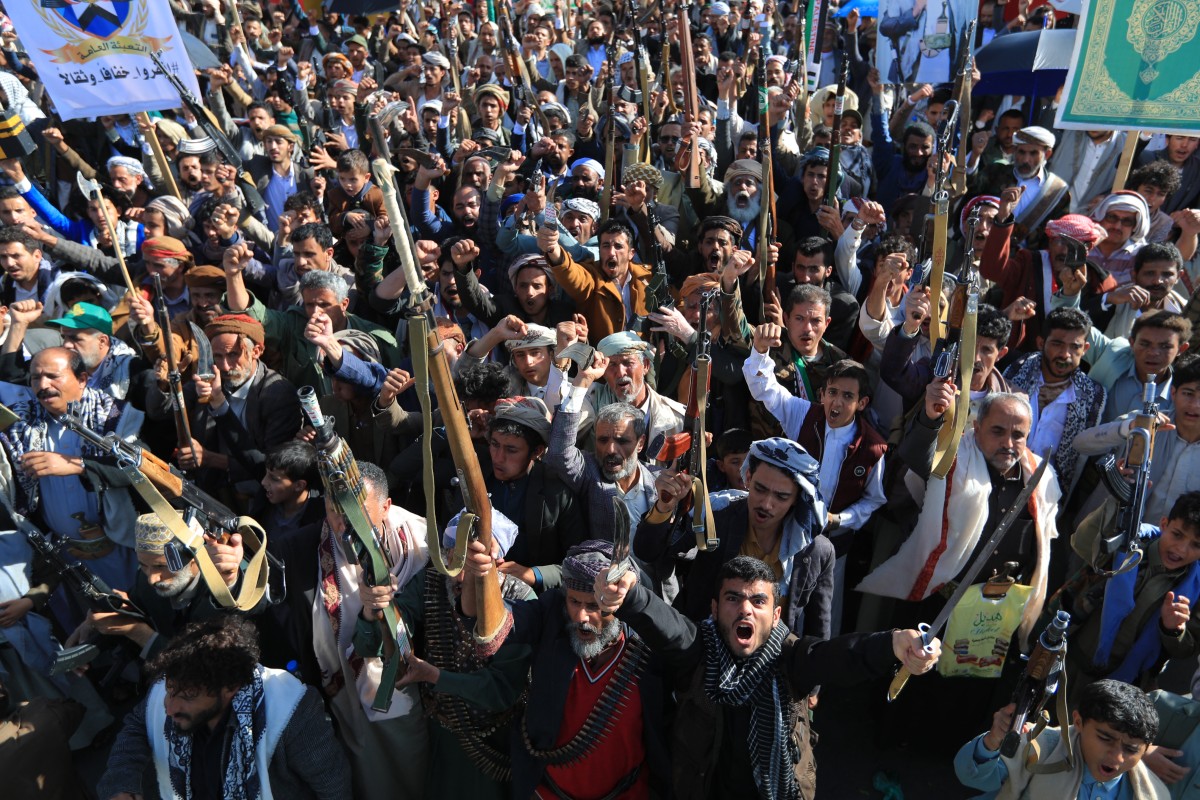
On February 28, 2026, the United States and Israel attacked Iran. Very quickly, Tehran largely closed the Strait of Hormuz, reducing Gulf exports to a trickle. Many expected the Houthis to open a second front at Bab el-Mandeb. They did not. Their involvement was cautious, gradual and late: it was not until March 28, one month after the war began, that they fired their first missiles toward Israel, as though they had waited for the moment when their entry would have the greatest impact.
Their operations were limited to missile and drone launches toward Israel. Their military effect was modest, given the distance and the effectiveness of Israeli air defenses. Above all, they avoided high-impact fronts: no campaign against shipping in the Red Sea, no strikes against the Gulf monarchies or regional energy infrastructure. The media dimension compensated for this: each launch sustained the image of a “resistance” force loyal to the Axis. These launches were suspended with the Islamabad Memorandum, concluded in June between Washington and Tehran.
Controlled Deterrence
Three analytical tools can be used to explain this: deterrence theory in its asymmetric form, asymmetric warfare theory and the concept of below-threshold escalation (escalation below threshold). The actor strikes where the political gain exceeds the military risk, threatens without acting on the threat, and makes its presence felt without fully committing itself. The Houthis thus shifted from “open asymmetric deterrence” to “controlled deterrence.”
Within this framework, Bab el-Mandeb changed status. From an instrument of everyday tactical pressure, the strait became strategic deterrence held in reserve. Its activation, combined with the closure of Hormuz, could, according to some projections, push oil above $150 a barrel and trigger global inflation. It was precisely because the card was so powerful that it was not played: using it would provoke an uncontrollable response.
The Four Constraints
Four factors explain this restraint. The first was the effect of the 2024-2025 strikes, which degraded capabilities, exposed intelligence vulnerabilities and established the credible threat of further strikes.
The second was economic fragility: Houthi-controlled areas depended on limited trade, fuel smuggling, salary transfers and migrant remittances; a major escalation risked causing a rapid internal collapse.
The third factor, often underestimated, was the relationship with Saudi Arabia. Since the 2022 truce, Riyadh had acted as an economic safety net, notably by partially financing salaries in Houthi-controlled areas.
The fourth was relative autonomy from Tehran. As a member of the Axis, the movement did not relinquish its ability to make decisions according to its own interests. Its objectives could then be summarized as follows: support Iran diplomatically, preserve its regional stature, strengthen its domestic legitimacy and keep the option of escalation intact.
A Decision Rule
The logic can be formulated as a simple rule. The movement chooses escalation if it increases its political influence without threatening its survival. It refrains if escalation jeopardizes its internal stability or triggers a destructive response. In the spring of 2026, this rule produced restraint. What remains to be understood is why, beginning in July, the same rule produced the opposite result, and then what becomes of it in October, when survival itself is at stake.
VII. July-September 2026: From the Mecca Pact to the Seizure of the Strait
The July Rupture
The shift begins in July 2026, when the Islamabad Memorandum unravels. Iran fires on ships it accuses of ignoring its transit rules in Hormuz, President Trump declares the agreement null and void, and the US Navy reinstates its blockade of Iranian ports on July 14. The Revolutionary Guards then threaten the other export corridors useful to the United States and its allies. According to Reuters, Tehran asks the Houthis to be ready to close Bab el-Mandeb.
In Yemen, the 2022 truce unravels in two stages. On July 3, a Mahan Air aircraft lands in Sanaa, the first announced Iranian flight in nearly ten years, and takes a Houthi delegation to Ali Khamenei’s funeral. On July 13, on the return flight, the Sanaa runway is struck to prevent the aircraft from landing; the plane is diverted to Hodeida. According to Reuters, it was carrying between ten and twenty-one Revolutionary Guard advisers and equipment for missiles and drones. The Houthis declare the truce over and fire on Abha airport the same day.
Events then unfold in less than two weeks. On July 20, the Houthis proclaim a naval blockade of Saudi Arabia; on the 22nd, two Saudi tankers are hit; on the 24th, Riyadh bombs Hodeida; on the 25th, the Houthis strike Aramco refineries in Jizan and Yanbu, the first direct attack on Saudi oil infrastructure in four years. Brent climbs back above $100. Their message remains calibrated: there is “no closure of Bab el-Mandeb”; the shipping ban targets Saudi Arabia alone.
Between late July and early August, Riyadh launches a maritime coalition bringing together eight states bordering the Red Sea and the Gulf of Aden; the Houthis respond by promising “total escalation.” From August 6 onward, they also strike Yemeni government forces on several fronts, notably in Marib. In August, attacks on Najran, Saudi vessels and the cargo ship Tihama, where two Pakistani sailors are killed, multiply. The Jizan refinery, with a capacity of 400,000 barrels per day, remains shut down for several weeks.
The Mecca Defense Pact (August 7, 2026)
It is against this backdrop that Mohammed bin Salman, Recep Tayyip Erdogan and Shehbaz Sharif sign the Mecca Joint Defense Agreement in Mecca on August 7, 2026. Its principle is that of a collective defense clause: any armed attack against one of the three states is considered an attack against them all. The text has not been made public and does not specify each party’s military obligations. It extends the Saudi-Pakistani defense agreement of September 2025.
For Riyadh, the agreement responds to a twofold reality. American protection has become uncertain, with Washington absorbed by the war with Iran. And the Kingdom, which since 2022 has sought to extricate itself from the Yemeni conflict, needs a deterrent that does not force it to plunge back into the war alone. The pact brings together two complementary powers: Türkiye, NATO’s second-largest military, already highly active in the Red Sea and Somalia, and Pakistan, the Muslim world’s only nuclear power, whose military has a long history of cooperation with the Kingdom. It extends the Riyadh-Ankara-Cairo convergence that has emerged in response to the realignments reshaping the Horn of Africa.
Institutionalization is rapid but incomplete. On August 31 in Istanbul, the first meeting of the Political and Defense Strategic Committee renames the arrangement the “Mecca Defense Alliance” and sets out a roadmap for future memberships. Islamabad says that more than six countries are candidates, but that none will be admitted before the agreement is fully operational. The Turkish and Pakistani parliaments still have to approve its ratification.
September: The Heaviest Attack and the Seizure of the Coast
On September 3, the Houthis launch a massive offensive in Taiz governorate to cut the Taiz-Mokha road; more than 120 people are reported killed in two days. Government forces counterattack in al-Jawf and al-Bayda and say they are aiming for Sanaa. The Houthis accuse Riyadh of striking a prison in al-Hazm; the toll, initially 11 dead, rises to 23. During the night of September 7 to 8, they retaliate with dozens of missiles and drones against Khamis Mushait, Abha, Jizan and Najran, including Abha airport, King Khalid Air Base and Aramco sites. Seventy-three people are injured, fires break out at oil facilities and oil jumps toward $100 a barrel.
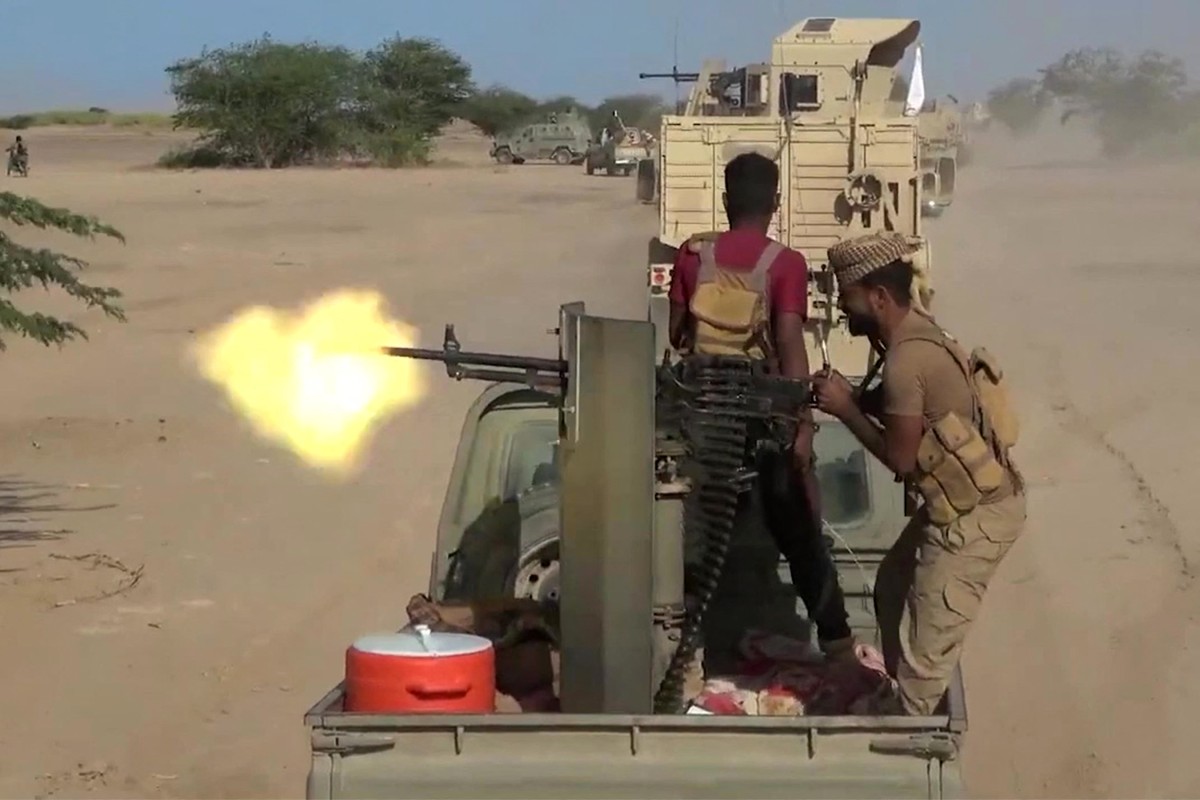
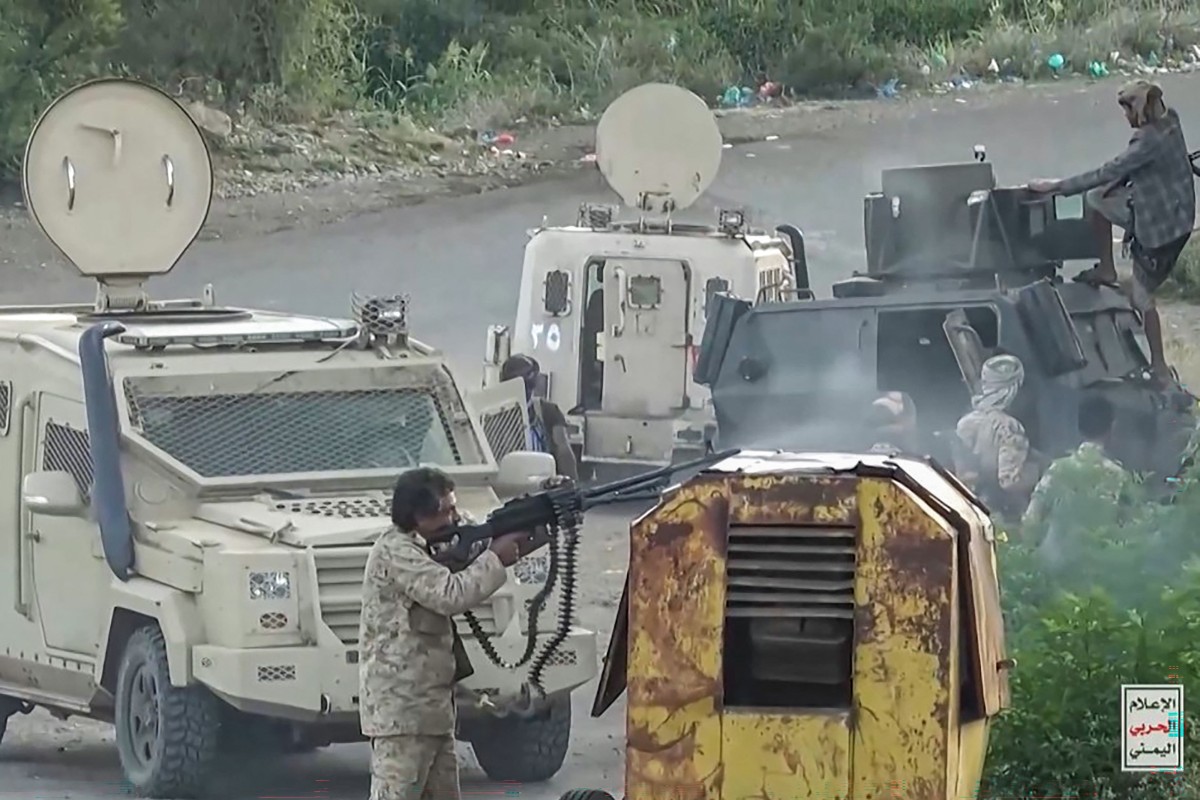
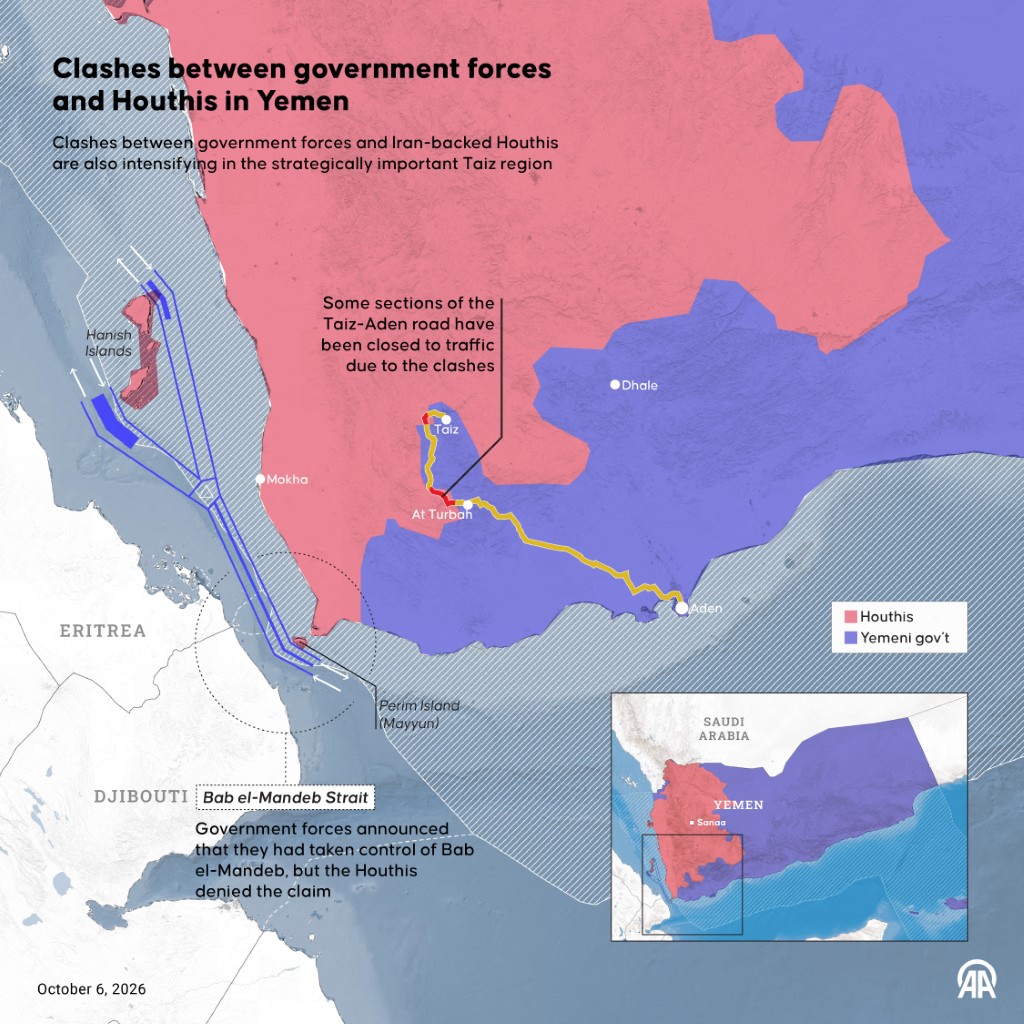
What follows catches everyone off guard. On September 9 and 10, the Houthis seize Hays, al-Khokha and then the port of Mokha; on the 11th, they enter Dhubab and take Mayun Island (Perim), in the middle of the strait; on the 14th, they occupy the Hanish Islands. In all, six districts and approximately 5,400 square kilometers change hands after pro-government forces withdraw. By late September, the Security Council refers to at least 125,000 people displaced since the beginning of the month. Fighting continues in the Kahboub mountains, which open the road toward Lahj and Aden.
This breakthrough owes much to Iran. According to Reuters, it was armed and advised by the Revolutionary Guards and led on the Tihama by an officer of the Quds Force, Abdolreza Shahlaei. Electronic-warfare units reportedly infiltrated opposing communications and ordered a retreat while posing as southern commanders. The conquest therefore owed as much to deception as to the balance of forces, which helps explain the fragility of the gains in October.
The War of Symbols: From Mecca to Medina
In mid-September, Riyadh says it intercepted a Houthi drone south of Mecca before it entered the city’s restricted airspace. The coalition describes it as the second attempt against Mecca since 2017. The Organization of Islamic Cooperation, the Yemeni government, Egypt and Pakistan condemn the incident. The Houthis and Iran deny it and denounce a “false pretext.”
On October 1, the coalition accuses the Houthis of having struck the Taibah power station in Medina by drone on September 29, a station that supplies the Prophet’s Mosque. One transformer is knocked out, without interrupting the grid. The Houthis call it a “lie.” Beyond the facts, which remain disputed, the stakes are clear: invoking the two holy cities allows Riyadh to mobilize the Muslim world and give the Mecca Pact a religious resonance. As early as September 9, Pakistan’s defense minister, Khawaja Asif, had warned that Houthi attacks could trigger the pact.
American Decoupling: The Muscat Understanding
Perhaps the most significant development is diplomatic. On September 10, Mohammed bin Salman calls President Trump twice to request strikes; he is rebuffed. Washington limits itself to support: more than one hundred military advisers provide Riyadh with intelligence and targeting assistance. In mid-September, American and Houthi representatives meet in Muscat with Omani facilitation. On the 18th, President Trump confirms that the two sides are “talking” with a view to reaching an agreement.
According to the accounts, the Houthis undertake not to target American or Israeli vessels and to abide by the May 2025 ceasefire understanding. It resembles a tacit agreement: international shipping is preserved, but Saudi vessels and tankers remain targets. This decoupling is not without hesitation. On September 20, after another call from the crown prince, President Trump orders preparations for strikes, then cancels them a few hours later, according to the New York Times.
The Houthis therefore continue their offensive against the Kingdom. On September 19, they strike Riyadh, where a fuel depot at King Khalid Airport is hit. On the 24th, they claim strikes on a “sensitive target” in Riyadh and on Aramco facilities in Yanbu, the terminal of the East-West Pipeline that allows exports through the Red Sea while bypassing Hormuz; the coalition says it intercepted six ballistic missiles and Brent closes above $106. On the 26th, two new attacks target Riyadh and a major city in the southwest. After the September 27 strike on a market in Mawiya, Taiz, which kills at least seven people and injures around forty, the Houthis threaten to target bridges on Saudi territory.
Internationalization at the End of September
The response takes shape in successive layers, without a declaration of war. On September 18 and 25, the Security Council unanimously condemns the Houthi attacks and recognizes Saudi Arabia’s right to self-defense. On the 22nd, the G7 calls on the Houthis to halt their strikes; the United Kingdom deploys a Voyager tanker aircraft in support of Saudi air defenses. On the 24th, France announces the deployment of troops, radars and defense systems to protect Yanbu.
On September 25, the Saudi, Turkish and Pakistani chiefs of staff meet in Riyadh to translate the pact into military cooperation. On the 28th, Rashad al-Alimi announces reconquest operations and the Yemeni Parliament approves general mobilization. The European Union seeks to reinforce Operation Aspides: the Netherlands sends a frigate, while Belgium and Italy consider doing so. The aircraft carrier USS Theodore Roosevelt sails toward the region. By late September, no Turkish or Pakistani troops have yet been announced and no international offensive campaign has been decided. It will take less than a week for that assessment to be overtaken by events.
VIII. October 2026: The Counteroffensive and Activation of the Pact
“Dawn of Yemen”: The Strait Becomes a Front Again
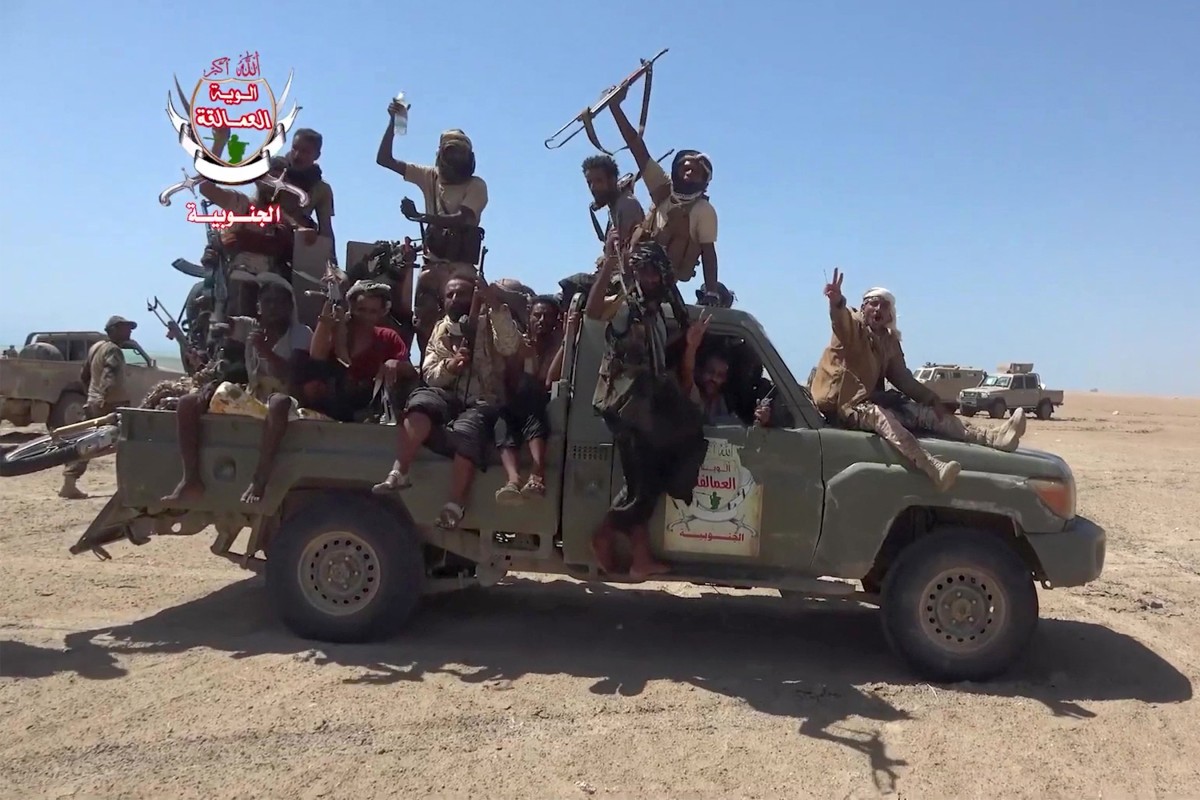
On October 4, Rashad al-Alimi launches Operation “Dawn of Yemen,” whose stated objective is to restore the institutions, retake Sanaa and end Houthi rule. On the 5th, government forces (the Giants Brigades, Nation’s Shield and the Tihama Resistance) claim the capture of Dhubab airport, the cutting of the Dhubab-Mokha road, control of the Bab el-Mandeb area and the recapture of the port of Mokha. They say they have encircled hundreds of Houthi fighters in Dhubab and on Mayun Island. The army spokesman also announces a “strategic offensive” on Sanaa.
Saudi support changes scale. The coalition commits around one hundred combat aircraft, says it destroyed 324 high-value targets on the first day, then a depot holding twenty ballistic missiles in Saada. Its navy strikes depots of explosive-laden boats and naval mines in Hodeida governorate and says it foiled an attack on shipping lanes in the southern Red Sea.
These gains remain disputed. The Houthis deny any enemy advance and deny that Mokha has fallen. Reuters instead describes government forces reaching the outskirts of the city while Houthi fighters withdraw toward the highlands. The figures put forward by the Yemeni army, more than 1,800 Houthis “neutralized” in a few days, have not been verified. On the Houthi side, 59 Saudi strikes in twenty-four hours on October 8 and civilian casualties are denounced.
The Houthi Response: The War of Airports
Threatened on the coast, the Houthis shift the escalation deep into Saudi territory. On October 3, an Aramco site near Riyadh is in flames, as confirmed by AFP and satellite imagery, while the coalition describes the claim as “misleading.” On the 5th, the airports of Jizan and Najran are hit, with three people injured according to Saudi civil aviation; the Houthis also claim strikes on Riyadh airport and an Aramco refinery on the Red Sea. Brent remains above $100, compared with around $73 before the war.
The same day, they warn airlines that Saudi airspace is “not safe,” with the explicit exception of Mecca and Medina. Strikes then follow on Abha, Khamis Mushait and Riyadh. On October 7, ballistic missiles target Aden airport, held by the government, and a flight from Cairo is diverted. On the 8th, King Khalid Airport in Riyadh is hit: three people are killed, including a pilot, according to the Saudi authorities. Traffic resumes the next day.
The logic is one of reciprocity. With Sanaa under an air blockade and the airports of Sanaa and Hodeida having been bombed, the Houthis intend to impose a blockade on all Saudi airports. They announce a long war. On October 9 and 10, the coalition says it destroyed three launchers and intercepted new missiles and drones.
The Mecca Pact Put into Effect (October 5)
On October 5, the Political and Defense Strategic Committee meets in emergency session in Riyadh. The three states decide to proceed “immediately” with implementing their collective-defense commitments and to ensure the rapid deployment in the Kingdom of the agreed forces and capabilities. This is the first time the agreement has been applied. The communiqué does not name the Houthis, but condemns attempts to target Mecca and Medina. Retired Pakistani general Nauman Mahmood is appointed the alliance’s first secretary-general for a three-year term.
The actual scope remains limited and defensive. Deployment will take place according to the “approved arrangements” and each country’s national laws, while parliamentary ratification has been secured neither in Ankara nor in Islamabad. According to Khawaja Asif, Turks and Pakistanis are “present in theater,” but only Saudi forces are fighting; Pakistan is taking part in reconnaissance. Analysts expect above all a reinforcement of air and missile defense. In Sanaa, an armed rally denounces Türkiye’s and Pakistan’s involvement as early as October 7.
Washington Holds Back, Tehran Bargains
American decoupling holds despite the deaths in Riyadh. In early October, President Trump still refuses the direct strikes requested by Riyadh and repeats that the Houthis do not want to fight the United States. Secretary of State Rubio nevertheless says that neither Riyadh nor the Yemeni government accepts the Houthis retaining the territories they have seized. France condemns the attacks on October 7 and reaffirms its solidarity with the Kingdom.
Tehran, for its part, has included Yemen in its bargaining over Hormuz. The seven-day plan transmitted to Washington by Qatar on September 22 provides for lifting the naval blockade, an exemption from oil sanctions, the release of about $12 billion in assets and a regional ceasefire including Lebanon and Yemen. The strait would reopen on the sixth day and negotiations would resume on the seventh. President Trump reportedly rejected it; on October 5, Tehran says it is examining the American comments. President Pezeshkian maintains that Houthi operations are independent of Iran and offers his good offices between Sanaa and Riyadh.
October 10: The Carnage at King Khalid Airport, a Threshold Crossed
On Saturday, October 10, King Khalid International Airport in Riyadh is hit for the third time in a week. This time, the projectile strikes neither a runway nor a fuel depot, but a passenger area: a witness quoted by Reuters sees Gate 401 of the domestic terminal take a direct hit. According to the General Authority of Civil Aviation, the toll rises to at least 12 dead and 309 injured, several of them in critical condition. The dead are of eight nationalities: four Saudis, two Bangladeshis, one American, one Jordanian, one Palestinian, one Syrian, one Sudanese and one Egyptian. An initial assessment points to a ballistic missile, and the Saudi warning system issues no alert. According to Reuters, it is the deadliest attack on the Kingdom’s soil in more than ten years.
The airport is closed with no reopening date announced, and hundreds of flights are cancelled or diverted. Air India, flydubai, the Lufthansa Group and PIA had already suspended their services, while the European Union Aviation Safety Agency broadens its recommendations regarding Saudi airspace. Responsibility for the attack remains ambiguous: unlike previous strikes, the Houthis do not formally claim this one, but the head of their media office celebrates having “closed Riyadh International Airport.” On October 11, they renew their warnings to airlines, employees and travelers, blame Riyadh for the “failed interceptions,” and announce that only humanitarian flights with a permit will be allowed. They thus turn against the Kingdom the very permit regime that the coalition has imposed for years on Sanaa airport.
Reactions move up a notch. The coalition calls it a “flagrant war crime” and promises a “firm” response. Qatar describes it as “a direct threat to regional security,” while Egypt, Jordan and Oman express their solidarity with Riyadh. Secretary of State Rubio condemns the “Houthi terrorists,” noting that an American citizen is among the dead. Above all, President Trump, who until then had refused any strike, says: “Maybe we will, we’ll see,” and announces a call with the crown prince. Asked about his commitment not to attack Iran before the midterm elections, he gives the same answer.
Three elements make this strike an escalation of a different order. The first is the target. Until now, the war over airports aimed to paralyze traffic and impose an economic cost; striking a terminal full of travelers means moving from paralysis to massacre. In a single strike, the death toll exceeds that of the entire summer. The second is the internationalization of the casualties. With fatalities from eight countries, including several Arab and Muslim states, the Houthi narrative of retaliation solely against “Saudi aggression” becomes difficult to sustain, and Riyadh has a powerful argument with which to mobilize its partners in the Mecca Pact. The third is the death of an American. It does not cross the red line identified above, which concerns an American vessel or a non-Saudi tanker, but it comes close enough to reopen, for the first time since September 20, the question of US strikes.
The possible consequences unfold on three levels. Militarily, the announced “firm” response points toward an intensification of strikes on Sanaa and Saada, potentially even against the movement’s leaders, in a spiral in which every airport strike invites a retaliatory strike. On the American side, Washington is hesitating between three options: maintain the decoupling by pressuring the Houthis through the Muscat channel, carry out limited punitive strikes, or fully join the Saudi campaign. The latter two would destroy the Houthis’ central advantage, US non-intervention, and bring closer the rupture scenario in which the movement would no longer have any reason to spare international shipping or Bab el-Mandeb. Diplomatically, the strike raises the cost of Iran’s seven-day plan: it could push Washington to demand that Tehran halt the launches, or, conversely, revive the debate over resuming strikes against Iran. In every case, by killing civilians in the heart of the capital, the Houthis have transformed compensatory escalation into a gamble on Washington’s restraint, a gamble whose outcome they no longer control.
Chronology (2026)
February 28: beginning of the US-Israeli war against Iran; partial closure of Hormuz;
March 28: first Houthi missile launches toward Israel.
June: Islamabad Memorandum between Washington and Tehran.
July 3: first Iranian flight to Sanaa in nearly ten years.
July 13-14: strike on the Sanaa runway, aircraft diverted to Hodeida; end of the 2022 truce; return of the US naval blockade against Iran.
July 20-25: Houthi blockade of Saudi Arabia; Saudi tankers hit; strikes on Jizan and Yanbu.
August 7: signing of the Mecca Joint Defense Agreement (Saudi Arabia, Türkiye, Pakistan).
August 31: first meeting of the pact committee in Istanbul; “Mecca Defense Alliance.”
September 3: Houthi offensive in Taiz governorate.
September 8: heaviest attack: Abha, Khamis Mushait, Jizan, Najran; 73 injured.
September 9-14: seizure of Hays, al-Khokha, Mokha, Dhubab, Mayun Island and then the Hanish Islands.
September 10: President Trump refuses the strikes requested by Mohammed bin Salman.
Mid-September: drone intercepted south of Mecca according to Riyadh; US-Houthi contacts in Muscat.
September 19-20: strike on Riyadh; US strikes ordered and then cancelled.
September 22-25: G7 appeal; British and French deployments; claimed strikes on Yanbu; Iranian seven-day plan; meeting of the pact’s chiefs of staff in Riyadh.
September 28-29: general mobilization in Yemen; drone strike on a power station in Medina according to the coalition.
October 3: fire at an Aramco site near Riyadh.
October 4-5: Operation “Dawn of Yemen”; claimed recapture of Mokha and Dhubab, denied by the Houthis.
October 5: activation of the Mecca Pact; Turkish and Pakistani deployment decided; Jizan and Najran airports hit.
October 7: Houthi missiles on Aden airport.
October 8: strike on King Khalid Airport in Riyadh: three dead.
October 9-10: new interceptions; launchers destroyed by the coalition.
October 10: strike on a terminal at King Khalid Airport: at least 12 dead and 309 injured, the deadliest attack in the Kingdom in more than ten years; airport closed; President Trump considers joining the strikes.
Conclusion: From Selective Escalation to a War for Survival
The summer of 2026 seemed to contradict the portrait of a cautious actor drawn in the spring. In reality, it confirmed that portrait while shifting its terms. The rule remained the same: resort to escalation when the political gain exceeds the risk to survival. October requires going further. The rule has not changed, but its second term has shifted: for the first time since 2022, the movement’s survival itself is explicitly being targeted.
What the Summer Had Changed
Three terms of the calculation had changed. The deterrent threat had weakened: absorbed by the war with Iran, the US administration preferred negotiating with the Houthis to opening a new front, as illustrated by the Muscat understanding. The Saudi safety net had torn with the end of the truce in July; striking the Kingdom no longer carried the same cost. Finally, the closure of Hormuz had made the Red Sea and the East-West Pipeline the lifeline of Saudi exports. Whoever controls Bab el-Mandeb and threatens Yanbu has Riyadh by the throat, while providing Tehran with a decisive strategic service.
The Houthis had therefore not abandoned calibration: they had redirected it. They played the strait card without closing it, struck Saudi Arabia while sparing American and Israeli vessels, and seized a territorial position that transformed a deferred threat into a permanent capability. The strait ceased to be deterrence held in reserve and became a positional rent, usable as leverage with Washington, Riyadh and Tehran.
What October Calls into Question
First lesson: the positional rent was more fragile than it appeared. A distant threat cannot be attacked; an occupied coastline can. By establishing themselves in Mokha, Dhubab and on Mayun, the Houthis gave their adversaries what they had denied them for years: fixed targets, extended lines and a clear objective for reconquest. The September breakthrough owed much to deception and Iranian support; it did not create a balance of forces capable of holding under a hundred combat aircraft. Whether or not Mokha has fallen, the strait has once again become a contested front, no longer an acquired position.
Second lesson: two of the three risks identified in late September materialized in less than fifteen days. The Mecca Pact was activated on October 5, and internationalization deepened, with a unanimous Security Council and Western support for the Kingdom’s defense. But neither took the feared form. Turkish and Pakistani involvement remains defensive, legally incomplete and confined to protecting Saudi territory. No international offensive coalition exists. The war is becoming regional without becoming American.
Third lesson: Houthi calibration holds on one axis and gives way on the other. It holds vis-à-vis Washington. American and Israeli vessels remain spared, international shipping is not targeted, and even the warning to airlines exempts Mecca and Medina. It gives way vis-à-vis Riyadh. Striking the capital’s airport and killing civilians there, targeting Aden, claiming an air blockade of the Kingdom: this is no longer selective escalation, but compensatory escalation, answering a loss of ground by raising the cost imposed on the Saudi rear.
This shift follows from the rule itself. As long as escalation did not threaten survival, restraint remained rational. Once the adversary openly makes the recapture of Sanaa and the end of Houthi rule its objective, restraint no longer protects anything. The movement is no longer arbitrating between political gain and risk: it is seeking to make reconquest too costly to continue. Hence the announcement of a long war.
The Real Asset: US Non-Intervention
The Houthis’ strategic asset is therefore no longer the strait. It is the American refusal to strike. It withstood Mohammed bin Salman’s repeated appeals, a strike order cancelled in extremis on September 20, and the deaths in Riyadh on October 8. The October 10 carnage, which cost an American his life, puts it to its harshest test: for the first time since September 20, President Trump says he is considering joining the strikes. All Houthi calibration is now organized around preserving it. The red line is known: a hit on an American vessel or a non-Saudi tanker would be enough to cross it.
That is also why the Mecca Pact matters beyond its current capabilities. Riyadh has responded to American withdrawal not by escalating its demands on Washington, but by building a substitute security architecture anchored in NATO’s second-largest military and the Muslim world’s only nuclear power. The Houthis will have been, despite themselves, the first test and the first accelerator of a post-American regional security order.
An Autonomy to Reassess
The summer finally requires qualifying the fourth constraint of the spring, relative autonomy from Tehran. The September offensive was armed, advised and partly led by the Revolutionary Guards. Above all, Iran included Yemen in its seven-day plan for Hormuz: the ceasefire it proposes explicitly covers the Yemeni front. The movement that claimed to leverage its position with three capitals risks becoming a bargaining chip itself. Tehran denies directing the operations, but it is Tehran that is negotiating their end.
Three Trajectories
The first is stalemate. The counteroffensive bogs down in the highlands, the Houthis retain part of the coastline, and the war of airports and oil settles in. This is the scenario the Houthis say they expect; it wears down Riyadh faster than Sanaa, provided the American sanctuary holds.
The second is rupture. If the coalition durably retakes the strait and pushes toward Hodeida, the Houthis lose their rent and retain only one card of equal value: striking international shipping or actually closing Bab el-Mandeb. That would be the “uncontrollable response” their entire strategy has sought to avoid since March. The danger of a headlong rush has never been as real as when they are retreating.
The third is a negotiated freeze. An agreement between Washington and Tehran on Hormuz would bring a ceasefire in Yemen. The Houthis, true to their logic, would seek their share. But Riyadh and the Yemeni government refuse to let them keep the territories they have seized, and the ceasefire line would be the central issue in any negotiation. Every kilometer retaken along the coast before then changes the terms, which explains the intensity of the fighting in October.
The Fragilities That Remain
On the Houthi side, the internal risk is worsening. Control rests on permanent mobilization, which serves to justify poverty, corruption and repression. External war prolongs this reprieve, but it erases neither the silent anger of an exhausted population nor the absence of a political project beyond the preeminence of one lineage. The Saudi economic safety net has disappeared, and strikes now hit Sanaa and Saada.
On the opposing side, the weaknesses that enabled the September collapse have not disappeared. The government camp remains fragmented, southern forces continue to pursue their own agenda, and a pact that has still not been ratified is no substitute for an exit strategy. More than 125,000 displaced people in one month are a final reminder of who pays the price of every phase.
The movement born to defend a marginalized Zaydi minority held, for a few weeks, one of the world’s principal maritime gateways. That was the measure of its success and, as is now clear, of its vulnerability: never has it been so exposed to such a broad coalition. The outcome is being decided at two tables at once, on the Red Sea front and in the negotiations between Washington and Tehran. At the second, the Houthis are no longer entirely masters of their stake.
—
Sources
Reference Works
Saoud EL-MAWLA, “Le Mouvement houthite au Yémen: d'une minorité politico-religieuse à une stratégie d'hégémonie”, Maghreb - Machrek, 2018/1, no. 235, pp. 69-103. DOI: 10.3917/machr.235.0069. Available on Cairn.info.
Saoud EL-MAWLA, “Houthi Involvement in the Iran War: Reasons for Limited Escalation”, Middle East Council on Global Affairs, April 21, 2026. https://mecouncil.org/blog_posts/houthi-involvement-in-the-iran-war-reasons-for-limited-escalation/
Laurent BONNEFOY, “Yémen. Dix ans de pouvoir houthiste, une emprise encore précaire”, Orient XXI, September 23, 2024.
Maysaa SHUJA EL-DEEN, “Yémen. Les houthistes, un pouvoir fragile aux racines familiales”, Orient XXI, August 22, 2022 (translation of “Entrenched Power: The Houthi System of Governance”, The Yemen Review, Sana’a Center for Strategic Studies, July 11, 2022).
Press and Current Affairs (July-October 2026)
Euronews, “Saudi Arabia strikes back after heaviest Houthi attack in years”, September 8, 2026.
Euronews (in Arabic), “The Houthis Approach Bab el-Mandeb and Riyadh Seeks Allies: Why Is Washington Not Intervening?”, September 19, 2026.
Yemen Monitor (in Arabic), “Accelerating Military and Diplomatic Moves Around Yemen and the Red Sea”, September 29, 2026.
Yemen Monitor (in Arabic), “Does the Mecca Pact Oblige Pakistan to Enter the Yemen War?”, September 2026.
Masr360 (in Arabic), “The Houthis and Red Sea Security: The Limits of Saudi Alliances at Bab el-Mandeb”, September 19, 2026.
Times of Egypt (in Arabic, AFP dispatch), “Houthis Target Saudi Arabia in Two New Attacks”, September 26, 2026.
Al-Dawla 24 (in Arabic), “Houthis Threaten to Strike Bridges in Saudi Arabia”, September 28, 2026.
CBS News, “Trump says he is considering whether U.S. should join fight against Houthis after Saudi airport strike”, October 10-11, 2026. https://www.cbsnews.com/live-updates/iran-war-trump-us-elections-saudi-arabia-yemen-houthis/
ABC News (Australia), “No flights in or out of Riyadh after spate of Houthi attacks on airports”, October 11, 2026. https://www.abc.net.au/news/2026-10-11/riyadh-airport-suspends-flights-houthi-attacks-middle-east/10725326
Yemen Monitor, “321 Killed and Wounded in Houthi Attack on Riyadh Airport”, October 11, 2026 (in Arabic). https://www.yemenmonitor.com/Details/ArtMID/908/ArticleID/184452
Al Jazeera, “Saudi Arabia says 12 killed, 300 wounded in Houthi attack on Riyadh airport”, October 10, 2026. https://www.aljazeera.com/news/2026/10/10/attack-on-airport-in-saudi-capital-riyadh-leaves-several-injured
Al Jazeera, “Houthi attack on Riyadh airport killed three Saudi nationals”, October 9, 2026. https://www.aljazeera.com/news/2026/10/9/saudi-arabia-reopens-riyadh-airport-after-houthi-attack-kills-three
CNN, “Attack on Saudi airport kills 3 as Iran-backed Houthis warn of long conflict”, October 8-9, 2026. https://www.cnn.com/2026/10/08/middleeast/riyadh-airport-houthis-explosion-intl
Time, “Houthi Attacks on Saudi Airports Kill 3”, October 8, 2026. https://time.com/article/2026/10/08/saudi-arabia-yemen-houthi-rebels-airport-attacks-war/
AGBI, “Mokha retaken, but the Houthis are not done yet”, October 8, 2026. https://www.agbi.com/defence/2026/10/mokha-retaken-but-the-houthis-are-not-done-yet/
Al Jazeera, “Yemen’s Houthis attack Aden airport”, October 7, 2026. https://www.aljazeera.com/news/2026/10/7/yemens-houthis-attack-aden-airport-saudi-forces-down-missile-near-riyadh
Ministère de l’Europe et des Affaires étrangères, “Attaques des Houthis contre l’Arabie saoudite”, October 7, 2026. https://www.diplomatie.gouv.fr/fr/presse-et-ressources/decouvrir-et-informer/actualites/arabie-saoudite-attaques-des-houthis-contre-l-arabie-saoudite
AFP, “Les Houthis ciblent l’aéroport de Ryad et contestent céder du terrain au Yémen”, October 6, 2026. https://lepetitjournal.com/beyrouth/actualites/les-houthis-ciblent-laeroport-de-ryad-et-contestent-ceder-du-terrain-au-yemen-455530
Al Jazeera, “Yemen forces claim key gains near Bab al-Mandeb”, October 6, 2026. https://www.aljazeera.com/news/2026/10/6/yemen-war-whats-the-latest-on-the-battlefield
FDD’s Long War Journal, “Yemeni government forces launch Saudi-backed counteroffensive against Houthis”, October 6, 2026. https://www.fdd.org/analysis/2026/10/06/yemeni-government-forces-launch-saudi-backed-counteroffensive-against-houthis/
Al Jazeera, “Pakistan, Turkiye and Saudi deterrence against Houthis: What that means”, October 6, 2026. https://www.aljazeera.com/amp/news/2026/10/6/pakistan-turkiye-join-saudi-deterrence-against-houthis-what-that-means
Khaleej Times, “Pakistan, Turkey agree to rapid deployment of forces in Saudi Arabia under Makkah pact”, October 6, 2026. https://www.khaleejtimes.com/world/gulf/pakistan-turkey-saudi-arabia-deployment-forces-makkah-pact
Bernama, “Pakistan and Turkiye to deploy troops to defend Saudi Arabia”, October 6, 2026. https://bernama.com/en/news.php?id=2615972
The National, “Makkah pact countries to meet in Riyadh with Houthi attacks on agenda”, October 5, 2026. https://www.thenationalnews.com/news/gulf/2026/10/05/makkah-pact-countries-to-meet-in-riyadh-with-houthi-attacks-on-agenda/
The National, “Yemeni forces claim control of Bab Al Mandeb strait and Mokha”, October 5, 2026. https://www.thenationalnews.com/news/gulf/2026/10/05/yemen-government-forces-claim-bab-al-mandeb-gains-as-saudi-coalition-says-100-jets-join-houthi-offensive/
Al Jazeera, “Saudi-led coalition says power station attacked in Medina, blames Houthis”, October 1, 2026. https://www.aljazeera.com/amp/news/2026/10/1/saudi-led-coalition-says-power-station-attacked-in-medina-blames-houthis
Al Jazeera, “Hormuz and Yemen: Iran offers de-escalation at a price others will pay”, September 29, 2026. https://www.aljazeera.com/opinions/2026/9/29/hormuz-and-yemen-iran-offers-de-escalation-at-a-price-others-will-pay
Al Jazeera, “Iran says it awaits US response on seven-day roadmap to end war”, September 25, 2026. https://www.aljazeera.com/news/2026/9/25/iran-says-it-awaits-us-response-on-seven-day-roadmap-to-end-war
Al Jazeera, “Oil prices jump after Yemen’s Houthis claim attacks on Saudi facilities”, September 25, 2026. https://aljazeera.com/economy/2026/9/25/oil-prices-jump-after-yemens-houthis-claim-attacks-on-saudi-facilities
QNA, “UN Security Council Condemns Houthi Attacks on Saudi Arabia and Red Sea Shipping”, September 25, 2026. https://qna.org.qa/en/News-Area/News/2026-9/25/un-security-council-condemns-houthi-attacks-on-saudi-arabia-and-red-sea-shipping
Yeni Şafak (according to The New York Times), “Trump called off planned US strikes on Houthis at last minute”, September 21, 2026. https://en.yenisafak.com/world/trump-called-off-planned-us-strikes-on-houthis-at-last-minute-3723513
Reuters (according to Axios), “Trump declines Saudi crown prince’s call for US strikes on Houthis”, September 11, 2026. https://www.internazionale.it/ultime-notizie-reuters/2026/09/11/trump-declines-saudi-crown-prince-s-call-for-us-strikes-on-houthis-axios-reports
Ahram Online, “Turkey, Saudi Arabia, Pakistan name Makkah defense agreement ‘Makkah Defense Alliance’”, August 31, 2026. https://english.ahram.org.eg/News/575633.aspx
AFP, “Saudi Arabia, Turkey and Pakistan sign defense pact”, August 2026. https://kuwaittimes.com/article/47765/top-stories/saudi-arabia-turkey-and-pakistan-sign-defense-pact/
Iran Watch (summary of a Reuters dispatch dated July 23, 2026), “Iran Flew IRGC Commanders, Missile Gear to Yemen’s Houthis”. https://www.iranwatch.org/news-brief/iran-flew-irgc-commanders-missile-gear-yemens-houthis-sources-say
FDD’s Long War Journal, “Saudi Arabia and Houthis trade attacks over restarting direct flights between Yemen and Iran”, July 2026. https://www.longwarjournal.org/archives/2026/07/saudi-arabia-and-houthis-trade-attacks-over-restarting-direct-flights-between-yemen-and-iran.php
The Houthis in Yemen: from Saada to Bab el-Mandeb (3)
The Houthis in Yemen: From Saada to Bab el-Mandeb (2)
The Houthis in Yemen: From Saada to Bab el-Mandeb (1)
South Lebanon: When Suffering Becomes Immediate History
Behind the “Yellow Line”, the Shadow of “Greater Israel”?
More from Saoud Al-Mawla
View All
More in Study
View All
Latest from Levant Time
View All