

The Houthis in Yemen: from Saada to Bab el-Mandeb (3)
III. From Saada to Sanaa: The Paradoxical Alliance and the Seizure of Power
The Erosion of the Saleh System
For more than three decades, Ali Abdullah Saleh governed through a system of tribal patronage. He relied on a pact concluded in 1978 with Sheikh Abdullah al-Ahmar, leader of the Hashid confederation, and General Ali Mohsen al-Ahmar, commander of the 1st Armored Division. His own clan, the Sanhan, a branch of the Hashid confederation, held the key military and security commands. This system rested on oil revenues, which accounted for as much as 75 percent of state resources in 2002.
The decline in production, around 40 percent after that peak, reduced the resources available for redistribution. Lesser sheikhs saw their subsidies cut or even eliminated. At the same time, the Houthis had resources of their own and a legitimacy independent of the tribal structures. They were therefore able to recruit among frustrated tribes, particularly within the Bakil confederation, which had long demanded equality with Hashid.
2011: From Revolution to a Pact with the Former Enemy
The 2011 uprising initially offered an opportunity for integration. The Houthis took part in the demonstrations and later in the National Dialogue Conference. At the same time, beginning in March 2011, they took control of Saada, followed by districts in Amran, Hajja and al-Jawf. After Saleh’s departure, negotiated through the Gulf Initiative, they switched sides.
Their alliance with their former adversary was inherently paradoxical. Between 2012 and 2014, Saleh opened army depots to them and gave them access to the networks of his party, the General People’s Congress. The two partners shared an enemy: the al-Islah party, linked to the Muslim Brotherhood, and General Ali Mohsen, who had sided with the revolution. For Saleh, the pact was meant to serve his revenge. In reality, it benefited the Houthis, who became what many Yemenis call a “Frankenstein’s monster.”
September 21, 2014, and the Saudi War
On September 21, 2014, the Houthis entered Sanaa. They methodically seized the radio and television stations, ministries and military barracks. A “Peace and National Partnership Agreement” provided for their withdrawal in exchange for a technocratic government; the government was formed, but the fighters remained. In January 2015, President Abd Rabbo Mansour Hadi and his prime minister, Khaled Bahah, resigned. Placed under house arrest, Hadi escaped to Aden, from where he called on Saudi Arabia for help.
On March 26, 2015, Riyadh launched Operation “Decisive Storm” at the head of an Arab coalition. The objective, restoring the internationally recognized government, was never achieved. In December 2017, Saleh attempted to turn against his allies and was killed. The Houthis emerged from the crisis in sole control of Sanaa. In 2018, the Stockholm Agreement, reached under humanitarian pressure, halted the offensive against Hodeida and firmly entrenched the movement on the Red Sea coast.
Beginning in April 2022, a UN-sponsored truce brought Saudi airstrikes to an end. Riyadh sought to extricate itself from the Yemeni conflict; direct negotiations opened through Muscat. The Houthis raised the price of peace, notably demanding that the coalition pay the salary arrears owed to civil servants. This four-year truce would hold, however precariously, until July 2026.
IV. The Houthi State: Authoritarian Effectiveness and Structural Fragilities
Embodying the State
The image of archaic fighters descending from the mountains does not withstand scrutiny. In the west of the country, between one quarter and one third of the territory, where more than half the population lives, the Houthis have managed to prevent the collapse of public services, the economy and security. The riyal has remained more stable there than in government-held areas, and jihadist attacks are rare. To achieve this, they initially relied on the networks of civil servants inherited from Saleh before installing their own men, especially after 2017.
The Supervisor System
At the heart of real power lies an apparatus parallel to the institutions: the supervisors (mushrifin). First established in Saada in 2011, the system was extended to all ministries after the takeover of Sanaa, under the guise of fighting corruption. Technocratic ministers often serve as a façade; real power lies with the supervisor, often a loyalist with no expertise in the relevant field. Even Mahdi al-Mashat, who chairs the Supreme Political Council, is effectively shadowed by his chief of staff, Ahmed Hamed, nicknamed “the president of the president.”
Each governorate has a general supervisor appointed by Abdelmalik al-Houthi and attached to the Revolutionary Committee. Beneath him, hundreds of supervisors are divided into five categories: security, finance, social affairs, ideology and education. The security services include Preventive Security, which monitors fighters; the Security and Intelligence Bureau; and the Zainabiyat, a female force tasked with monitoring and arresting women.
This network has transformed traditional structures. Tribal sheikhs, once chosen by their communities, are co-opted, marginalized or broken, sometimes through the destruction of their homes. The aqil, once a neighborhood chief and mediator, becomes an informant: he identifies young men who can be mobilized and distributes humanitarian aid preferentially to loyal families.
A Fiscal Machine in the Service of War
Houthi-controlled areas lack natural resources. Yet, according to a 2022 estimate, levies there may reach $1.8 billion a year, as much as the tax revenues of the entire country at the end of the Saleh era. Businesses are ordered to settle arrears dating back to their establishment. Zakat has become a compulsory tax, collected during Ramadan. Added to this are contributions for commemorations, including the Mawlid, Ashura and Jerusalem Day, as well as a khums-type levy benefiting the Hashemites.
This money finances the war effort rather than salaries. Civil servants often receive only half their salary, at irregular intervals. At the same time, real estate prices in Sanaa have soared, driven by a new class of war profiteers close to the movement. International humanitarian aid has also been partly captured; in 2024, and again in 2025, UN agencies and NGOs were subjected to waves of arrests.
Ideology, Repression and Silent Anger
Abdelmalik al-Houthi’s ideology permeates the army, schools and mosques. A morality police restricts women’s rights; opponents compare the regime to that of the Taliban. The system remains marked by unspoken assumptions about the place of the Hashemites and the hereditary transmission of power, which in practice marginalizes the country’s Sunni Shafi‘i majority.
The diagnosis is clear: the movement’s grip is strong but precarious. War serves to justify poverty, corruption and repression. It also fuels a nationalist reflex against Saudi “aggression,” which for a long time helped obscure the movement’s proximity to Tehran. But once the war is over, there will no longer be a pretext. Hence an important hypothesis for what follows: the movement has a structural interest in maintaining a state of permanent mobilization.
V. The Red Sea as a Weapon: From Solidarity with Gaza to Asymmetric Deterrence (2023–2025)
A Regional Actor
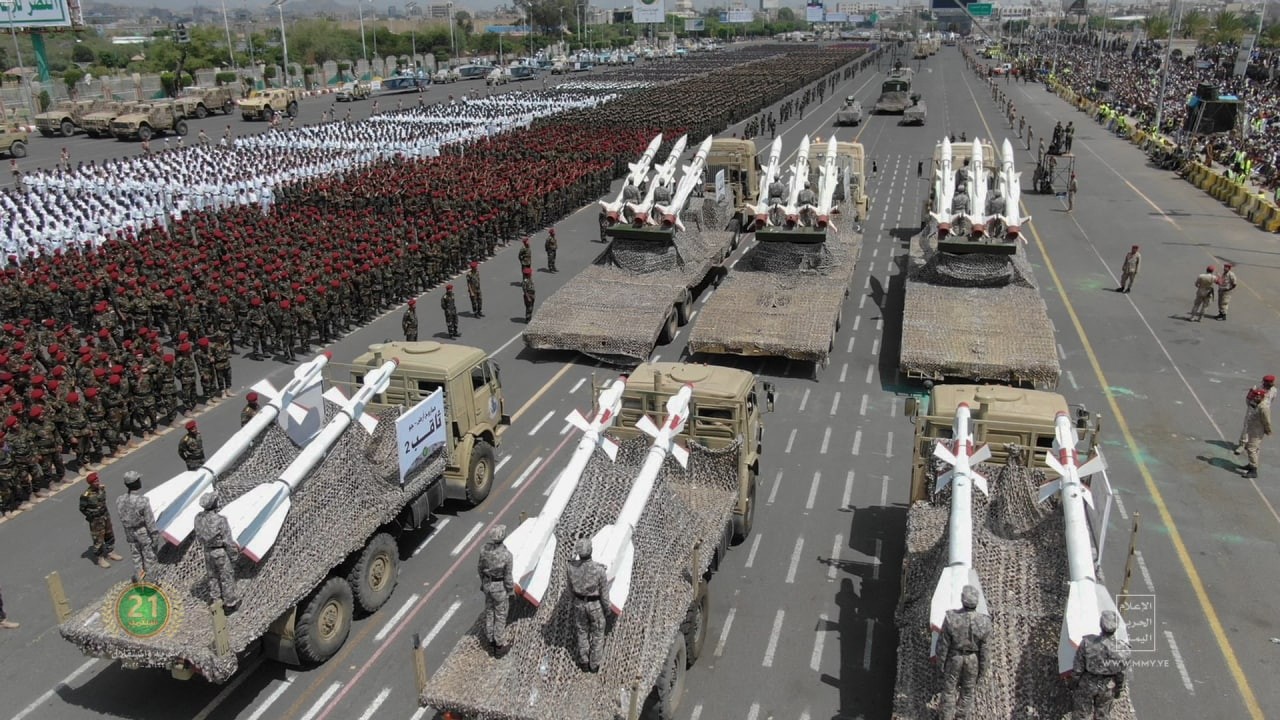
Beginning in November 2023, in the name of solidarity with Gaza, the Houthis opened a maritime front. In ten months, they carried out more than 120 increasingly sophisticated attacks against merchant vessels and fired missiles toward Israel, more than 2,000 kilometers away. The bulk carrier Rubymar, loaded with fertilizer, sank in March 2024; the tanker Sounion, struck in August, came close to causing a historic oil spill. Egypt lost more than half of its Suez Canal revenues in 2024.
The US-British strikes launched in January 2024, followed by the Israeli bombing of Hodeida on July 20, 2024, did not reduce the movement’s power-projection capability. In September 2024, a new type of missile exploded a few kilometers from Ben Gurion Airport. Politically, the campaign was a success: it earned the Houthis public expressions of gratitude from Hamas and unprecedented regional popularity. Above all, it placed Saudi Arabia in an awkward position, unable to take up arms again alongside Washington and Israel against a movement claiming to act in the name of Palestine.
The Doctrine of Asymmetric Deterrence
This phase illustrates the logic described by theories of asymmetric warfare: a weaker actor uses low-cost means, missiles, drones and unmanned vessels, to produce a disproportionate strategic effect. The Bab el-Mandeb Strait, linking the Red Sea to the Gulf of Aden, provides the leverage. Around 10 to 12 percent of global maritime trade and 25 to 30 percent of container traffic pass through it. Any disruption there immediately affects energy prices and supply chains.
The Cost of 2025
The year 2025 marked a turning point. The US air campaign from March to May degraded the movement’s infrastructure; it ended with a ceasefire negotiated by Oman, under which the Houthis undertook to stop targeting American vessels. Israeli strikes on Sanaa and Hodeida then continued and exposed serious intelligence vulnerabilities: several senior officials were killed, including the head of the Sanaa government in August and the chief of staff in the autumn. The Gaza ceasefire in October finally suspended their attacks against Israel.
A Red Sea Being Reshaped
Around the strait, the map was being redrawn. On December 26, 2025, Israel became the first UN member state to recognize Somaliland; its foreign minister traveled to Hargeisa in January 2026, and discussions were reported over a possible presence near the port of Berbera. In response, Mogadishu secured condemnation from 21 states, including Saudi Arabia, Egypt, Türkiye, Qatar and Iran, and terminated its agreements with the UAE. Egypt deployed troops to Somalia and consolidated a Cairo-Asmara-Mogadishu axis; Türkiye assumed responsibility for protecting Somali territorial waters. The African shore of Bab el-Mandeb thus became an arena of rivalry directly intersecting with the Houthi issue.
Next article: The War Against Iran (February–June 2026): the “Limited Intervention”