

South Lebanon: When Suffering Becomes Immediate History
A Study of Selected Cases of Displacement
I - The Importance of Immediate History and Its Definition
Faced with the catastrophe we are living through, with an open war that is destroying and erasing the traces of life in South Lebanon, with the displacement it is causing and the economic and political collapse affecting Lebanon as a whole, faced also with the failures of the state and its institutions in dealing with the aggression and its consequences, particularly its failure to fulfill its duty to impose its sovereignty over all its territory, which was one of the fundamental causes of this war in the first place, and faced with its confusion in addressing the economic and financial situation, particularly corruption on the one hand and the educational future of the present generations on the other, I turned to the book Writing History, from the “History and Social Sciences, History and Memory” series, published by Afrique Orient in Casablanca in 2014. It includes a text by Bernard Paillard entitled “Immediate History,” meaning what takes place in the moment itself.
In this contribution, he examines the problem posed by the traditional historical school, which required a “temporal distance” from an event as an essential condition for ensuring objectivity and scientific integrity when writing about it.
Paillard, however, argues that “immediate history” can study a current event as it is taking shape. What happens “here and immediately” can become a field of contemporary history, because immediate history offers the historian and researcher a precious opportunity to capture the “living event,” with all its psychological and social interactions, before it later turns into official narratives confined to lists and cold figures, without conveying the details of what happened or the suffering and problems that resulted from it.
He believes that sociology helped consolidate this approach, referring in particular to the research Edgar Morin conducted on current events in the 1970s. From these works, he concludes that contemporary history can draw on three sources: journalism, history, and sociology. Morin concludes that immediate history is not simply a rapid journalistic account of events, but a sociological analytical tool.
Paillard ultimately raises a question: who is qualified to study these issues, historians or sociologists? His answer is that the question itself has little meaning, because the study of “history in the making” can only take place within a dialectic of past, present, and future. It is therefore sociohistorical.
The researcher is no longer merely an observer standing apart from what is happening. The researcher also becomes a witness and, by recording events immediately through interviews and testimonies, documents what is seen and directly observed. This helps preserve collective memory from distortion and omission.
Classical historiography relies on preserved documents, whereas the recorder of immediate history relies on interviews with eyewitnesses while their memories are still vivid and, in our case, while their suffering is still vivid as well. It also draws on the press, audiovisual media, and information from all forms of communication.
One of the obstacles the researcher may encounter in this field is an “excess of information.” This requires immediate critical skills and the ability to filter information in order to sort and classify it objectively.
The researcher thus becomes a participant at the same time as an observer. The work carried out also contributes to “archiving” events and shaping them. This requires rigorous awareness so that the researcher does not become merely a journalistic commentator. This form of immediate history documents fleeting moments and captures psychological and social transformations as they occur.
The Concept of the “Whole in the Part”
Morin and Paillard argue that a small and geographically limited event occurring within a major crisis can carry within it the code of the entire system. A minor event or individual dispute in a school, such as a conflict between two families over the distribution of an aid package, an altercation in a village, such as the events in Arabsalim involving supporters of the Amal Movement and supporters of the party, or the refusal to rent out a home, something displaced families encountered repeatedly in different areas, including in confessionally homogeneous villages, can all be revealing.
All of this condenses latent social, partisan, sectarian, and regional tensions that rise to the surface when social and political controls weaken or disappear. We know that displacement and exile weaken such controls and tear apart the original social fabric of those concerned.
Edgar Morin’s method treats “crisis” as something more than a passing dysfunction. After studying the student revolt of May 1968, he concluded that a “crisis,” whether a revolution, a large-scale rumor, or an unexpected political event, acts as a kind of structural revealer, uncovering what lies latent within society: political, class, or psychological conflicts and contradictions concealed beneath a veneer of stability. Contradictions then surface all at once and with particular intensity. This is why Morin considers crisis an accelerator of history: within a short period, deep structural contradictions and conflicts within society become visible, even though under ordinary circumstances they might have taken decades to emerge. The historian of the immediate therefore studies “depth” through the “surface.”
Bernard Paillard, “Immediate History” (L’histoire immédiate), in Dictionnaire des sciences historiques.
II - An Example of Displacement: Mrs. D. Why Are My Children Going Hungry?
Introducing the Case
Mrs. D. is a 40-year-old displaced woman who has been married for about eleven years. Her husband used to work in a junior position at a bank. His circumstances later deteriorated, and he began taking on small manual jobs, helping with garden maintenance and similar work.
Before her marriage, she lived in one of the border villages of South Lebanon and worked at a hotel near her home. She has had a mild congenital disability affecting one hand since birth. After her marriage, she maintained good relations with her own family, while her husband’s family rejected her, in her view because of her physical condition. The family therefore has no relationship with them today.
The family’s problems began to worsen with the Covid pandemic and the economic collapse of 2019. Economic activity and work slowed, money became increasingly scarce, and people began postponing nonessential expenses and work because of the shortage of liquidity.
This greatly worsened the family’s circumstances. The husband no longer had a steady income that would allow him to support his family.
The First War of Support: The Shock of Losing Security
A home is not merely a physical place. It represents a sense of control and psychological stability and establishes a clear boundary between the “safe inside” and the “dangerous outside.”
After the first war of support, the 66-day war as they call it among themselves, the family’s situation deteriorated further. They began surviving on debt and assistance from her family and the wider community: shops, a pharmacy that provided medicines free of charge or at a steep discount, and so on.
The wife took a manual job with an association, sweeping streets for only two months in accordance with the association’s policy. She was unable to find work afterward. Her husband also remained unemployed. She later told me that he had been a soldier in the army and had deserted in 2015. Perhaps his dependence on others is an additional reason why his own family does not help him.
Forced Housing Precarity Among the Displaced
During the second war of support, like thousands of others, they were displaced for a second time and have still been unable to return home.
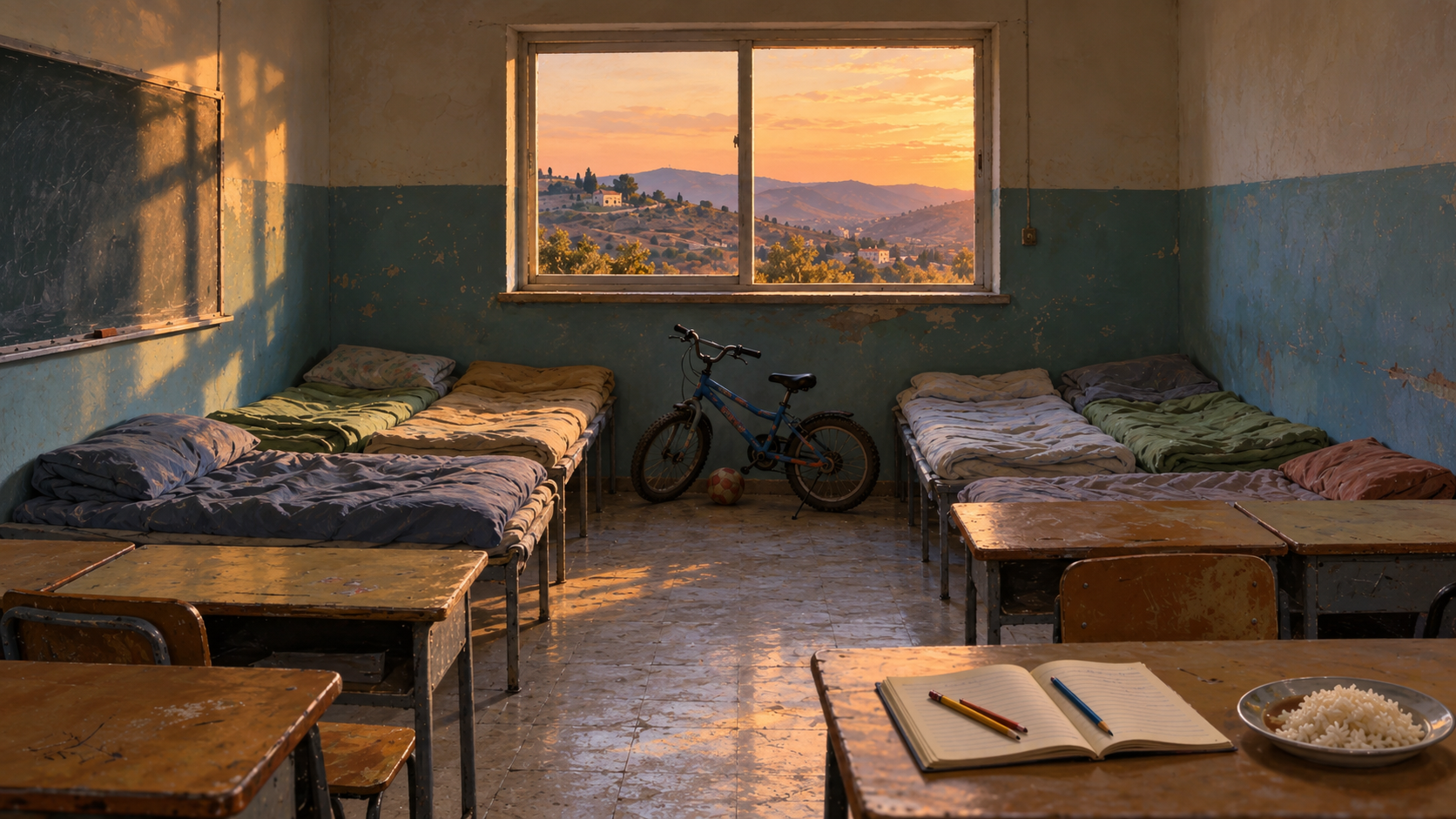
They were initially housed in a public school, then moved five times, each time to another school. Eventually, they were placed in a room inside a public school, with no resources whatsoever.
This repeated displacement reflects not only the effects of war, but also the absence of any state emergency housing policy capable of guaranteeing a minimum degree of stability in an explosive situation and amid the prospect of renewed Israeli aggression, given the scale of the catastrophe.
When a displaced person is uprooted twice, the sense of security is shattered twice, and the entire world becomes unpredictable.
Studies show that the absence of stable housing generates a permanent sense of insecurity and loss of control, one of the leading causes of psychological deterioration among displaced people. The moment of the “return to school,” which became a moment of eviction for some displaced families, exposed the transition from precarity to outright homelessness.
Economic Inequality Within the Catastrophe
Some displaced families were able to rent homes using their savings, while the most vulnerable could not. Here, catastrophe does not bring people together. It deepens disparities because the state does not intervene to restore a balance.
The Breakdown of Social Protection
Her repeated moves, like those of others, from one school used as a temporary shelter to another reveal that the state has maintained the same policy and has still failed to establish an adequate shelter system, as though the displaced were going to return to their villages tomorrow.
The Ministry of Education, meanwhile, relied on stopgap solutions that reached their limits with the beginning of the school year. The education sector is suffering the consequences of this policy, with disorder and incapacity whose effects will be felt by this entire generation.
The General Social Situation
Naturally, the interview with the mother is dominated by complaints about the economic situation. The family has absolutely no income from any source, apart from occasional assistance and help from the wife’s family, who are themselves poor. Her family has no income apart from what her middle brother earns from manual work. He lives in a three-room home in a poor working-class neighborhood in Beirut’s southern suburbs.
Her mother, whose husband is deceased, and her two unmarried sons, one in his forties and the other twenty-five, moved in with the middle brother because of their lack of means. She also has an older sister who is married and has children.
Her family now lives in a cramped and overcrowded home with no privacy. She naturally points out that her brother’s home could not accommodate them if she herself wanted to move in with her family.
Her brother helps her as much as he can, and her mother saves whatever she can to send her a handful of dollars to recharge her phone or buy food.
She borrowed 300 dollars that she cannot repay.
Mrs. D. tries to find work, without success. This mother is not asking for luxury or a comfortable life. She is asking only for what would allow her to remain standing: a home, a job, food. Yet these basic necessities are denied to her in Lebanon today.
She is shut out of the labor market because of her particular circumstances, her disability, and because she is displaced and living in a school. She is rejected silently, without explanation and without acknowledgment.
She is displaced, poor, a woman, and a person with a disability. Any one of these circumstances is enough to make life harder. Together, they become a sentence of exclusion. Her husband, meanwhile, retreats further into helplessness, as displaced people from villages experience estrangement and disorientation in the city.
Deprivation, a Lost Childhood, and Premature Adulthood
As noted, the conversation is dominated by her complaints about the family’s material circumstances and its need for assistance. She begins by describing the children’s sense of deprivation. They ask: why don’t we ever go anywhere? To a restaurant or to the sea, for example. Why don’t you buy us toys? And finally comes the hardest question: “Why did you bring us into the world?”
When they express their simplest wishes, a toy, a ball, or an outing, she tells them she cannot provide these things because she has to use the money to buy food or recharge the phone so she can remain in contact with the outside world and with her family.
The children spend their days in the street and play with other children. They compare themselves with them, which deepens their sense of deprivation. Yet they retain a sense of pride that prevents them from complaining in front of the others or revealing their need.
As for food, they receive one meal a day as aid, generally the same thing: rice with very little chicken, or a hamburger with ketchup only. They must somehow manage the other two meals themselves, which is not always possible.
She says that two days ago her children went to bed without eating. The youngest fell asleep saying, “I’m hungry…”
This is not a passing sentence. It is a sentence that should haunt any society that claims to be alive and to have a conscience.
Psychosomatic symptoms have appeared: this child has become afraid of every sound. He trembles, cries, and wets himself.
This is not simply “fear.” This is a body living in a permanent state of alarm. A body that no longer distinguishes between real danger and an ordinary sound. Childhood here is not merely wounded. It is shattered.
The older child, aged 9, is no longer really a child. He proposes that he work. That he carry stones. That he become a laborer to help his mother. He promises that he will return to school later, as though childhood could be postponed. As though education could simply be recovered after leaving it.
He does not play. He thinks about how to save his family. This is not a child’s responsibility. It is a lost childhood. A child who does not live his childhood, does not play, and has no hobby. They have nothing that might help them pass the time. They ask to use the phone, but that too requires money to recharge it.
This is a direct consequence of the inability of those who are supposed to bear responsibility.
And throughout all of this, the state is present. It is not absent. It is present, but it does not do what it should.
The Educational Situation
The children spend their days in the street. They have to return to their rooms at six in the evening. “They gave each of them a notebook and two pencils. But how are they supposed to pass the time? In the South, they used to play with the neighbors’ children, ride bicycles, and go out to buy ice cream. Since 2024, they haven’t gone anywhere.”
She was able to enroll the children in their usual school so that they could attend classes online. This at least gives them some reassurance and stability by allowing them to maintain a connection with their original environment and their classmates.
On the first day of school, the teacher asked the usual question: where did you spend your summer vacation? “My son told her: we spent it displaced in schools, and we are still in a school.” Some of his other classmates had gone to the sea, the corniche, or elsewhere.
The teacher asked them to buy the books. The mother was unable to obtain them easily. Classes will be held online, something everyone agrees is “as good as nothing.” In any case, this form of education requires Internet access, which is expensive for many of them, not to mention the state of Internet service in Lebanon.
She asks: “Where is the conscience? I can’t leave my children without an education.”
The Making of a “Lost Generation” and the Existential Danger to Lebanon
From my interviews with parents and some educators, particularly Mrs. Mona Jahmi, one can conclude that displacement and repeated transfers from one shelter to another affect children and their ability to concentrate, remember, and understand.
Repeated exposure to loud noises and psychological shocks will also affect children’s cognitive flexibility, producing symptoms such as fragmented attention and the loss of basic skills such as reading and writing among those still in the foundational stages of learning. Some parents have complained of declining reading ability, as well as the spread of irritability, violence, stubbornness, and disrespect toward parents, who themselves feel helpless.
Mrs. D. also noted that the children spend their days in the street, without educational tools to support them. This creates the risk of an “absolute void,” removing them from the atmosphere of discipline and commitment necessary for continued intellectual and educational development.
It also creates the risk of a “street culture” emerging in shelters, or of learned behaviors developing because of the absence of traditional school and social supervision. Profanity spreads, physical violence in play increases, and rebellion against the authority of exhausted parents grows.
The phenomenon of premature adulthood seen in the older son, aged 9, also carries the risk of fostering a desire to drop out of school and enter the labor market in order to support his family.
This helps widen the “current class and psychological divide” between a displaced child who is poor and deprived, another displaced child whose circumstances are somewhat better, and a child who remained at home and experienced a normal summer. We can imagine the impact of these disparities on children’s psychological well-being.
The Crisis of State Capacity and the Absence of Safety Nets: The $130 Million Paradox
Asked about assistance from the state, she describes what she receives as follows: “Morphine injections. They tell you they will help, but no help ever comes…”
When a family is forced to leave a shelter without an alternative while its children are hungry, the problem is no longer simply a lack of services. The political relationship itself begins to collapse. The state no longer appears as a protector, but as an absent or indifferent actor.
This failure becomes even more stark when one considers the decision to transfer 130 million dollars to the Council for the South.
The problem here is not the size of the amount, which is small, but the way it is used, or rather not used, to shelter and feed the most vulnerable displaced people.
This woman says that none of the allocated money reaches her. All she hears are promises: “We will help you.” The money exists, but it is swallowed up in the drains of a state plagued by corruption and clientelism. The problem is therefore no longer scarcity. It becomes a decision. A decision to leave people to their fate. And this is the situation of tens, if not hundreds, of thousands of people.
The question is not: what does this family lack? The question is: why is it being left to go hungry?
In the logic of the modern state, resources are directed first toward protecting individuals in emergencies.
In the Lebanese case, however, resources appear detached from people’s needs and remain confined within closed channels that do not reproduce protection, but reproduce the system itself.
It is precisely here that the logic of “rentier intermediation” appears in its ugliest form: public money exists, but does not reach where it should. The need exists, but is not translated into a right. Between the two, the very idea of the state breaks down. The “crisis of legitimacy” moves from the theoretical level into everyday reality: the state does not merely fail in its performance, it fails to justify its existence before its citizens.
Psychological and Social Repercussions
Studies of repeated displacement have shown that trauma does not disappear with time. It accumulates and is reactivated with every new experience of uprooting, significantly increasing the risk of post-traumatic disorders.
But what this woman is living through does not end with war and displacement. She has entered another phase, less dramatic in appearance but more brutal: living in temporary places.
The school, which is supposed to be a space for learning, becomes a shelter in Lebanon. Then it suddenly returns to its original function, opening its doors to students and closing them on those who had sought refuge there. This is where the most violent transformation occurs: from being a “displaced woman” or “displaced person” to becoming a “superfluous person.”
The problem is not only that the state has failed. Its behavior has produced specific psychological and social consequences:
Turning Anxiety into a Permanent Structure
Had the displacement been temporary and clearly managed, the harm might have remained limited. But in the absence of stable shelter, anxiety becomes a chronic condition.
Producing Humiliation Instead of Protection
When displaced people are told to leave schools without any alternative being provided, the state is no longer merely absent. It becomes part of the painful experience itself. It moves from failure to participation in the harm.
Breaking the Idea of a “Right”
When the money exists, 130 million dollars, but is not used to shelter or feed the most vulnerable, access to housing ceases to be a right and becomes a matter of luck or individual means. Inequality is reproduced on a very large scale, and society shifts from a logic of rights to a logic of individual survival.
This transition poses a major social danger because it erodes trust in the state, institutions, and perhaps society as a whole. It entrenches precarity as a generalized norm.
Positive Awareness in the Face of Sectarian Fragmentation: A Glimmer of Awareness
Despite all this, this mother remains attached to the idea of the “homeland.” It appears that collapsing systems may still generate within themselves “silent mechanisms of self-resistance” against complete fragmentation.
She says: “What frightens me most, most of all, is that our children will grow up learning certain things… Not only the war. Things that come from living in an area that is not theirs. They may start learning hatred, or saying: I belong to this sect and you belong to that one. My son is 8 years old and he had never once asked me whether I was Sunni, Shiite, or Christian. But since he started spending time with his friends here, they have begun asking him: what are you? Even though they themselves are Shiites.
He comes and asks me: what am I? I told him: just tell them you are Lebanese. And don’t get into those kinds of details with them. He said okay.
I tell my children and teach them: ‘We love all sects. We are brothers with Muslims, Christians, Sunnis, Druze, Shiites, everyone. We do not discriminate.’
I tell my son: ‘When you grow up and someone asks you what your sect is, tell them: I am Lebanese. We are Lebanese and our land is Lebanese.’”
Instilling a Shared Identity
Despite the suffering and the fertile ground created by war for hatred and forms of social separation based on sub-identities, especially since they are living in an area that is unfamiliar to them and may encounter suspicion there, the mother emerges as a kind of “moral safeguard.”
Her words, “When you grow up and someone asks you what you are, tell them: I am Lebanese,” represent a conscious attempt and a fierce form of national resistance aimed at preventing the breakdown of her children’s moral framework. She rejects any slide toward sectarian mobilization or class hatred and clings to national identity as a final refuge in a country that is fragmenting.
Fears: The Return of War
She says: “There are many people like me in the school. There is an elderly woman with us who has cancer. Her son helps her, but he has a family too.
There is another elderly woman I know. Her children are unemployed and cannot find work. Honestly, she has to borrow money to buy a pack of cigarettes.”
The situation has become extremely difficult. “Here, I don’t even know which association is responsible for us, but it is an association that brings one meal a day.
What I’m afraid of, honestly, is that the war will flare up again, that the country will become even more unsettled than it already is, and that no one will be left who can help others. We have children. I’ve lived my life,” she says, even though she is only forty, “but I’m afraid for my children. What kind of future will they have?”
When asked whether she blames anyone for the situation they are in, she replies: “I understand that this is a war bigger than us, that it is a political issue and a general situation. But I blame those we elected. I’ve had a disability card since 2006 and I have never received any assistance from them, nothing at all. Last year they sent me 100 dollars once… And when I asked for help, they told me: you are not eligible because you are over 30. I’m 40. We help those under 30 and those over 50!”
I asked her: why don’t you go and see the MP now? She replied: “Where am I supposed to see the MP? I don’t have his phone number. I can’t call him.”
Finally
A Hezbollah-affiliated guard stands outside the school and questions those entering the building. I therefore also asked Mrs. D.: what about the guard outside the school? Ask him for help from his party. Ask him whether they have any assistance.
She replied: “I asked the young woman from the Ministry of Social Affairs… As for the sheikh who is at the school, I didn’t go to him.”
I asked her: who is responsible for the war?
She replied: “Hezbollah. Why should we lie to ourselves…”