

The Disintegration of the Lebanese Model: Between Deadlock and the Absence of an Alternative
Reading the Structure of Scientific Revolutions and Paradigm Shifts
The history of science has followed a winding course of demolition and reconstruction, rather than the calm, linear accumulation long assumed to characterize it. Until the middle of the twentieth century, the prevailing view regarded science as an edifice rising brick by brick, with each generation of scientists adding another stone to the monument of absolute truth.
The publication in 1962 of The Structure of Scientific Revolutions by American historian and philosopher of science Thomas Kuhn, however, caused an intellectual earthquake that transformed our understanding of how human thought develops. Kuhn did not merely offer a new reading of the history of science. He laid the foundations for a new epistemology, showing that scientific development proceeds through sudden leaps and sharp ruptures, shaped by sociological and psychological contexts that are themselves not free of conflict.
Kuhn was not, of course, writing about politics, but about the way scientists move from one theory to another. Yet the paradox is that the analytical tool he developed to understand scientific communities can also help answer another question: how do societies change, and how do systems lose their vitality and ultimately collapse?
What Is a Paradigm, and How Can It Be Applied to States?
In Thomas Kuhn’s philosophy, a “paradigm” is the set of beliefs, rules, and shared values upon which a given community agrees in order to organize its affairs and solve its problems.
Kuhn describes this as the phase of “normal science,” in which everyone works within a single intellectual framework that is taken for granted and not fundamentally questioned. In politics, this resembles stable systems governed by established rules, even when those rules are unjust or ineffective.
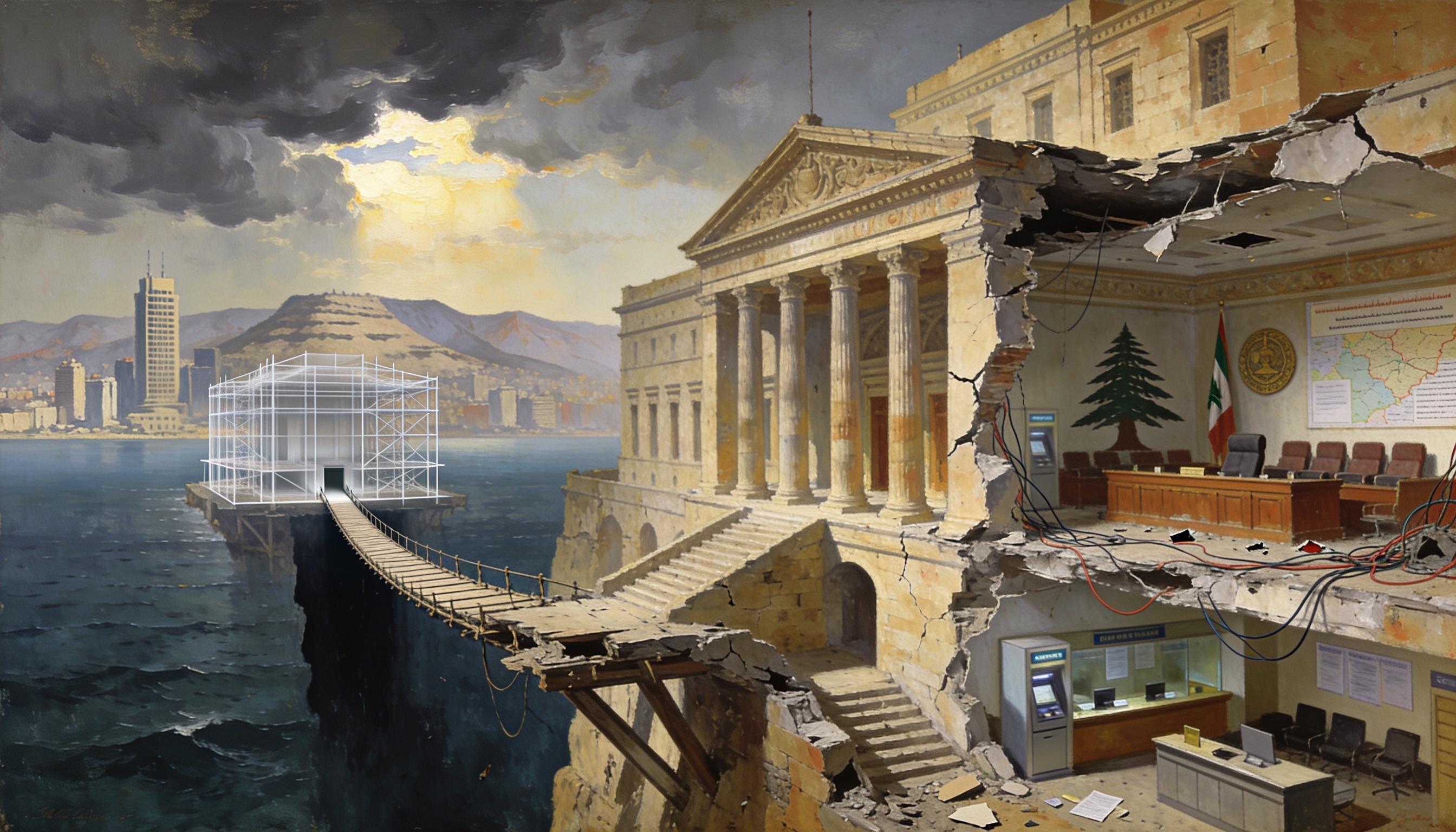
Kuhn’s approach appears today to offer a particularly useful key to understanding the existential crisis facing Lebanon. The Lebanese now find themselves at the heart of a “paradigm crisis”: the old model has completely collapsed, while a new one remains unable to emerge, leaving the country in a state of uncertainty, instability, and fear of the unknown.
For Kuhn, transformation does not begin with sudden collapse. It begins with the emergence of “anomalies,” phenomena that the existing system can no longer explain.
The “Lebanese paradigm” that governed the country since independence, and was consolidated in modified form by the 1989 Taif Agreement, rested on a clear formula: consociational democracy, confessional power-sharing, a rentier economy based on services and banking, the preservation of delicate regional balances, and the protection of public freedoms.
Lebanon experienced a period during which this model functioned relatively normally. When the country faced problems, such as government crises or limited security tensions, they were treated as “puzzles” that could still be solved within the existing rules: a political compromise here, international loans there, without touching the core of the confessional or financial system.
Cognitive and Political “Anomalies”
The stability of decaying models begins to falter when anomalies accumulate and traditional tools prove unable to explain or resolve them.
In Lebanon, these anomalies accumulated gradually over decades, culminating in the comprehensive financial collapse of 2019, the Beirut port explosion in 2020, and the paralysis of constitutional institutions since the opening of the so-called support fronts.
The ruling class attempted to deal with these disasters by patching up the old model, much as scientists sometimes cling to theories whose explanatory power is fading. They tried to persuade people that the crisis amounted merely to a “temporary liquidity shortage” or a technical problem that could be addressed through piecemeal measures.
But in Lebanon, the “anomaly” evolved from an economic and administrative problem into an “existential question” concerning the very possibility of the state’s survival: can a state continue to exist without full sovereignty over its territory, without an independent judiciary, with a deeply devalued national currency, without a minimum level of basic services, and while subject to an occupation with no clear end in sight?
An Intractable Crisis and the Absence of an Alternative Model
According to Thomas Kuhn, when all attempts to contain anomalies fail, a community enters a “crisis” phase. Confidence in the old model erodes, and assumptions previously taken for granted become open to doubt. In science, competing schools of thought emerge during this phase, each attempting to provide new solutions.
In Lebanon, we are living this crisis in all its psychological and political dimensions. Everyone knows that the old system, built on confessional quotas, corruption, rentierism, and institutional paralysis, is clinically dead and no longer viable.
Yet Lebanon’s central dilemma lies precisely in the failure of a new model to emerge that is capable of replacing the old one and restoring a measure of stability. Reformist forces and popular movements advocate a model based on “a sovereign, democratic state governed by the rule of law, and on citizenship that transcends confessional affiliations.” But this model still lacks the political power required to implement it, the necessary social consensus, and sufficiently deep social roots to become dominant.
The Lebanese therefore find themselves suspended in a frightening condition: the old order refuses to disappear, while no new model has yet managed to take shape.
The Complications of Arms and Occupation: Deadlock and Uncertainty
What makes the Lebanese crisis even more complex and ambiguous than an ordinary scientific or political paradigm crisis is the intervention of coercive factors that transcend national borders and impose the logic of military force over the natural evolution of ideas.
These factors operate on two intertwined fronts: the continuing Israeli occupation and attacks, on the one hand, and Hezbollah’s weapons outside the framework of the state, on the other.
The Israeli occupation represents a permanent existential threat to Lebanon, imposing a continuous state of emergency on the country and preventing it from devoting its full attention to calm internal reform. At the same time, Hezbollah’s weapons constitute a structural dilemma within the Lebanese model itself. Embedded in a regional alliance centered on Iran, their military weight, and the fact that their strategic decisions lie outside state authority, place them beyond the effective control of Lebanon’s constitutional institutions.
This is where the Lebanese predicament lies. In any normal political model, one of the state’s fundamental functions is to exercise the monopoly on legitimate violence and protect its borders. In Lebanon, that principle has been emptied of substance.
Weapons outside state authority prevent the emergence of a model based on a “fully sovereign state.” At the same time, Hezbollah and its political and social constituency present this arsenal as a “permanent alternative model” for protecting Lebanon against Israeli ambitions.
This stark contradiction creates a state of “incommensurability” among the Lebanese. They no longer disagree merely over the details of politics; they speak entirely different languages when defining the concepts of “homeland,” “sovereignty,” and “security.”
For those who support the continued existence of this arsenal, it remains, despite its failures, an instrument of liberation and an existential necessity. For its opponents, it is the principal obstacle to building the state and rebuilding the economy.
Future Scenarios Amid Uncertainty
How can this cognitive and political conflict end?
In science, crisis ends through a “scientific revolution” that overturns established standards, radically reformulates problems, and produces a comprehensive renewal of methods. A new paradigm then establishes itself and ultimately wins the allegiance of the scientific community, whether through individual conviction or through the passing of the older generation, as Max Planck famously observed.
In Lebanese politics, however, the future remains shrouded in uncertainty because no clear resolution is in sight.
From this perspective, three possible paths emerge.
The first is continued slow dissolution. Lebanon would remain trapped in a state of “permanent crisis,” with people learning to coexist with anomalies and collapse as an established reality, without acquiring the ability to change it. Such a path would gradually exhaust both people and the country’s structures, ultimately destroying the state itself.
The second scenario is violent confrontation. One of the competing models may attempt to impose itself through military force or domination, potentially leading to Lebanon’s disintegration or to communal violence, particularly amid acute polarization over weapons, Israeli threats, and the complete collapse of the state.
The third scenario is a far-reaching structural refoundation. A major historical settlement, shaped by regional and international transformations, could give birth to an entirely new formula, a new paradigm capable of redefining the social contract, resolving the question of weapons, and insulating Lebanon from destructive conflicts.
Finally
A reading of Thomas Kuhn invites us to consider that profound crises, despite their darkness and dangers, can constitute the passage through which an old model gives way to a new one.
Lebanon’s collapse is not merely an economic failure. It marks the historical exhaustion of a profoundly dysfunctional model of governance.
And while the current predicament, with its security entanglements, the presence of weapons tied to regional actors, and the Israeli threat, makes the situation opaque and uncertainty its defining feature, it confirms at least one truth: a return to the Lebanon of before 2019 is impossible.
Saving Lebanon does not lie in patching up a dead system, but in collectively finding the courage to formulate a new model capable of including all its citizens under the authority of law and the state, however painful the sacrifices required by that transition may be.