

Nuclear Issue: Iran Reverts to Its Old Ways
Crude oil prices confirm their upward trend


The Gulf and the Arabian Peninsula experienced another day of military escalation on Wednesday, marked by strikes and reprisals, statements and counterstatements between Iran and its proxies on one side, and the United States and its Gulf allies on the other. Two developments nevertheless dominated the news: surging oil prices and suspicions that Iran may be resuming the development of its nuclear industry.
Iran said it attacked more than a dozen vessels attempting to cross the Strait of Hormuz on Wednesday, sending oil prices soaring, and announced that it would soon extend the area requiring navigation clearance beyond this strategic passage.
Tehran justified the attacks by citing U.S. strikes on Iranian tankers on Tuesday, and once again issued a warning to its “enemy.”
The regime’s powerful parallel armed force also said it carried out attacks on Wednesday against a Jordanian air base used by U.S. forces, intended to “punish the aggressor.” The Jordanian military said it intercepted 18 missiles.
Since the start of the war, traffic through the Strait of Hormuz has been virtually paralyzed, disrupting global energy markets and regularly driving crude prices sharply higher. North Sea Brent was trading above the crucial $100-a-barrel threshold after reports of ships on fire in the Gulf region. This is the first time that symbolic mark has been breached since July.
Tehran lists its demands
Acting as though they were the victors, the Revolutionary Guards said on Wednesday that the war with the United States could end if Washington stopped threatening Iran and accepted a number of its demands:
- “Refrain from any further threats.
- Withdraw Israeli regime military forces from Lebanon.
- End the blockade of Yemen.
- Unfreeze $24 billion in frozen Iranian assets, and refrain from any interference with the country’s nuclear and ballistic capabilities.”
In other words, the IRGC rejects any negotiated solution, demanding “peace” so it can quietly build an atomic bomb with the billions it expects to recover, while also deciding, incidentally, the fate of several countries in the region in the name of fighting the “Great and Little Satans.”
Nuclear program: work intensifies at Mount Kolang
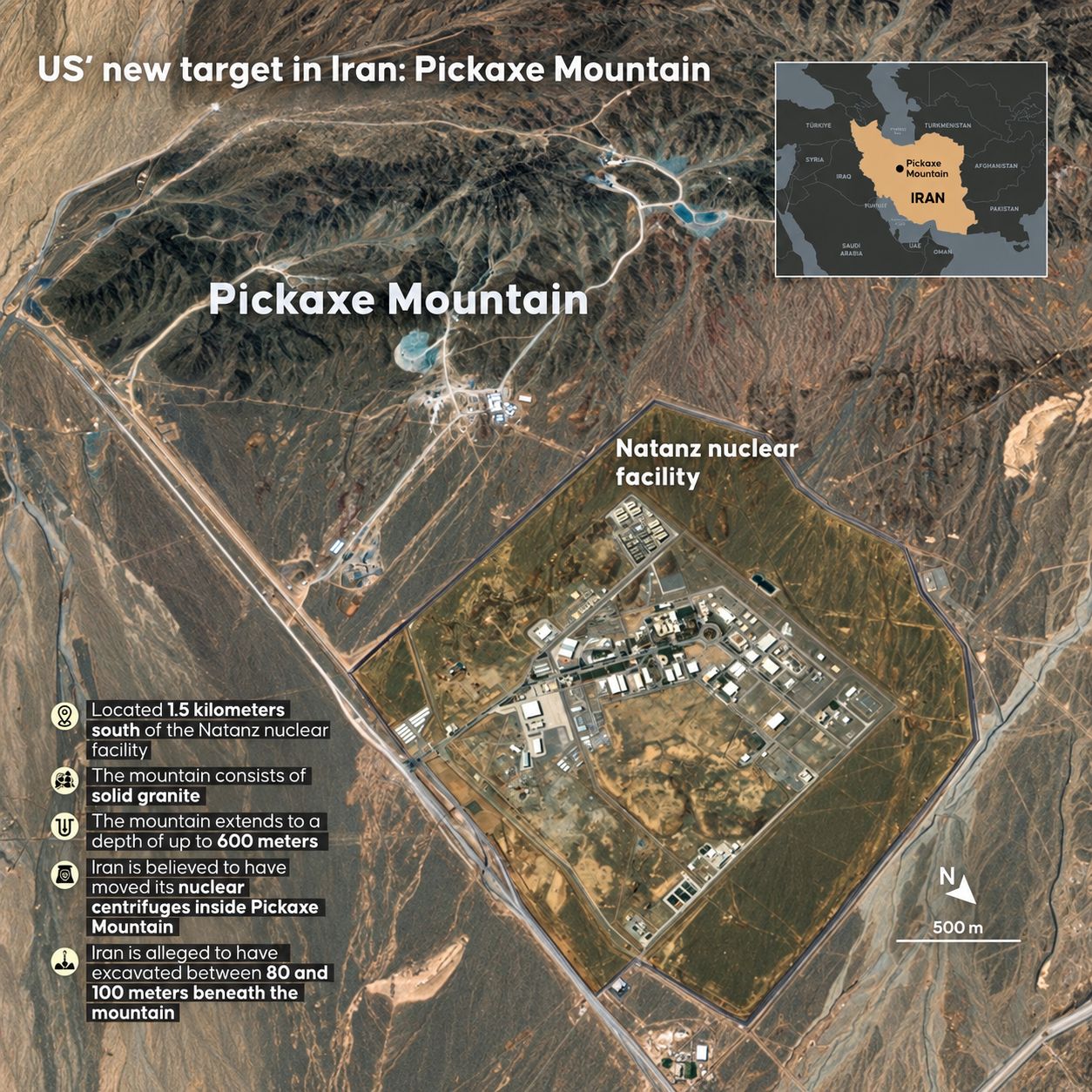
The threat posed by Iran’s nuclear program has crystallized tensions between Iran and Western countries for years. The Center for Strategic and International Studies (CSIS) said construction work has intensified over the past year at Mount Kolang in central Iran, which is suspected of housing an underground nuclear complex.
The think tank based its assessment on six years of satellite imagery, and analysts highlighted a shift “from active excavation to probable internal construction work and continued external reinforcement.”
Mount Kolang (“Pickaxe Mountain” in English) is a fortified facility buried deep in granite; destroying it would prove difficult, even with the most powerful U.S. munitions, such as the GBU-57 bomb, the think tank said, arguing for a diplomatic solution backed by monitoring mechanisms.
Naturally, Iran denies the existence of any secret underground nuclear complex beneath Mount Kolang.
Also regarding the nuclear issue, the Board of Governors of the International Atomic Energy Agency decided on Wednesday to refer Iran’s non-compliance with its nuclear obligations to the UN Security Council. The move is intended to increase pressure on Iran, two diplomats said.
The IAEA has not had access to key nuclear facilities in Iran since Israel, joined by the United States, carried out strikes on nuclear sites in June 2025.
The IAEA reiterated that its lack of information and access constituted a “proliferation risk,” calling on Iran to address the issue “with the utmost urgency.”
Meanwhile, Israeli Prime Minister Benjamin Netanyahu said on Wednesday from Mount Hermon, during a rare visit to Israeli soldiers deployed in Syria, that the Islamic Republic of Iran was on the verge of collapse.
“There is still work to be done. The main task is to bring down the terrorist regime in Iran. We are very close to that. We know that this entire axis [with Iran’s allied groups, editor’s note] will eventually collapse,” he said on the Syrian side of Mount Hermon during a visit with Defense Minister Israel Katz.
“Iran is in the background,” Katz added. “We struck it twice, and if necessary, we will strike a third time in order to continue countering the threats.”
Lebanese army toughens its stance toward Israel
On the Lebanese front, the army warned on Wednesday that the Israeli escalation threatened the implementation of the bilateral framework agreement in the south, where strikes have killed at least 29 people since Friday despite the ceasefire.
In a statement accompanied by a video posted on its X account, it listed the measures it had taken to implement the agreement and, in return, documented nearly 7,700 Israeli violations since the framework agreement was signed.
Israel’s aim is “to undermine the credibility of the Lebanese army within Lebanon and in the eyes of the international community,” the statement concluded.
“Act II” protests: France Holds its Breath
Sisi Stresses the Defensive Nature of Support for Riyadh
France Avoids a State of Emergency but Prepares for the Worst
A Nobel Peace Prize to Save International Law in Peril
A Lebanese-Iranian Meeting in New York, but Several Political Messages
More from LevantTime .
View All


More in Today's Essential
View All


Latest from Levant Time
View All


