

Iranian conflict: caught between military escalation and fruitless negotiations


The past week was marked by failed attempts to reach an agreement protocol between Washington and Tehran, amid contradictory statements. Between Lebanon and Israel, a clear military escalation was recorded on the ground, accompanied by significant Israeli advances that reportedly crossed the Litani River.
The recent days in the Middle East have been characterized by a statement made by U.S. President Donald Trump the previous weekend about the imminent conclusion of an agreement protocol between the United States and Iran, which would pave the way for 60 additional days of negotiations and allow for lifting the blockade on Iranian ports and reopening the Strait of Hormuz. Yet the optimism displayed by the American president on more than one occasion has had no effect: the week ends without any notable progress, and all options remain on the table, including another round of violence.
A statement made by an "American official" to Axios on Sunday sums up the situation: There will be an agreement with Iran, but the date of its signing is not yet determined.
A major moment this week occurred Friday afternoon, Levant time, when Donald Trump announced he would make his decision regarding the Iran deal following a meeting with his advisors in Washington. In one of his social media posts, he revealed details about the proposed document: an immediate lifting of the blockade in exchange for reopening the Strait of Hormuz, and destruction of Iranian enriched uranium by the Americans under the supervision of the International Atomic Energy Agency. And most importantly, no disbursement of frozen Iranian assets for now. But he emerged from this meeting without announcing a decision that day. The American president repeatedly assured that he would not sign an agreement that does not respect the "red lines" he has defined.
For their part, the Iranians repeatedly denied each of Donald Trump's statements, in the form of information provided by sources to Iranian state media outlets (notably those close to the Revolutionary Guards) rather than through official statements. According to these "sources," there is no question of nuclear destruction in the agreement protocol, and the Strait of Hormuz would remain under joint Iranian and Omani control. This prompted an American threat from Treasury Secretary Scott Bessent against the Sultanate of Oman, who brandished the threat of "punitive measures" if the sultanate participates with Iran in collecting passage fees imposed on ships.
The Strait of Hormuz thus remains the main sticking point, according to leaked information, just as the question of frozen assets and sanctions that the Americans are unwilling to lift except gradually. After such a week of mixed messages, the protagonists of this seemingly endless theatrical piece appear deadlocked, each on their own side.
The American president and his team are facing mounting pressure due to this unpopular war in the United States and its economic consequences from rising fuel prices, yet cannot settle for an agreement that would be perceived as a step back from the pre-war situation (since February 28) and, above all, compared to the nuclear agreement previously signed by former president Barack Obama. In an interview this week, when asked by an American journalist about the pressure of midterm elections on his decisions, Donald Trump assured that democratic deadlines cannot deter him from pursuing his objective of preventing Iran from possessing nuclear weapons.
For its part, Iran appears mired in its own internal struggles, and decision-making there seems increasingly difficult, despite recurring statements attributed to Supreme Leader Mojtaba Khamenei, more elusive than ever. The hardline faction of the regime remains capable of blocking any agreement by showing intransigence on certain points, notably the reopening of the Strait of Hormuz. The specter of a new popular uprising triggered by the suffocating economic crisis would not be far from the concerns of the Pasdaran: with the partial restoration of the internet in Iran, videos of major protests are beginning to circulate on accounts of Iranians opposed to the regime abroad, with information about fierce repression being carried out against them. Reports of executions of opponents continue: this week it was revealed that two Kurdish brothers, suspected by the Revolutionary Guards of being part of the "instigators" of the January movement in Iran, were tracked down and killed.
On the ground, despite the predominance of the possibility of an agreement, security incidents have not been lacking. On Thursday, explosions were heard in the Iranian port of Bandar Abbas and Iranian missile fire hit vessels attempting to pass through the Strait of Hormuz. Kuwait was targeted by Iranian fire this week, with the Guards claiming to have attacked an American base. But none of these attacks were of a nature to escalate into a large-scale confrontation, although they show how fragile the current truce remains.
Israeli Concerns
The memorandum of understanding taking shape between Iran and the United States has not overshadowed the Lebanese dimension of the conflict. Indeed, the statements of the two belligerents practically agree on only one point: the extension of the ceasefire on the Iranian front would be accompanied by an effective cessation of hostilities on the Lebanese front, between Israel and Hezbollah. Reports of Israeli concern about halting its operation in southern Lebanon without achieving the goal of dismantling Hezbollah are multiplying in the Israeli press. The Shiite party, for its part, took the opportunity, through its deputies, to criticize the direct negotiations conducted by Lebanese authorities with Israel, and assert that only negotiations with Iran could achieve a genuine ceasefire.
Another source of concern for Israelis: in everything that has accompanied the leaks regarding the emerging Iran-US agreement, the two major points absent are Iranian regional influence through its armed wings and the fate of ballistic missiles in Iran. This week, another of these armed wings, Iraqi Hezbollah, announced it does not want to hand over its weapons to the Iraqi state and is seeking to strengthen its military capacity.
Beaufort Castle Under Israeli Control
On the Lebanese front, this week was marked by a clear advance of the Israeli army in depth. The Israeli army reportedly crossed the Litani toward the north after constructing five military bridges there.
The week was further marked by two factors: Lebanese-Israeli military negotiations in Washington and an unprecedented escalation in southern Lebanon and the Bekaa.
The talks at the Pentagon late in the week between the two military delegations lasted more than ten hours, and the feedback is not reassuring. In both Israeli and Lebanese press, there is consensus that no breakthrough resulted from these meetings.
According to the Lebanese army, it is not possible to make progress without a ceasefire. The Israeli side, based on press analyses, complains that the Lebanese do not hold all the cards. Washington nonetheless called this session "constructive," and talks will continue. The coming week will see a new round of political negotiations in Washington on June 2 and 3.
These negotiations are taking place under Israeli fire and Hezbollah escalation, making them extremely difficult. A difficulty underscored on Saturday by Prime Minister Nawaf Salam. While denouncing Israel's systematic destruction of the South, he emphasized that "negotiations remain the least costly path" for Lebanon.
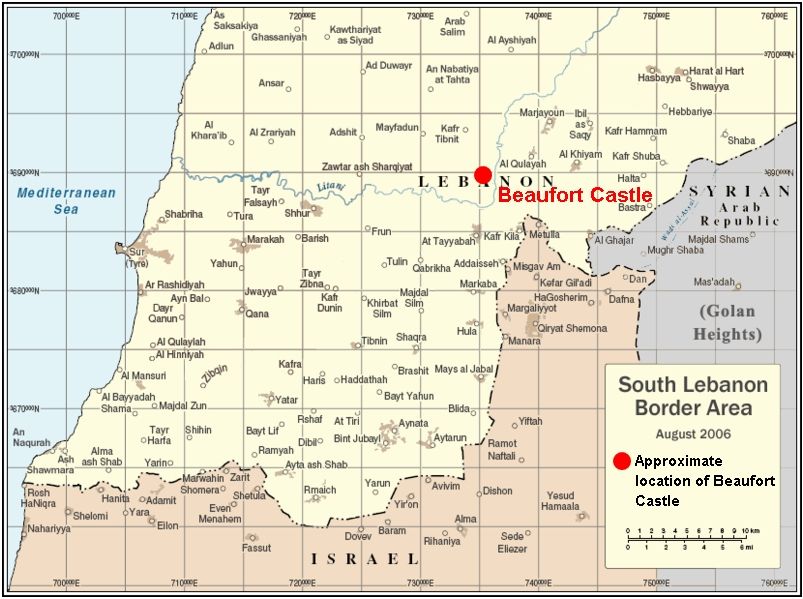
On this map produced by the UN, one can clearly see the strategic position of Beaufort Castle, which serves as an observation point on the Lebanese side and even, to the east on the occupied Golan and the "Galilee Panhandle" (UN)
The South, meanwhile, is ablaze more than ever. On Sunday, the Israelis announced the capture of the highly strategic Beaufort Castle and are moving toward controlling the Nabatiyé region. This move would cut off all supply lines for Hezbollah militants between the South and the Bekaa, and would reinstate the border strip line as it was before the 2000 withdrawal, but this time without its inhabitants. Evacuation calls "north of Zahrani" in recent days, the latest on Sunday morning, suggest an occupation of much larger territories in the coming days. It should be noted that Civil Defense announced on Sunday its decision to leave the city of Tyre and retreat to Sidon.
Hezbollah, for its part, has also increased the intensity of its attacks, resuming the launch of missiles deep into northern Israel. In its statements, it asserts it is waging fierce battles on the ground, particularly around Nabatiyeh.
Hezbollah's attacks are apparently forcing the Israelis to take stricter measures in northern Israel, closing schools and beaches and asking a northern hospital to set up an underground center. Israeli Channel 13 cited military sources who say they are "surprised" by the extent of Hezbollah's response, reiterating that maintaining troops in place in Lebanon would be a prerequisite for any further negotiations.
This week was also marked by threats to Lebanese heritage, first and foremost Beaufort Castle, directly hit by missiles, a medieval marvel in turmoil. These threats prompted Foreign Minister Joe Rajji and Culture Minister Ghassan Salamé to speak out demanding international protection, particularly regarding the remains of Tyre.
Facing this military escalation, French Foreign Ministry chief Jean-Noël Barrot announced Sunday evening that France has decided to call for an urgent UN Security Council meeting to examine developments in Lebanon. This meeting is expected to take place on Monday, according to diplomatic sources.
The calls from Tyre and Nabatiyé
Another major development this week: a dual appeal by more than a hundred intellectuals from Tyre and as many from Nabatiyé for the demilitarization of these two heritage-rich regions and their placement under the sole authority of the state, for their protection. A "rebellion" that shows a clear shift in mood among the southern population, and one that was therefore very poorly received by Hezbollah.
In short, nothing suggests a decrease in tensions in the South in the coming week. On Sunday, Israeli Chief of Staff Eyal Zamir assured that the 'operation in Lebanon is far from over,' not to mention statements favoring escalation by Prime Minister Benjamin Netanyahu and Defense Minister Israel Katz, who emphasized that the capture of Beaufort Castle is a step within the framework of large-scale military operations that could be launched shortly and might no longer be limited to South Lebanon.
The two protagonists on the front appear to be pressed for time, particularly in light of a potential Iran-U.S. agreement. While the Israelis seek to achieve maximum gains on the ground, Hezbollah is trying to hold its position in hopes of a ceasefire.
From Yemen to Lebanon: Iran Wages a Covert Proxy War
Escalation in Yemen; explosives seized in Lebanon: Iran reactivates its proxies
When Terrorism Enters the Middle East Conflict…
Middle East Conflicts Take Center Stage at the UN General Assembly
The Houthis Continue Their Escalation Against Riyadh
More from LevantTime .
View All


More in Weekly essentials
View All


Latest from Levant Time
View All


