

Iran is Pulling Out all the Stops and Activating Iraqi Militias


Hezbollah in Lebanon, the Houthis in Yemen, Hamas in Gaza… On Tuesday, Iran decided to mobilize its fourth major proxy in the region to ramp up pressure on the United States and its allies: Iraq, where the Islamic Republic continues to maintain a network of armed groups overseen by the Revolutionary Guards.
Washington announced Wednesday airstrikes in Iraq targeting pro-Iranian armed groups, carried out jointly with Saudi Arabia, which had itself been hit earlier by missiles fired from Iraqi territory.
These attacks, carried out in several Iraqi cities, killed 20 people — including five Iranians — and wounded 32 within the ranks of the Hashed al-Shaabi, according to this predominantly Shia network of factions, which is integrated into Iraq's armed forces and encompasses several pro-Iranian armed groups.
While Donald Trump claimed, according to a Fox News journalist, that the strikes were "coordinated with the Iraqi government," the Iraqi presidency condemned what it called a "blatant violation of Iraq's sovereignty."
Iraq's National Security Ministerial Council subsequently announced that it had adopted "a comprehensive security plan (...) to address any violation of Iraq's sovereignty and prevent any entity from using Iraqi territory to threaten neighboring states."
Pro-Iranian groups in Iraq denied being behind the strikes that targeted oil facilities in eastern Saudi Arabia.
Nevertheless, the U.S. military's Central Command (CENTCOM) stated Wednesday that "U.S. and Saudi combat aircraft struck multiple terrorist logistics and weapons sites in eastern Iraq."
Tehran condemned the strikes carried out in the neighboring country. Iran's state television reported, on Wednesday afternoon, American bombardments on a town located near the Iraqi border.
Additionally, the U.S. military announced it had intercepted missiles targeting its forces "based in the Middle East" that were fired from Iran. Iranian state television then reported American strikes in northwestern Iran.
Jordan, a U.S. ally that has already been targeted by Tehran, announced early Wednesday that it had shot down five missiles fired from Iran. The Revolutionary Guards claimed responsibility for a missile attack on "an air base and the U.S. central command headquarters."
In response to these repeated Iranian aggressions, U.S. President Donald Trump declared, according to remarks reported by a Fox News journalist, that the United States would strike Iran "hard" following Iranian strikes on American bases in Jordan — reigniting, after a brief lull, the conflict engulfing the Middle East.
Houthi attacks in the Red Sea
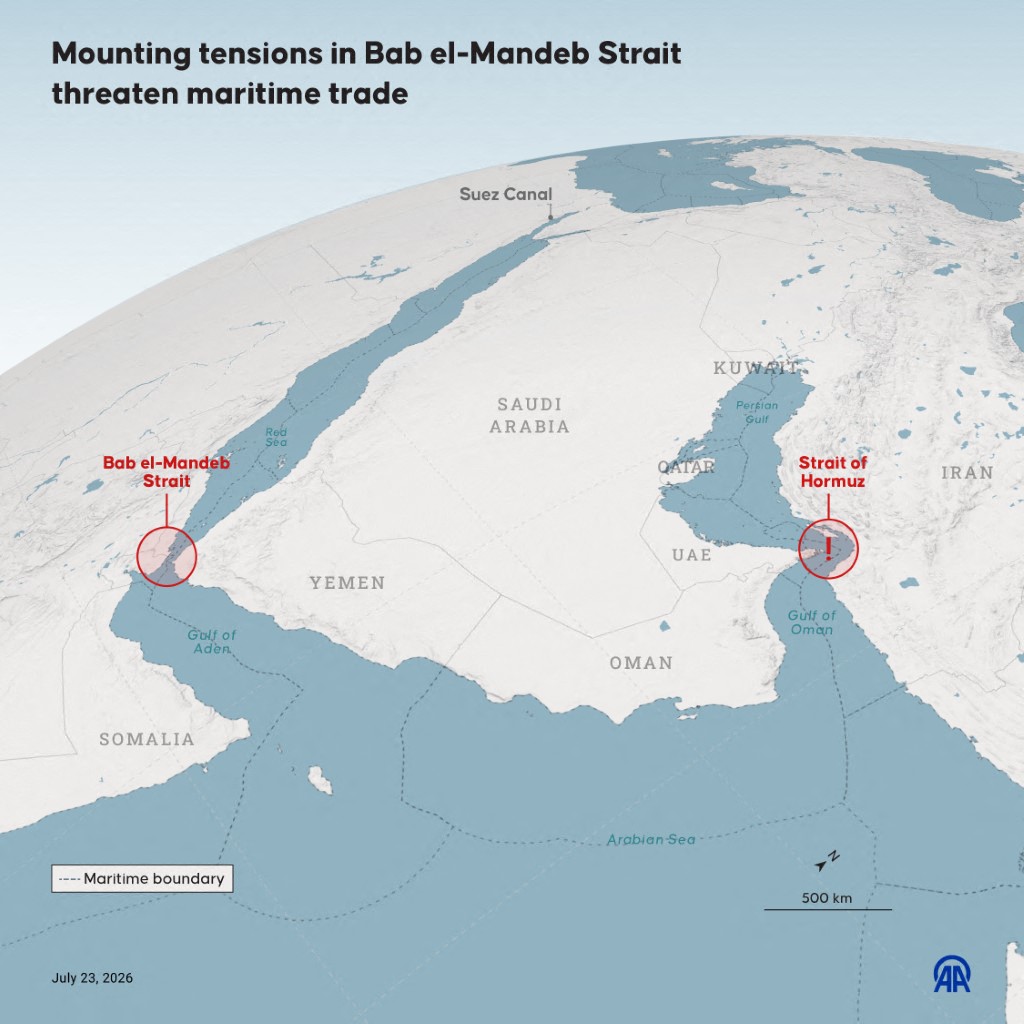
In Yemen, the UN-recognized government accused the Houthis on Wednesday of seeking to impose transit fees on ships passing through the Red Sea and the Strait of Bab el-Mandeb, a strategic chokepoint located at its southern end.
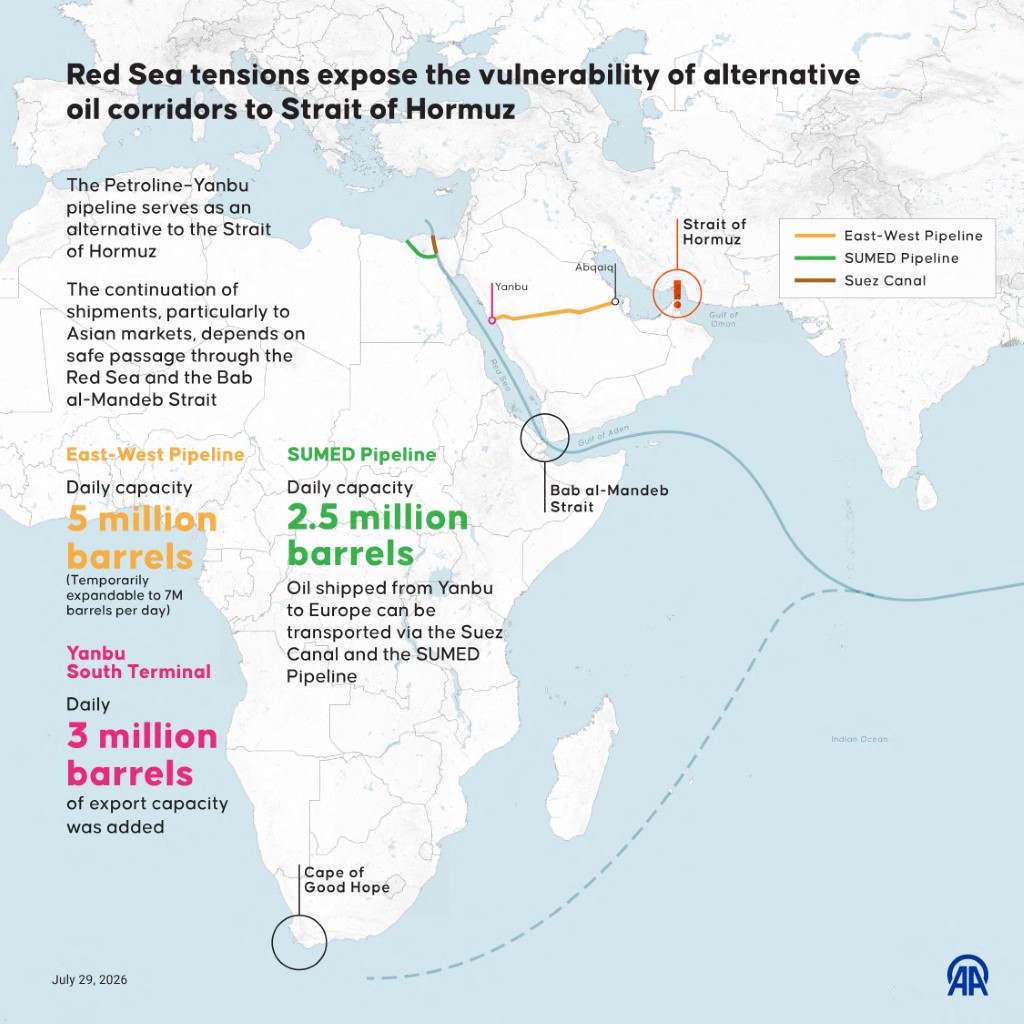
The rebels claimed Tuesday to have targeted a Saudi oil tanker in the Red Sea using missiles, accusing it of having "violated the naval blockade" they are threatening to impose on the kingdom, the world's top crude oil exporter.
Saudi Arabia is counting on the Red Sea to continue its exports, as Iran once again locks down the strategic Strait of Hormuz on the other side of the Arabian Peninsula.
The Revolutionary Guards also announced Wednesday that they had intercepted and immobilized three tankers attempting to pass through the strait, through which — before the war — nearly 20% of the world's oil and liquefied natural gas transited.
These new strikes came the day after Israeli Prime Minister Benjamin Netanyahu's visit to Washington, where he met with Donald Trump for the first time since the regional war broke out, triggered by both countries' attacks on Iran on February 28.
The origins of the Hachd al-Shaabi
Turning to the group known as the Hachd al-Shaabi, also known as the Popular Mobilization Forces, it was established in 2014 following a fatwa issued by Grand Ayatollah Ali al-Sistani, the highest Shia religious authority in Iraq, calling for armed resistance against the jihadist group the Islamic State (IS), which had seized vast swaths of the country.
Pro-Iranian armed groups rallied together, and thousands of volunteers joined the fight. Hachd al-Shaabi fighters were largely trained by Iran and guided by Tehran-backed groups that had already fought against American forces following the 2003 invasion of Iraq and the fall of Saddam Hussein.
Their activities were overseen by General Qassem Soleimani, the commander of the Quds Force — the branch of the Islamic Revolutionary Guard Corps responsible for external operations — who was killed in a U.S. airstrike in Baghdad in 2020.
In 2016, legislation was passed integrating the Hachd al-Shaabi into Iraq's armed and security forces. A year later, it played a key role, alongside those forces and with the support of the U.S.-led international coalition, in the defeat of the Islamic State.
Since the 2003 invasion, the United States has maintained significant influence in Iraq. However, its intervention also paved the way for the expansion of Iranian influence, as Tehran's Shia allies rose to the highest levels of power in Baghdad.
Since then, Iraq has become one of the primary arenas for proxy confrontations between Washington and Tehran.
Today, the Hachd al-Shaabi encompasses dozens of armed groups, including several brigades belonging to powerful pro-Iranian factions that have been designated as terrorist organizations by the United States.
Some of these factions are accused of drawing government salaries while operating with complete autonomy.
Over the years, their influence has grown considerably. Several groups have secured seats in parliament, while a number of their leaders, including the commander of the Hachd al-Shaabi, have been targeted by U.S. sanctions.
Various pro-Iranian armed groups also belong to the broader network of the Islamic Resistance in Iraq, which has claimed hundreds of attacks against American installations across the region since the start of the war in the Middle East.
They align themselves with the Tehran-led 'axis of resistance,' which also includes Lebanese Hezbollah, Hamas in Gaza, and the Houthis in Yemen.
Among the most active are Kataeb Hezbollah, which has long targeted American interests in Iraq and has had several of its commanders killed in U.S. strikes.
Other groups, such as Kataeb Sayyid al-Shuhada and the Al-Nujaba movement, are present on certain Hachd al-Shaabi bases while also maintaining their own facilities, primarily used for drone manufacturing.
They also possess rockets and are believed to hold short-range ballistic missiles.
France Avoids a State of Emergency but Prepares for the Worst
A Nobel Peace Prize to Save International Law in Peril
A Lebanese-Iranian Meeting in New York, but Several Political Messages
“No State Can Have Two Armies and Two Decision-Making Authorities,” Salam Says in New York
Trump Pulls Back at the Last Minute From Strikes on the Houthis
Más de LevantTime .
Ver todo


Más en Today's Essential
Ver todo


Lo último de Levant Time
Ver todo


