

Diplomatic pressure: missions multiply in Iran


On Friday, Iran had still not met American conditions for resuming negotiations with Washington, which is displaying cautious optimism about a possible breakthrough. Global stock markets were indeed trading in the green during the day, buoyed by hope sustained by the diplomatic pressure being exerted to reach a statement of intent that would serve as a basis for resuming Iranian-American talks.
Pakistan's army chief, Asim Munir, is expected in Tehran for talks with senior officials, according to Iran's official news agency, IRNA.
Reuters reported the presence of a Qatari delegation in Iran as part of a mission conducted in coordination with Washington, while the Axios website indicates that Saudi Arabia, Egypt, and Turkey are also involved in ongoing diplomatic efforts.
But for now, Tehran, which hopes to wear down the United States to extract maximum concessions, continues to defy Donald Trump.
The Revolutionary Guards announced this morning the number of cargo ships and tankers that have crossed the Strait of Hormuz under the new toll rules imposed by the Islamic Republic. These are "contrary to international law," the European Union recalled.
Brussels, moreover, decided on Friday to extend sanctions imposed on Iran to "persons and entities involved in actions that threaten freedom of navigation in the Middle East."
Among the countries affected and inconvenienced by Iranian measures on Hormuz, the United Arab Emirates, which called on Iran, through the voice of the high adviser to the Emirati president, Anwar Gargash, to "not overestimate its hand" in upcoming negotiations with Washington. According to him, the chances of an Iran-US agreement to unblock this strait are "50-50."
Furthermore, Mr. Gargash warned against a ceasefire "with no way out, which would sow the seeds of future conflict." "The Iranian nuclear program, which was our second or third concern, is now our first concern," he emphasized. "We have realized that Iran is capable of using any weapon at its disposal."
The shock of American sanctions
In Lebanon, meanwhile, people remain shocked by sanctions imposed by Washington on a group of lawmakers and, for the first time, on security officials deemed close to Hezbollah and the Amal movement of House Speaker Nabih Berry. These are, namely, the chief of the national security department at the General Security, General Khattar Nassereddine, and the chief of the army's intelligence bureau in the southern suburbs of Beirut, Colonel Samir Hamadé. Both are accused by the US Treasury of having "shared important intelligence with Hezbollah during the ongoing conflict."
The other individuals targeted are Hezbollah lawmakers Hassan Fadlallah, Ibrahim Moussaoui, Hussein Hajj Hassan, as well as former minister Mohammad Fneich, a member of the pro-Iranian formation's executive council and former lawmaker, the ambassador accredited by Tehran to Beirut, Mohammad Reza Chibani, as well as Ahmad Assaad Baalbacki and Ali Ahmad Safaoui, both Amal security officials.
The Lebanese army indirectly rejected the accusations leveled by Washington against its officer, accused of aiding Hezbollah, by emphasizing in a statement that the loyalty of its soldiers goes "solely to the institution."
All officers and soldiers "carry out their national missions (...) in accordance with decisions of the army command," according to a statement from the forces, which said it had not been informed of the sanctions "through the usual channels of communication" with Washington.
Iran denounced the sanctions against its ambassador, calling them "illegal."
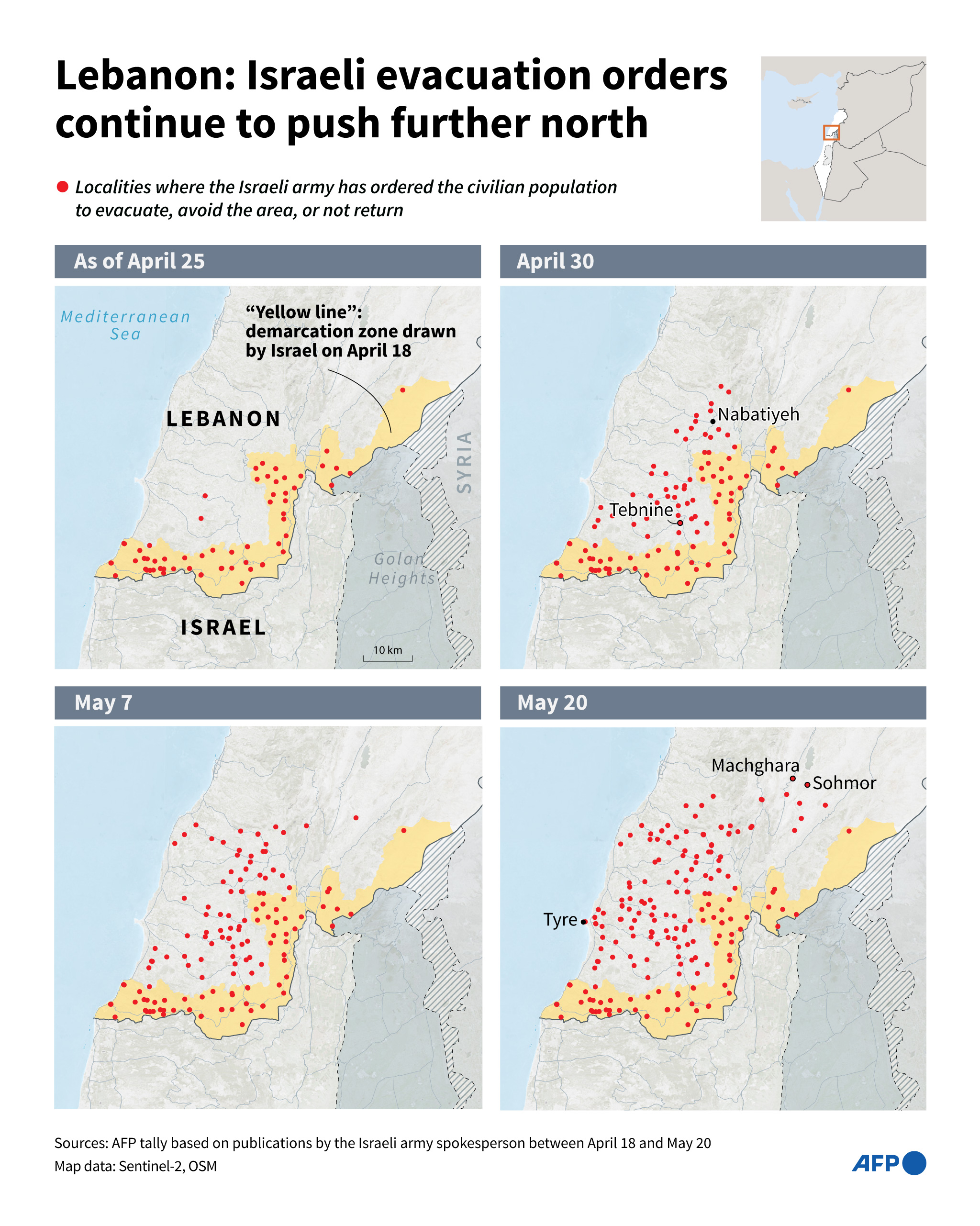
On the ground in Lebanon, an Israeli strike killed six people, including two emergency responders and a young girl, in the village of Deir Qanoune al-Nahr, in the Tyre region.
During the night from Thursday to Friday, four emergency responders affiliated with Hezbollah were killed in a raid on Hanaouay, near Tyre.
NATO and Trump
Meanwhile, meeting in Sweden, foreign ministers from NATO's European countries hoped to get clarification Friday from the United States about its military presence in Europe, especially following Donald Trump's announcement to deploy 5,000 American soldiers in Poland, when he had been considering reducing the American military presence on the continent.
During this meeting, U.S. Secretary of State Marco Rubio told his NATO allies that American decisions on troop deployments in Europe announced in recent weeks by Donald Trump were not "punitive." "It's simply an ongoing process that existed before," he said, adding that the U.S. would need to "address" Mr. Trump's "concerns" about the Middle East.
In Washington, U.S. intelligence chief Tulsi Gabbard announced her resignation.
She, who appeared to disagree with President Donald Trump over the war in Iran,
has headed the National Intelligence Directorate (DNI), the agency that oversees all intelligence agencies, since Donald Trump's return to the White House.
Tulsi Gabbard was expected to leave by American media, appearing to be at odds with Donald Trump.
Notably, she had refused during a parliamentary hearing in March to confirm the Republican's claims that Iran represented an "imminent threat" before the U.S.-Israeli strikes that triggered the war in the Middle East.
She is the fourth woman to leave the Trump administration in three months, following Justice Minister Pam Bondi, Homeland Security Minister Kristi Noem, and Labor Minister Lori Chavez-DeRemer.
On April 3, in the midst of the war in Iran, the Pentagon announced the departure of the Army Chief of Staff, General Randy George, a removal that adds to the list of senior officers removed by the Trump administration.
France Avoids a State of Emergency but Prepares for the Worst
A Nobel Peace Prize to Save International Law in Peril
A Lebanese-Iranian Meeting in New York, but Several Political Messages
“No State Can Have Two Armies and Two Decision-Making Authorities,” Salam Says in New York
Trump Pulls Back at the Last Minute From Strikes on the Houthis
Más de LevantTime .
Ver todo


Más en Today's Essential
Ver todo


Lo último de Levant Time
Ver todo


