

Contradictory Statements on The «New Regime» in Iran Mentioned by Trump
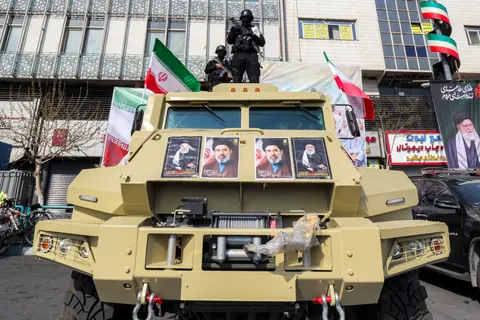

Once again, public opinion and the populations of the Levant, and the Middle East in general, are confronted with a cascade of contradictory statements and indiscretions leaked to the media, concerning the evolution of the war launched on February 28 in the region.
President Donald Trump thus reaffirmed this Wednesday, April 1st, the existence in Tehran of a «new regime», indicating that the «president of this new power has just asked us for a ceasefire». « We will decide on the expediency of this ceasefire when the Strait of Hormuz is reopened to free maritime circulation, President Trump declared. Otherwise, we will continue to bomb the infrastructure in order to bring Iran back to the Stone Age ».
The optimistic remarks of the White House chief about the positive attitude of the « president of the new Iranian regime » that has emerged in Iran « and who proves to be smarter than his predecessors » were, however, denied by official sources in Tehran.
A statement attributed to the Iranian Ministry of Foreign Affairs thus categorically denied any request for a ceasefire that would have been presented to President Trump. For his part, the Vice-President of the Iranian Parliament affirmed that « the Strait of Hormuz will remain closed, and no negotiations are underway on this matter ».
These contradictory positions raise several questions: is President Trump displaying measured optimism to make the Iranian regime assume responsibility for a forthcoming escalation in military operations, which would take the form of a landing or targeted, punctual commando operations?
Does a « more Cartesian new regime » truly exist that would have emerged in Tehran?
Is the current power in Tehran seriously shaken by a deep divide between a pragmatic wing and a radical current represented by the Pasdaran?
Only tangible facts and developments in military operations will provide fragments of answers to these questions. It remains that some parameters are far from supporting the thesis of the emergence of a « new regime in Tehran », as demonstrated by the savage repression targeting Iranian opponents and the executions of political prisoners that continue without respite.
Furthermore, new American reinforcements have been sent to the region, including several thousand Marines and paratroopers, which tends to highlight the fact that the general climate among the real decision-makers in Iran remains largely bellicose.
Military operations
In any event, raids, bombardments (by naval units) and missile launches continued on a large scale on Wednesday.
American and Israeli air forces resumed their intensive raids in the areas of Tehran and Isfahan, targeting strategic, military and industrial infrastructure.
In the late afternoon on Wednesday, unconfirmed reports even mentioned the deployment of large American B-52 bombers.
On Tuesday night to Wednesday morning, a significant Israeli attack, by sea, hit a convoy of cars in the Jnah suburb, a neighborhood not usually targeted by raids.
The toll of this strike is particularly heavy, no less than seven killed and more than 25 wounded according to the latest assessment from the Ministry of Health.
The identity of the targeted person was only communicated at midday by the Israeli army, specifying that it was Youssef Hachem, a senior Hezbollah official, responsible for the Southern front and for launching rockets and drones towards northern Israel.
Hezbollah only confirmed the information several hours later.
This seasoned fighter, who has some forty years of militia activities to his credit in the ranks of the party of God, played an essential role in the restructuring of the party's armed wing, following the 2024 debacle.
Hezbollah also announced the death of another of its officials, Mohammad Baqer al-Naboulsi, in the same strike. He is probably the other « high-ranking fighter » in the pro-Iranian militia, whom the Israeli army announced it had killed in the same convoy.
The other assassination of the day (related to Lebanon), announced by the Israeli army on its X account on Wednesday, is that of « Mahdi Vafaei, head of the engineering branch of the Lebanese Quds Force in the Mahallat region, Iran ».
« Vafaei carried out underground projects (tunnels) in Lebanon and Syria, leading efforts to set up and manage underground terrorist infrastructure sites for Hezbollah and the Assad regime », the former Damascus regime having fallen in December 2024, an Israeli statement indicates.
The IDF claimed another strike south of Beirut, in the locality of Khalde, at dawn, which left two dead and three wounded. The Hadeth neighborhood in the southern suburbs of the capital was also targeted by powerful strikes at dawn on Wednesday.
Meanwhile, in South Lebanon, fighting continues to rage and Israeli advances are ongoing, while the Israeli army and Defense Minister, Israel Katz, continue to threaten Lebanon with a broader occupation.
On the ground, the only villages not yet fully evacuated, mainly Christian, are more than ever caught up in the war following the « redeployment » of the Lebanese army, criticized for having withdrawn in the face of Israeli advances and for having abandoned the residents who are resisting in their villages.
In response to these criticisms on Wednesday, the Lebanese army explained that its repositioning aimed to avoid any encirclement and isolation of its supply routes, assuring that it maintained patrols in the villages concerned.
A measure that could reassure populations living in growing anguish, cut off from the outside world.
European statement on UNIFIL
On the other hand, the targeting of the United Nations Interim Force in Lebanon (UNIFIL) continues to cause waves among European countries, which contribute to the peacekeeping force.
A statement from the European Union « strongly condemns the recent attacks against UNIFIL contingents, which inexplicably caused casualties among peacekeepers ». The statement calls for calm, expresses solidarity with Lebanon, and holds Hezbollah responsible for this new war.
For her part, the Minister Delegate to the Minister of the Armed Forces and Veterans Alice Rufo went to Lebanon to « express her solidarity and support for Lebanese sovereignty ». She also testified to « France's solidarity with the Indonesian UNIFIL soldiers, who lost three of their own during attacks on March 29 and 30, 2026 ». No mention of the attacker's identity, the Israeli army.
From Khamenei to Qassem
And it is in this tense climate, both on the Lebanese and Iranian fronts, that a statement attributed to Iran's Supreme Leader, Mojtaba Khamenei, invisible since the start of the conflict, reaffirms the Islamic Republic's support for Hezbollah and its Secretary-General, Naïm Qassem, who is just as invisible as the former as he preferred to communicate these last two speeches in writing.
Amidst the Israeli advance in South Lebanon, and against the backdrop of a toll of over 1300 deaths since the beginning of this conflict opened to avenge his father's death - to use Hezbollah's terms - Mojtaba Khamenei congratulated Qassem's party for its actions, assuring it of Iran's continued support and asking it to continue thwarting Israeli plans.
Other allies of Iran, the Houthis of Yemen, are increasingly involved in the war, and announced on Wednesday missile launches in coordination with Iran and Hezbollah, against Israel.
According to Israeli emergency services, 14 wounded fell on Wednesday in the Tel Aviv region.
A serious development was recorded in Iraq, related to another Iranian ally, Iraqi Hezbollah: an American journalist, Shelly Kittleson, was kidnapped by this group in Baghdad, which was confirmed by the US State Department, through Dylan Johnston, Deputy Assistant Secretary of State, on his X account.
In Iran
On the Iranian front, Israeli-American strikes continue, hitting, in recent hours, several steel production sites.
Strong explosions shook Tehran during the night, and it turned out that one of them targeted the vicinity of the former headquarters of the American embassy in the Iranian capital.
A highly symbolic place for Americans and Iranians: it was there that the 1979 hostage crisis took place, after the Iranian revolution.
The embassy, which never reopened its doors, had become a museum of the revolution.
Two days ago, US President Donald Trump swore that he « would avenge everything the Revolutionary Guards had inflicted on Marines and American nationals for 47 years ».
It is in this context that relations are further deteriorating between the United States and its European allies, who still refuse to enter a war « that is not theirs », as British Prime Minister Keir Starmer reiterated on Wednesday.
According to remarks reported by AFP, Donald Trump thundered that « if France or another country wants to have its oil or gas, it should buy it from the United States or go directly to the Strait of Hormuz (...) to get it ».
For its part, the European Union called on Iran to « guarantee freedom of navigation » in the strait, at a time when Tehran is talking about imposing a right of passage on ships.
France Avoids a State of Emergency but Prepares for the Worst
A Nobel Peace Prize to Save International Law in Peril
A Lebanese-Iranian Meeting in New York, but Several Political Messages
“No State Can Have Two Armies and Two Decision-Making Authorities,” Salam Says in New York
Trump Pulls Back at the Last Minute From Strikes on the Houthis
المزيد من Taline Becharraoui
عرض الكل


المزيد في Today's Essential
عرض الكل


الأحدث من Levant Time
عرض الكل


