

Timeline of ceasefires after the 40-day war in Iran

After forty days of war between the United States and Israel on one side and Iran on the other, along with simultaneous fighting between Israel and Hezbollah in Lebanon, a preliminary ceasefire framework agreement between Washington and Tehran came into effect on April 8, 2026.
A few hours later, a series of massive Israeli air operations struck more than thirty Hezbollah positions in Lebanon within ten minutes, killing over 300 people and wounding 1,150 others — among the deadliest strikes of the conflict — as the Israeli air force dropped precisely 160 bombs.
The American-Iranian agreement, initially set to last fifteen days and not covering Lebanon, was extended indefinitely on April 21. In addition to halting hostilities between the two parties, it provided for the reopening of the Strait of Hormuz and the start of diplomatic talks.
Those talks culminated on June 17, 2026, in a 60-day memorandum of understanding — signed by Donald Trump and Masoud Pezeshkian — that included a halt to the war in Lebanon and aimed to establish a lasting cessation of hostilities.
In the meantime, under strong American pressure, a supplementary agreement covering Lebanon came into effect on April 17, 2026 — nine days after the start of the Iran-U.S. ceasefire and the simultaneous deadly Israeli strike.
This truce, negotiated among Trump, Netanyahu, and Joseph Aoun, called for a halt to fighting for a period of ten days. It was subsequently extended and eventually led to the Lebanon-Israel framework agreement signed in Washington on June 26, 2026.
The Illusion of a Ceasefire
Since April 17, and even after the framework agreement of June 26, the ceasefire in Lebanon quickly showed its limitations on the ground. Hostilities never truly stopped: between repeated violations, the geographic expansion of strikes, and economic devastation, southern Lebanon remained the scene of high-intensity confrontation until June 26, and of medium-to-low intensity since then.
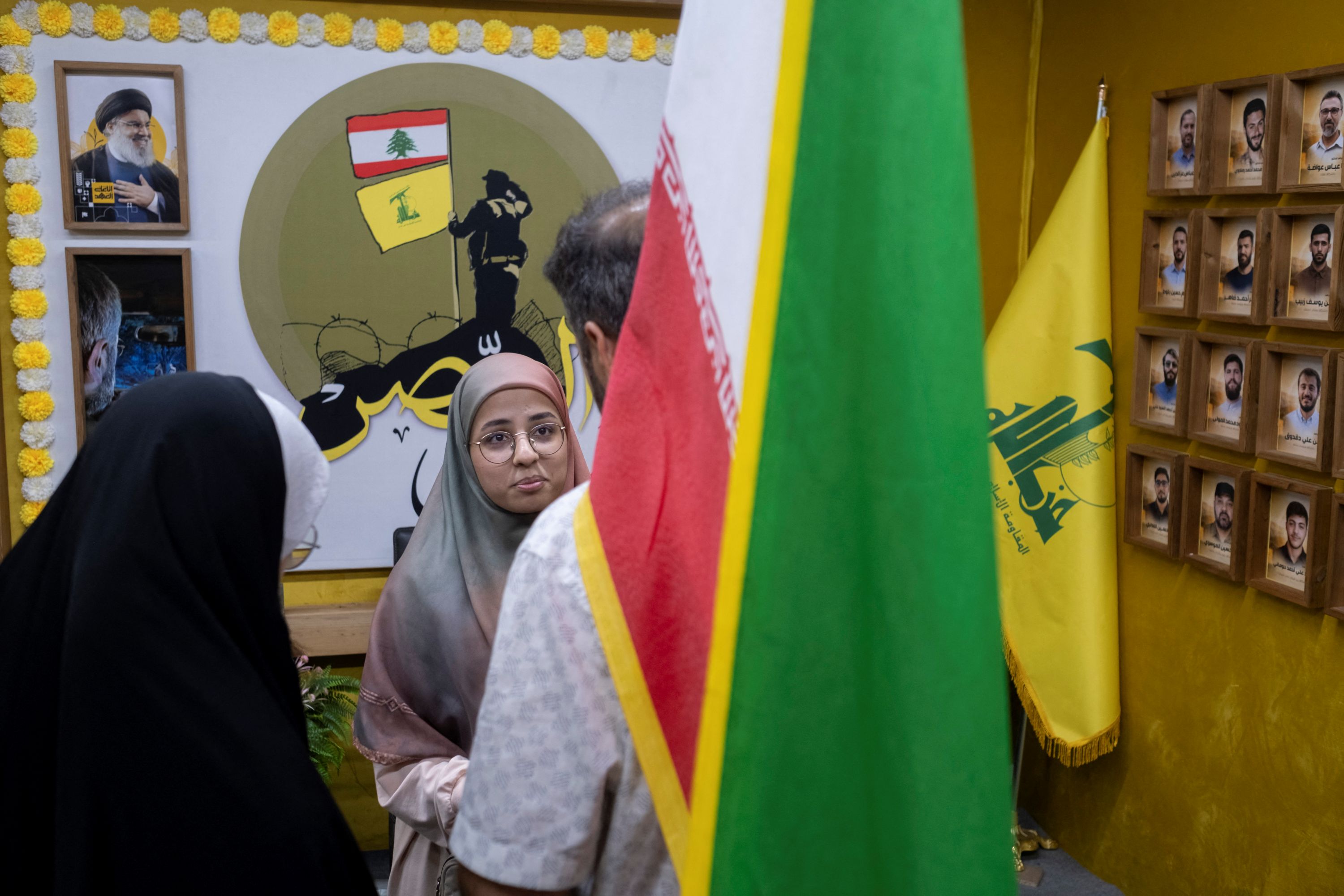
In the same Hezbollah booth referenced in the previous caption, a poster shows a fighter giving a military salute, with both the Lebanese flag and the Hezbollah flag. This is an extremely rare — almost unthinkable — sight, as the national flag is seldom present at Hezbollah events, let alone displayed alongside the group's yellow banner. (AFP)
To better illustrate the White House's stance on ceasefires between Israel and Hezbollah — the latter not having been directly included in the negotiations — Donald Trump, when questioned in early June 2026 in the Oval Office, stated that "a ceasefire in Lebanon is different from a ceasefire anywhere else in the world."
This statement signals his intention to decouple the Lebanese situation from the Iranian file, even though Iran treats the two conflicts as interconnected — a linkage that is more in line with reality and that undermines the agreements, unless Lebanese authorities demonstrate firmness and solidarity.
A Persistent Asymmetry of Force
Hezbollah and its unconditional supporters continue to exhibit a pathological denial of a reality far grimmer than their collective imagination allows.
Between the first Lebanon-Israel ceasefire in April and June 14, 2026 — the date on which the Washington-Tehran memorandum of understanding including Lebanon was announced — the data collected reveal a clear imbalance in both military strength and activity on the ground.
Over this 59-day period, Israeli forces carried out a total of 5,056 attacks of all types combined (primarily airstrikes, drones, artillery, and others) compared to 947 by the Shia movement across all types combined (tandem-warhead anti-tank missiles, drones, mortars, and others), amounting to 5.34 Israeli attacks for every Hezbollah attack (1). This disproportion translates into a daily average of 94 Israeli attacks, with alarming peaks in intensity — most notably on May 26, 2026, when 203 attacks carried out by the Israeli military were recorded in a single day.
Alarming figures since the start of the conflict
Going back to the beginning of the conflict, no precise official count of the raw number of bombs dropped on Lebanon since March 2, 2026 has been published.
Scientific institutes and Lebanese government authorities have, however, conducted their own tallies. Between March 2 and April 16, 2026 (prior to the first Lebanon-Israel ceasefire), the Lebanese CNRS recorded 8,200 Israeli attacks of all types combined (airstrikes, artillery fire, and incursions), including 306 massive waves of air raids during the first two weeks of March alone. Adding this figure to the one recorded after April 17 (2), the total from March 2 through June 14 amounts to 13,256 Israeli strikes. Finally, since mid-June 2026, the bombardments have continued at a lower but daily rate of between 10 and more than 160 projectiles per day, according to UNIFIL.
At the same time, no comprehensive official figures on the tonnage of munitions used (net explosive mass or bomb weight) have been published since the start of the conflict, for either the Israeli military or Hezbollah. However, data released by the IDF points to the use of guided bombs ranging from 250 to 900 kg in airstrikes, which represents an approximate total tonnage of 12,500 tonnes of air munitions targeting Lebanon. For comparison, during the 33-day war in 2006, Israel dropped 7,500 tonnes of bombs on Lebanon. For greater precision, UNIFIL observation records indicate that on typical monitoring days, approximately 97% of the explosive and projectile trajectories observed originated from Israeli forces.
On Hezbollah's side, its arsenal relies on rockets, anti-tank missiles, and suicide drones rather than heavy air-dropped bombs. Since the collapse of the first ceasefire on April 17, the pro-Iranian group has fired several thousand projectiles, with peaks of 100 to 200 projectiles on high-intensity days. The individual explosive payload of these rockets (of the Katyusha/Grad type) is generally estimated at between 20 and 50 kg, resulting in a total tonnage at least 18 times lower than that of Israeli munitions — bringing the total mass of Hezbollah munitions targeting Israelis to around 700 tonnes.
Hezbollah's technological innovation
At the end of April 2026, Hezbollah crossed a new military threshold by deploying FPV (First Person View) kamikaze drones en masse, guided by ultra-thin fiber optic cables. Inspired by tactics from the Ukrainian conflict and assembled at low cost (between $300 and $600 per unit), these non-metallic devices operate entirely independently of radio waves and GPS signals. This technical feature makes them completely undetectable by radar and immune to Israeli electronic jamming systems.
Through a continuous high-definition video feed transmitted via ultra-thin fiber optic cables connecting the drones to their Hezbollah operators, the group has been able to carry out surgical strikes with devastating precision against IDF armored vehicles, inflicting higher Israeli casualties since May and forcing the Israeli military command to rethink its ground protection systems.
La charge explosive unitaire de ces roquettes (type Katioucha/Grad) est généralement estimée entre 20 et 50 kg, ce qui laisse un tonnage total nettement inférieur de 18 fois au moins à celui des munitions israéliennes; cela ramène la masse de munitions du Hezbollah ayant ciblé les Israéliens à 700 tonnes.
L'innovation technologique du Hezbollah
À la fin du mois d’avril 2026, le Hezbollah a franchi un nouveau cap militaire en déployant massivement des drones kamikazes FPV (First Person View), guidés par des câbles ultrafins de fibre optique.
Inspirés des tactiques du conflit ukrainien et assemblés à bas coût (entre 300 et 600 dollars l’unité), ces appareils en matériau non métallique s'affranchissent totalement des ondes radio et du signal GPS.
Cette caractéristique technique les rend strictement indétectables par les radars et insensibles aux systèmes de brouillage électronique israéliens.
Grâce à un flux vidéo haute définition ininterrompu, à travers des câbles ultrafins en fibres optiques reliant les drones à leurs opérateurs du Hezbollah, ceux-ci parviennent à mener des frappes chirurgicales d'une précision redoutable contre les blindés de Tsahal, causant des pertes en vies humaines israéliennes plus élevées depuis le mois de mai et forçant l’état‑major de l’État hébreu à repenser ses systèmes de protection terrestre.
These "kamikaze drones" accounted for more than 50% of the pro-Iranian militia's operations up until June 26.
On the other side, Israel's response relied primarily on air power (60.5% of strikes) and heavy use of artillery, targeting infrastructure as a priority—though it proved ineffective against FPV drones.
And what about the Lebanese-Israeli framework agreement?
From a purely tactical and technical standpoint, a relative decline in the intensity of military operations has been observed since June 26.
The massive Israeli air raid campaigns have given way to more targeted airstrikes and drone strikes, along with limited ground operations including the demolition of buildings and infrastructure.
While Hezbollah also appears to have reduced or halted its attacks, the situation remains extremely fragile, given the Iranian factor—seeking to delay the ongoing talks in Bürgenstock—and the Israeli factor, which prioritizes security concerns and aims to empty the south of the Yellow Line of residents who support the pro-Iranian militia.
In conclusion, the "ceasefire" is extremely fragile, and Hezbollah is far from claiming a clear victory, despite having adapted to new tactics and techniques. For Lebanon, already weakened by a multidimensional crisis, implementing the terms of the framework agreement is a genuine challenge.
(1) and (2): Fadi Hajji-Georgiou – Research and Development
The Nobel Prizes and the Search for a Glimmer of Light in Human Behavior
Iran: Executions of young people, a favored tool of repression
A Chinese Perspective on Lebanon's Collapse
Dahr el-Baidar Explosives: Toward the End of Complacency?
Lebanese Moderation Needs a Project
Mais de Khalil Helou
Ver tudo


Mais em Analyze
Ver tudo


O mais recente do Levant Time
Ver tudo


