

September News: The Battle of Lebanon
September has just come to an end and, unfortunately, I did not manage to achieve one of the goals I had set myself for the month, namely to finish a text I am currently writing on Lebanese cinema.
A text shot through, among other things, with the question of what this cinema should film at a time when the country is living through a new Israeli invasion, when Lebanese society is more divided than ever, and when narratives from elsewhere about what is happening to us are already beginning to emerge. I am thinking, for example, of the film that has been announced about the pager operation, which will probably remain silent about the destruction caused by Israel in southern Lebanon and instead invite the viewer to marvel at the technical feat involved in such an operation.
If I was unable to finish my text, it was certainly partly because of the laziness brought on by the summer weather, but above all because events overtook me with the death of Chilean filmmaker Patricio Guzmán in mid-September, an event to which I could hardly remain indifferent.
First of all, because some of his films have meant a great deal to me, but above all because, with his death, Lebanon lost one of its great filmmakers, since Patricio Guzmán was clearly the most Lebanese of Latin American filmmakers.
The most Lebanese because he came from a country that, like Lebanon, has always struggled to rid itself of the demons of its past, as the memory of the Pinochet dictatorship continues to divide Chilean society, as illustrated by the recent election to the presidency of José Antonio Kast, the son of a former Nazi Party member and an avowed admirer of Pinochet.
The most Lebanese also because the themes running through his films, such as exile, traces, the disappeared and, above all, memory, strangely echo those that haunt a large part of Lebanese cinema. “Chile, Obstinate Memory,” the title of one of his films, could in fact sum up an entire section of our cinematic production.
Finally, and above all, the most Lebanese because, like Jocelyne Saab, Maroun Baghdadi or Borhane Alaouié, Guzmán was truly born into cinema through an event.
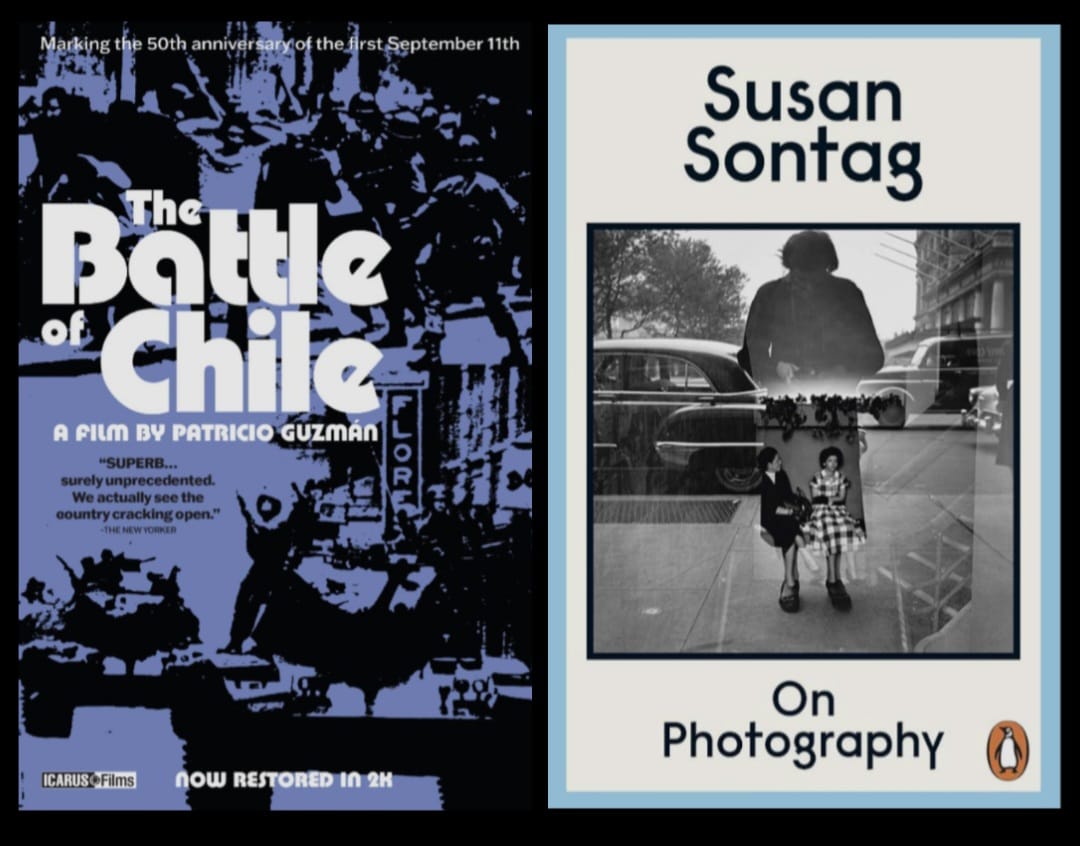
An event that, in the case of these Lebanese filmmakers, was the 1975 civil war and that, in Guzmán’s case, was the political experience of Allende, brutally interrupted by Pinochet’s 1973 coup, from which he would make the monumental documentary “The Battle of Chile,” one of the most important documentaries in the history of cinema.
Born out of the urgency to film what was happening in the streets, as Guzmán himself would recount in several interviews, “The Battle of Chile” chronicles, over nearly five hours, the rise in political tensions that accompanied the final months of Salvador Allende’s democratically elected government, up to the coup of September 11, 1973, which would brutally bring both this political experiment and the life of the Chilean president to an end.
And there is hardly any need to explain how strongly this film, which Guzmán described as a camera against forgetting, and the approach that gave birth to it resonate today, at a time when the question once again arises of what will have to be filmed in Lebanon.
But watching it again, I realized how much this film also speaks to today’s world and the images that accompany it. Not so much through the coup itself as through the political, economic and media mechanisms that preceded it, in which certain contemporary drifts can be recognized, at a time when we increasingly have the impression that our democracies function perfectly well as long as people vote “the right way,” but that, as soon as the result at the ballot box runs counter to certain interests, an entire machine is set in motion in an attempt to circumvent it.
I am thinking, for example, of Elon Musk’s interventions in support of the German far right, or of the 2024 French legislative elections, in which the left, despite having come first in terms of seats, was ultimately not called upon to form a government.
All these events have produced images, just as the war in Gaza produces its daily share of images of destruction and massacres. But these images are very different from those, far rarer at the time, that Guzmán filmed. Images meant to denounce what is happening now proliferate on social media and show it to us almost live, without nevertheless managing to change its course.
But we must also acknowledge that the images against forgetting produced by Guzmán and the Lebanese filmmakers have their limits, since “The Battle of Chile” did not prevent the election of José Antonio Kast, any more than the films of Jocelyne Saab, Maroun Baghdadi and Borhane Alaouié prevented history from repeating itself in Lebanon.
Of course, there is an entire body of literature on the limits of images and their capacity to act upon reality. I am thinking in particular of Susan Sontag, who, in Regarding the Pain of Others, dwells on Jeff Wall’s “Dead Troops Talk,” a staged photograph depicting dead soldiers talking among themselves without paying attention to the person looking at them. A way of reminding us that showing an experience is not necessarily enough to transmit it, since “we,” who did not experience it, she writes, “do not understand. We cannot imagine what it was like.”
But what seems especially interesting to me here is that this limitation of the image meets another one that Sontag had formulated in her reflections on photography, through a strange paradox. Even as we photograph in order to preserve a trace of reality, in the very same movement “images consume reality.”
The camera thus becomes “both the antidote and the disease, a means of appropriating reality while at the same time rendering it obsolete.”
And without wishing to distort Sontag’s thought too much, or to give the impression of prophesying about what Lebanese cinema will be tomorrow, it seems to me that the images that will be filmed will be caught in a comparable paradox. A paradox intensified by the fact that, with everything we have been living through since 2019 and the economic crisis, we still do not really know what story we are living through, just as Guzmán did not yet know, while filming in the streets of Chile, that he was making a film about a coup. Are we witnessing an ending or a new beginning?
And yet, despite all the limitations of these images against forgetting or images of denunciation, we need our own images. Images that perhaps should not be burdened with too many missions, by asking them to preserve memory, denounce or change the course of events, but that must nevertheless exist. Exist because, without them, our narratives risk disappearing in favor of those others will tell about us.
In the end, this may seem like very little to ask of images, and yet perhaps it is not so little, since the images that remain of an event also end up becoming the memory we have of it. This is what Chris Marker, who had in fact helped Guzmán make “The Battle of Chile” possible, observed in “Sans Soleil,” speaking of his own images: “they have now substituted themselves for my memory, they are my memory.”
And perhaps that, ultimately, is where the battle of Lebanon is being fought.