

The Samir Kassir Festival, or the Lebanon Yet to Be Born
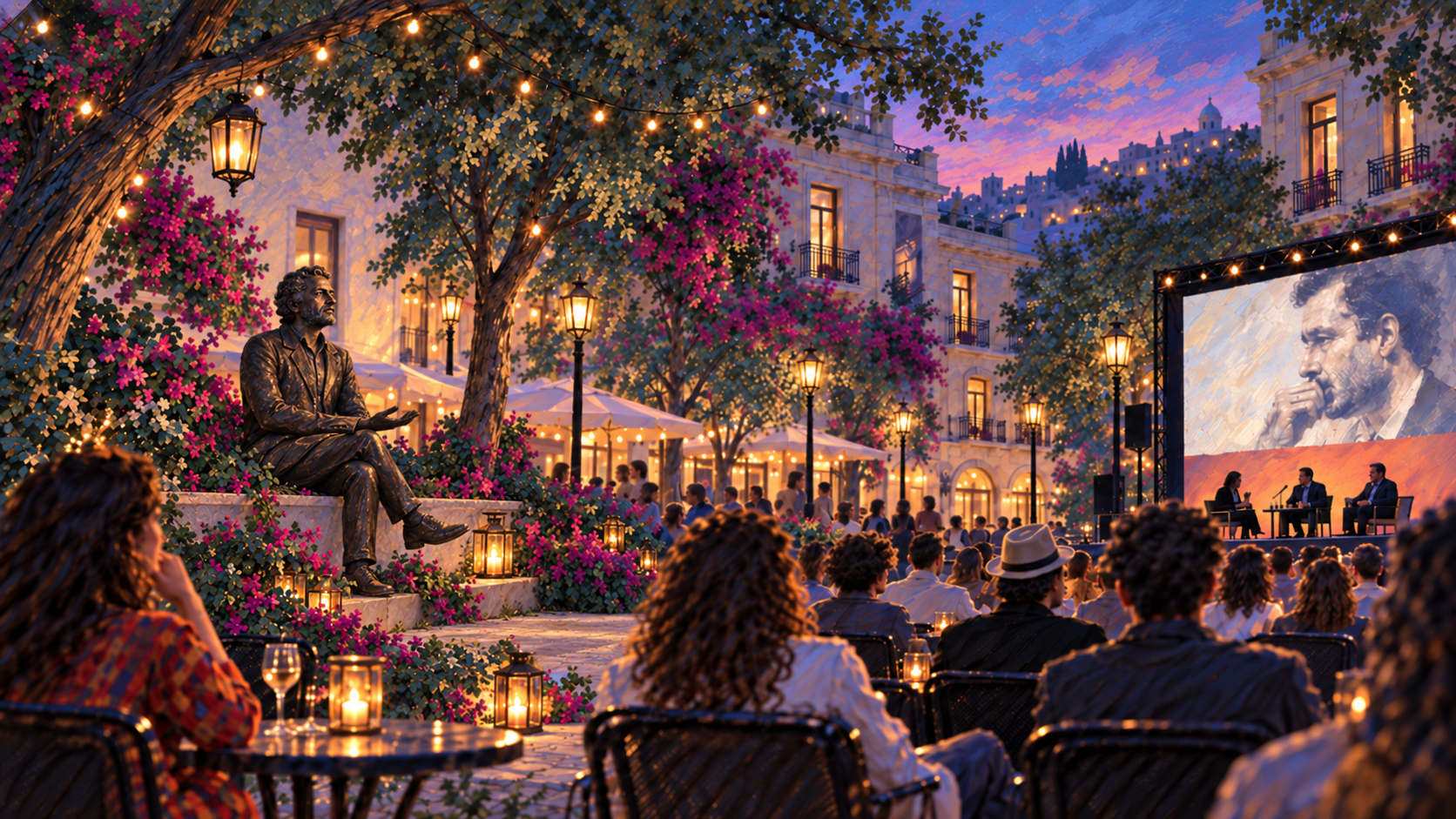
Every year, when the Beirut Spring Festival organized by the Samir Kassir Foundation begins, I find myself watching the audience before I watch the stage or the screen.
Perhaps because, to me, Samir’s name is not simply the name attached to a festival, and because the Samir Kassir Foundation is not simply a cultural institution, I find myself looking for something else in people’s faces: does the Beirut Samir believed in still exist? Are there still people who want culture, debate, art, and freedom? Is the city still capable, amid everything it has endured, of bringing people together around an idea rather than around a leader, a sect, or a fear?
The answer I see, year after year, gives me some hope.
The audience is growing.
But what matters more than the numbers is the kind of audience that is growing around the festival.
A distinctive cultural, intellectual, media, and artistic public is taking shape around it. Faces from different generations. Young people, students, journalists, artists, academics, writers, activists, and people who do not share a single political identity, but who are united by intellectual curiosity and by the desire to see Beirut remain a space for questions, debate, and creativity.
That may be one of the festival’s greatest achievements.
In a Lebanon where we have grown accustomed to measuring the importance of an event by the number of guests or the weight of political representation, the Samir Kassir Festival offers a different standard: the value of an audience does not lie only in how many people are sitting in the room, but in who came, why they came, and what they took with them when they left.
It is impossible to speak about the endurance of this space without saying something about Gisèle Khoury. Gisèle did not simply carry Samir’s name and memory. She turned absence into work, into an institution, into continuity. She had that stubborn determination not to allow Samir to become merely a memory, and to ensure that the Foundation remained a space for freedom, culture, and journalism. Today, when we see the festival’s audience growing and becoming more diverse year after year, it is impossible not to remember that much of what we are witnessing is also the fruit of what Gisèle planted and insisted on protecting until the very end.
That became especially clear during the screening of Alfred Tarazi’s A Lover’s Manifesto, Part Two.
I went to see the work, but found myself watching Lebanon.
A Lebanon we know in part, have forgotten in part, and which entire generations may never have had the chance to know at all.
Alfred Tarazi does not give us a history lesson, nor does he try to persuade us that the past was beautiful and the present ugly. He does something more intelligent: he opens the archives and lets them speak.
Newspapers, photographs, advertisements, music, cinema, architecture, details of everyday life, and people’s faces become fragments of a story that began before the birth of Greater Lebanon, passed through independence, and accompanied the building of the Republic.
But in truth, it is the story of a question that has never gone away:
What is Lebanon?
More than a hundred years later, we are still asking the same question.
For me, this is where the power of the work lies.
We are not looking at historical archives from the position of neutral spectators. We are the children of what this history produced. We live today in a country that is still debating its unity, its Constitution, its sovereignty, the limits of the state, the relationship between its communities and the nation, and Lebanon’s relationship with its surroundings and with the world.
So when old Beirut appears before you, along with its newspapers, cafés, cinemas, universities, advertisements, and a social life that was developing at remarkable speed, you cannot simply look at them as beautiful images from a bygone age.
A question immediately imposes itself: what did we do with all of that?
But we must also resist easy nostalgia.
The Lebanon shown in the archives was no paradise.
There were social inequalities, marginalized regions, conflicts over the country’s identity, and a sectarian system that carried its own contradictions within it.
But something important was there.
There was a belief in the idea of progress.
There was a society that wanted to build. A press that wanted to write. A university that wanted to teach. An artist who wanted to experiment. A businessman who wanted to invest. A woman who wanted a larger place in society. And young people who looked at the world and wanted Lebanon to be part of it.
Beirut wanted to become a city.
Not merely a capital of sects.
And that is where I found Samir again.
I knew Samir Kassir, I worked with him, and I still work today at the Foundation that bears his name. It is therefore difficult for me to separate the Beirut Spring Festival from the idea he had of this city.
Samir did not love Beirut because he thought it was an ideal city.
He knew its contradictions and perhaps wrote about them more harshly than many others did. But he believed in its ability to be a different kind of Arab city: free, open, pluralistic, irreverent, steeped in journalism and culture, a city unafraid of debate or difference.
That is why his assassination was not only the assassination of a journalist and an intellectual.
It was an attempt to assassinate an idea.
More than twenty years later, the question is: did that attempt succeed?
I look at the audience at the festival and say: no.
And that is not a sentimental statement.
When you see attendance growing, when you see a serious cultural audience expanding, and young people who never knew Samir personally coming to a festival that bears his name, you are looking at something worth pausing over.
Ideas sometimes outlive the people who carried them.
Perhaps that is the most beautiful irony of the Beirut Spring Festival: those who assassinated Samir wanted to silence one voice, yet over the years his name has become a space that hosts dozens of voices.
And every new seat occupied by a young man or woman who has come to listen, watch, or discuss is, in a sense, an answer to the assassination.
That is why I found something in Alfred Tarazi’s work that goes beyond the film itself.
It touches the essence of what the Samir Kassir Foundation is trying to do: protect memory so that it does not become the property of those who write history through force.
Archives are not a warehouse for the past.
Archives are power.
Whoever preserves people’s photographs, newspapers, films, music, and stories preserves part of their right to define themselves.
This matters especially in Lebanon today.
We live in a country where memory itself is being destroyed: homes disappear, neighborhoods change, villages are demolished, generations emigrate, institutions close, and newspapers, libraries, and archives are lost.
Amid all of this, Alfred Tarazi gathers the fragments and tells us: look, this too is your story.
That is why I loved the title of the work: A Lover’s Manifesto.
Someone who truly loves does not claim that the beloved is perfect.
They know the flaws well, perhaps become angrier at them than others do, but they refuse to give up on what they love.
That, for me, is my relationship with Lebanon.
I do not want a mythical Lebanon that never existed. I do not want to return to the 1950s. Nor am I looking for an image of the “Switzerland of the East” to hang on a wall and weep before it.
I want to understand why this country, despite its small size and the fragility of its structure, was able to produce so much vitality, and why we later allowed sects to become stronger than the citizen, weapons stronger than politics, fear stronger than freedom, and, all too often, emigration stronger than hope.
Perhaps that is why I left the screening thinking as much about the audience as I did about the film.
Alfred Tarazi was showing us the archives of the Lebanon that was, while the audience around him offered a small glimpse of the Lebanon that could be.
A Lebanon where people still go to watch a film about the history of their country.
Where people still want to debate.
To know.
To disagree.
And where culture is still seen as a public matter rather than a luxury.
That may seem like very little compared with the scale of what we are living through.
But it is not little.
Countries do not live by armies, borders, and institutions alone, however important those things may be. They also live through their memory, their culture, and the spaces where their citizens can meet beyond closed political and sectarian alignments.
That is what I felt at the Samir Kassir Festival.
For ninety minutes, Alfred Tarazi gave us back images of the Lebanon that was.
The faces watching with him, however, and especially that audience growing year after year, made me think of another Lebanon:
The Lebanon that has yet to be born.
And perhaps our task lies somewhere between the two.
To preserve from the first what deserves to endure, and to have the courage to build the second.